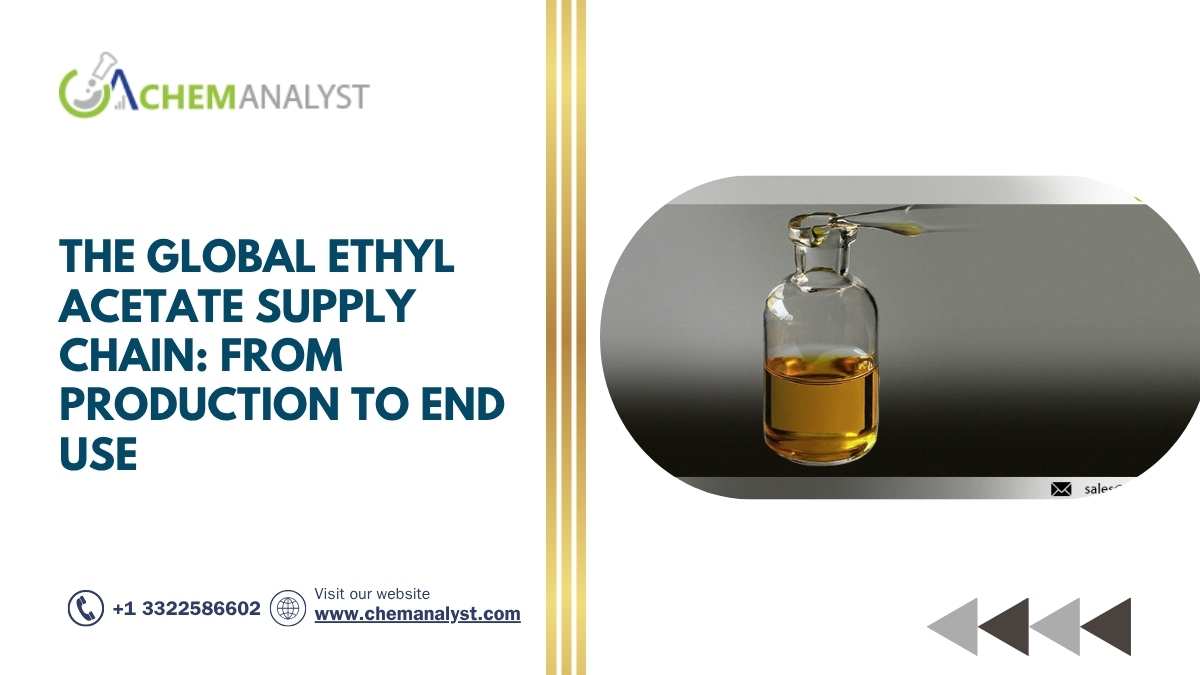
Follow ethyl acetate’s path through the global supply chain, including ethanol sourcing, manufacturing processes, and its role in paints, adhesives, and pharmaceuticals.
https://www.chemanalyst.com/Pricing-data/ethylene-40Introduction
Ethyl acetate (EtOAc), a versatile solvent and chemical intermediate, plays a crucial role in numerous industries ranging from paints and coatings to pharmaceuticals and food processing. As global demand for solvents and cleaner chemicals grows – driven by sectors like automotive, packaging, electronics, and consumer products – ethyl acetate’s importance has steadily risen. In 2024, worldwide ethyl acetate production capacity was estimated at roughly 6.0 million metric tons, with Asia (particularly China) dominating output. Trends toward bio-based production, stricter environmental regulations (especially on volatile organic compounds), and shifting trade dynamics are now reshaping the ethyl acetate supply chain in profound ways.
What Is Ethyl Acetate and Why Does It Matter
Ethyl acetate is a colourless, sweet-smelling liquid ester (formula C4H8O2) commonly produced by combining ethanol and acetic acid (the Fischer esterification process). It is prized as a solvent due to its effective dissolving power, moderate evaporation rate, and relatively low toxicity. These properties make ethyl acetate indispensable in formulating paints, inks, adhesives, and coatings that require fast drying and strong solvency. Moreover, ethyl acetate’s role extends to the food and pharmaceutical industries as a flavouring agent, extraction solvent, and processing aid. In essence, while often overlooked, ethyl acetate enables the production of many everyday products, from glossy coatings on cars and electronics to decaffeinated coffee and purified pharmaceuticals.
Key Applications:
1. Paints, Coatings & Inks – The paints and coatings industry are the largest consumer of ethyl acetate, especially in Asia. Ethyl acetate serves as a fast-evaporating solvent in automotive paints, industrial lacquers, varnishes, and printing inks. Its use ensures proper viscosity and quick drying of coatings and ink formulations, making it vital for high-speed printing and spray-painting processes.
2. Adhesives & Packaging – Ethyl acetate is widely used in adhesives, sealants, and flexible packaging. It helps formulate strong glues (for example, in the footwear and construction industries) and is a common solvent in laminating adhesives for food packaging. In printing processes for packaging, ethyl acetate-based inks enable sharp, fast-drying prints on films and foils. This solvent’s effectiveness in dissolving resins contributes to reliable bonding and high-quality packaging materials.
3. Pharmaceuticals & Cosmetics – A small but significant portion (≈8–10%) of global ethyl acetate demand comes from the pharmaceutical sector. It is used as a process solvent for purification and concentration of antibiotics and other active ingredients, thanks to its favourable boiling point and extractive properties. In cosmetics and perfumes, ethyl acetate appears as a solvent in nail polish removers, base coats, and fragrances. Its quick evaporation and mild odor make it suitable for personal care products where residue or strong odors are undesirable.
4. Food & Beverage (Flavors & Extraction) – Ethyl acetate also finds niche use in the food and beverage industry. It is employed as a solvent to extract caffeine from coffee and tea (in “natural” decaffeination processes) and to extract or concentrate flavour compounds from fruits and herbs. Additionally, ethyl acetate itself naturally occurs in minor amounts in wines and fruits and is sometimes used as a flavouring agent (imparting a fruity aroma). Its role in these applications underscores its relatively low toxicity – it is generally recognized as safe (GRAS) for use in foods in small quantities.
Global Production Landscape
Key Producers:
• Major chemical companies producing ethyl acetate include INEOS (UK), Celanese (USA/Singapore), Eastman Chemical (USA), Jubilant Ingrevia and Godavari Biorefineries (India), SEKAB (Sweden), and leading Chinese firms such as Jiangsu Sopo and Yip’s Chemical. Many of these producers are integrated across the value chain – for example, some have their own acetic acid or ethanol production to ensure steady feedstock supply.
• Asia-Pacific leads by a wide margin in production capacity, accounting for roughly 80% of global ethyl acetate capacity as of 2023. Within this, China alone contributes about 60% of world capacity (supported by abundant raw materials and large downstream demand). India is the second-largest producer, with around 670 thousand tons of capacity (~11%), followed by a handful of producers in Europe and North America. Western Europe and North America represent only ~7% and ~5% of capacity respectively, although new investments are on the horizon to boost non-Asian production (see “Green Transition” below).
Top Ethyl Acetate Producing Countries (2024):


As of 2024, below is the market share of key ethyl acetate-producing countries in the form of a pie chart:
Top ethyl acetate producing countries by estimated share of global capacity (2024). “UK” refers to INEOS’s Hull plant (Europe’s largest single EtOAc unit). “Others” includes all remaining producers across Europe, Asia, the Americas, and the Middle East.
Top Exporters and Importers
Export Hubs:

Import Leaders:
Rank Country

Trade Dynamics: In 2024, the largest exporters of ethyl acetate by value included China (over one-third of global export value), followed by significant volumes from Belgium, the UK, Saudi Arabia, and Singapore. China’s prominence in exports reflects its massive production surplus, while Belgium and Singapore often act as trading and distribution hubs (in Belgium’s case, re-exporting within the EU market). Notably, the United Kingdom – home to Europe’s biggest ethyl acetate plant – has re-emerged as a major exporter post-Brexit, supplying markets across Europe and beyond. On the import side, demand is spread across both developing and developed economies. The European Union (collectively) is the largest net importer of ethyl acetate, with countries like Italy and Belgium importing substantial quantities to feed their coatings, pharmaceuticals, and packaging industries. In Asia, Indonesia and Japan are leading importers, reflecting their robust manufacturing sectors (which rely on ethyl acetate as a solvent) and limited domestic production. Many of the top importing countries host large downstream facilities – for example, Italy’s coatings and polymer industries and Japan’s electronics and pharma sectors – which drives steady demand for ethyl acetate imports.
Key Supply Chain Elements
1. Feedstock Sources: The production of ethyl acetate is closely tied to the availability of two key inputs – ethanol and acetic acid – though alternative pathways exist:
o Traditional route: Ethanol + Acetic Acid → Ethyl Acetate. This Fischer esterification route is the most widely used worldwide. It typically involves sourcing ethanol either from petrochemical processes (hydration of ethylene) or fermentation of biomass (corn, sugarcane, molasses), and acetic acid from petrochemical sources (methanol carbonylation) or biological routes. The flexibility to use bioethanol means many producers (especially in India and parts of Europe) can claim a partially renewable product. When bio-based ethanol is used, the carbon footprint of ethyl acetate production drops significantly (by ~20–30%) compared to fully petroleum-based routes, since biomass-derived CO2 is partially offset.
o Emerging route: Direct addition of acetic acid to ethylene. This process (pioneered by BP’s AVADA technology, now operated by INEOS in Hull) allows ethyl acetate to be made in one step from ethylene and acetic acid using specialized catalysts. It avoids the need for separate ethanol production. The UK’s Hull plant uses this route, and it is considered energy-efficient with a competitive carbon footprint (though still reliant on fossil ethylene). Other regions (e.g., continental Europe) are evaluating this technology for new capacity investments.
o Alternate route: Ethanol dehydrogenation (Tishchenko process). In this route, ethanol is partially dehydrogenated to acetaldehyde, which then reacts with excess ethanol to form ethyl acetate. It effectively converts ethanol directly into ethyl acetate + hydrogen. This process was more common historically and in regions with cheap ethanol. Its carbon footprint can be lower if the co-produced hydrogen is utilized as fuel or feedstock. However, due to reaction equilibrium limitations and competition from the direct esterification route, this method today is limited to a few plants (it has seen use in Russia and, in modified form, in some modern catalytic processes.

Production Facilities:
2. Modern ethyl acetate plants are typically located within large petrochemical complexes or integrated bio-refineries. For example, INEOS’s Hull facility (UK) is Europe’s largest, benefiting from co-located acetic acid production and port access. In China, numerous plants in Shandong and Jiangsu provinces integrate coal-derived or bio-derived ethanol with locally produced acetic acid, achieving economies of scale. Indian producers like Godavari Biorefineries and Jubilant Ingrevia have integrated agricultural supply chains – converting molasses (a sugar industry byproduct) into ethanol and then into ethyl acetate. This integration insulates them somewhat from volatile ethanol prices and ensures a stable supply. Globally, several companies are expanding capacity or building new plants to meet demand. Notably, in Europe, CropEnergies AG is commissioning a new 50,000 tons/year “green” ethyl acetate plant in Germany by 2025, which will use renewable ethanol as feedstock. Such investments underscore a trend toward securing regional supplies and offering more sustainable grades of ethyl acetate. Partnerships and joint ventures also feature in the supply chain; for instance, some chemical companies have off-take agreements to supply ethyl acetate to downstream formulators (ensuring that paint or adhesive manufacturers have dedicated supply).
3. Logistics & Transportation: Ethyl acetate, being a flammable liquid (flash point around -4°C), requires careful handling in the supply chain. It is typically transported in bulk chemical tankers, ISO tank containers, or steel drums. Unlike gases or very volatile chemicals, ethyl acetate does not require pressurized vessels for bulk shipping, but tanks are often nitrogen-blanketed to prevent contact with air (minimizing fire risk and product degradation). Key export hubs are located near major production sites – for example, Shanghai and Nanjing ports in China handle significant ethyl acetate shipments, as do Hull (UK) for European exports and Jubail (Saudi Arabia) for the Middle East. In India, producers ship through ports like JNPT (Nhava Sheva) and Kandla to reach overseas markets. Storage infrastructure is an important aspect: Importing regions maintain tank farms to stock ethyl acetate, given that demand (for paints, coatings, etc.) can be seasonal. Any disruption in logistics – such as a shortage of shipping containers or port congestions – can create supply bottlenecks and price fluctuations for ethyl acetate in destination markets. Moreover, companies must comply with regulations for transporting hazardous materials: drivers and crew are trained for handling spills or fire, and routes are sometimes restricted. The overall logistics network for ethyl acetate is well-established, but as demand grows in emerging markets, further investments in distribution (e.g., additional storage terminals in Southeast Asia or Africa) may be needed.
4. Regulatory & Safety Issues: Ethyl acetate is generally viewed as a safer solvent compared to many alternatives (it’s less toxic than benzene or chlorinated solvents, for example). However, it is classified as a VOC (Volatile Organic Compound) and a flammable liquid, which means environmental, and safety regulations heavily influence its production and use. Workplace safety standards require proper ventilation when handling ethyl acetate due to its strong fumes, which can cause dizziness or irritation at high concentrations. Facilities that manufacture or use ethyl acetate must implement strict controls to limit emissions – for instance, solvent recovery units or thermal oxidizers to burn off evaporated fumes – to comply with air quality laws. On the production side, effluent treatment is necessary to remove acetate or ethanol traces from wastewater. Regulatory trends are pushing toward lower emissions and greener solvents: jurisdictions like the EU have directives limiting VOC content in paints and coatings, prompting some formulation shifts (e.g., to water-based systems or less volatile solvents). This can affect ethyl acetate demand, although its role as a relatively “eco-friendly” solvent (readily biodegradable and less smog-forming) often positions it as a preferred choice when some solvents are phased out. Safety-wise, companies must adhere to transport regulations (like IMDG code for marine transport, which classifies ethyl acetate as a Class 3 flammable liquid). In storage and loading facilities, fire prevention systems (foam, sprinklers) are a must. Overall, while ethyl acetate does not carry the severe toxicity of certain chlorinated chemicals, compliance with flammable liquid handling and VOC emission standards is a critical aspect of its supply chain management.
Common Supply Chain Challenges
• Feedstock Volatility: The cost and availability of raw materials (ethanol and acetic acid) can fluctuate widely, introducing uncertainty into the ethyl acetate supply chain. For example, ethanol prices can spike due to crop failures or shifts in biofuel policy (as ethanol is also used for fuel blending), while acetic acid prices move with petrochemical cycles and methanol costs. A surge in molasses or sugar prices might raise bio-ethanol costs for Indian producers, whereas a rise in oil prices could impact acetic acid for petro-based producers. These fluctuations directly influence ethyl acetate production costs and market prices, challenging producers and consumers to manage risk (often via short-term contracts or price adjustment mechanisms).
• Environmental Regulation: As noted, tightening environmental regulations pose a challenge. Traditional production routes must invest in emission controls and more efficient processes to meet stricter standards. In some regions, regulations capping VOC emissions in paints/coatings could dampen demand or force chemical companies to innovate lower-VOC formulations. Furthermore, processes need to reduce wastewater and energy use to meet sustainability goals – prompting interest in routes like the glycerol-to-epichlorohydrin (for ECH) or renewable ethanol for ethyl acetate, which cut waste and carbon emissions. Compliance costs can be high, and producers not adopting cleaner technologies may face penalties or lose market access in regulated markets.
• Logistical Bottlenecks: The global nature of the ethyl acetate trade means that transportation and infrastructure issues can disrupt the supply chain. Developing markets, where demand is growing fastest, often have limited chemical storage capacity or fewer specialized tankers. Any bottleneck – be it port delays, a shortage of bulk tank containers, or unreliable road infrastructure from port to plant – can cause supply delays. For instance, if a major exporting country faces port congestion or shipping container shortages (a situation observed during the COVID-19 pandemic), importers down the line experience inventory shortfalls. Additionally, ethyl acetate’s flammability means fewer options for ad-hoc storage or transport (it can’t be simply stored in any warehouse without proper permits). Thus, robust logistics planning and investment in infrastructure (tank terminals, dedicated berths for chemical tankers) are needed to prevent these chokepoints.
• Geopolitical and Trade Risks: Like many chemicals, ethyl acetate is subject to geopolitical influences and trade policies. Tariffs or trade disputes can redirect trade flows – for example, if one region imposes anti-dumping duties on imports from a certain country (there have been past anti-dumping measures on ethyl acetate to protect domestic producers), suppliers must find alternate markets. Political instability or sanctions can also affect feedstock supply (e.g., availability of ethanol from certain countries). A notable parallel can be drawn with other bulk chemicals: just as liquefied petroleum gas (LPG) trade is sensitive to geopolitical events, ethyl acetate trade can be impacted by international relations. For supply chain planners, this means maintaining diversified sourcing options. Chemical companies often qualify multiple suppliers from different regions for ethyl acetate to avoid over-reliance on any single country. Additionally, currency fluctuations can impact trade competitiveness (a devaluation in a producing country’s currency might make its ethyl acetate exports cheaper globally, shifting market share). All these factors require constant monitoring and agility from players in the supply chain.
The Green Transition: Bio-Based Ethyl Acetate
Bio-ethyl acetate – ethyl acetate produced from renewable feedstocks – is gaining momentum as industries and regulators push for sustainability. The simplest way to achieve bio-based ethyl acetate is by using bio-derived ethanol (from sugarcane, corn, biomass, etc.) in the standard production process. Several producers have taken this route: for instance, Indian companies have long used molasses-based ethanol, effectively making their ethyl acetate largely renewable in origin. In Europe, interest in bio-based solvents is rising quickly. The upcoming German plant by CropEnergies will use sustainable ethanol to supply 50,000 tons/year of renewable ethyl acetate to the market. Similarly, Sweden’s SEKAB produces ethyl acetate from bioethanol, catering to customers who prioritize green sourcing. The benefit is a notably lower carbon footprint – using ethanol from biomass can cut overall CO2 emissions and also reduce reliance on petroleum.
Another aspect of “green” ethyl acetate is overall process improvement: new technologies aim to reduce waste and energy consumption. For example, processes that integrate reaction and separation can increase yields and save energy, and catalysts are being developed to operate at lower temperatures or with fewer byproducts. There is also research into biotechnological production, where microbes might one day produce ethyl acetate via fermentation in a single step (some yeasts naturally produce small amounts of ethyl acetate during fermentation). If scaled, this could bypass traditional feedstocks altogether. Although such methods are still experimental, they represent the innovative directions the industry is exploring.
Drivers for this green transition include not only environmental compliance but also market differentiation – chemical suppliers can often command a premium or secure long-term contracts by offering a “renewable” solvent option. Downstream, companies in sectors like cosmetics, food, or consumer goods are keen to advertise the use of bio-based ingredients. Moreover, government policies (e.g., Europe’s support for bioeconomy, or tax incentives for renewable chemicals) encourage investment in bio-ethyl acetate. While today the volume of bio-based ethyl acetate is a fraction of total production, its growth rate is outpacing that of conventional product. Over the next decade, we can expect a more substantial share of the ethyl acetate supply chain to be green – mirroring what’s happening in other chemical markets like epichlorohydrin’s shift to glycerol and propylene glycol’s shift to bio-glycerin, etc. Essentially, bio-ethyl acetate is positioning itself as a sustainable alternative that aligns with global ESG (Environmental, Social, and Governance) goals, ensuring this solvent remains a cornerstone in a future low-carbon economy.
What to Watch Going Forward
• Diversification of Production & Feedstocks: The ethyl acetate industry is likely to become more geographically diversified. China will remain a heavyweight, but other regions are investing to capture more of their local demand. New capacity in South Asia, the Middle East, and Europe will reduce import dependence. For example, apart from the German project, there are reports of potential capacity additions in Southeast Asia to supply regional markets. Additionally, the balance between petroleum-based vs. bio-based feedstocks will be a key trend. If oil prices rise or carbon regulations tighten, producers may increasingly switch to bioethanol (where available) or other alternative processes to maintain cost-effectiveness and compliance.
• Infrastructure and Supply Chain Resilience: As demand grows, especially in emerging economies, attention will turn to improving infrastructure – more storage terminals, dedicated transport fleets, and possibly localized production through smaller units or joint ventures. The industry learned from recent global disruptions (pandemic, shipping container shortages) that over-reliance on a few supply routes is risky. So, stakeholders will watch for investments in making the supply chain more resilient. This might include strategic stockpiling of ethyl acetate or its feedstocks, multi-modal transport arrangements (e.g., flexibility to switch between sea tanker, rail, or road as needed), and digital supply chain monitoring for early warning of disruptions.
• Policy & Regulation Changes: Regulatory developments will strongly influence the ethyl acetate landscape. On one hand, incentives for green chemistry – such as carbon credits or subsidies for bio-based production – could spur additional capacity shifts toward bio-ethyl acetate. On the other hand, any tightening of VOC emission laws could impact downstream consumption patterns (for instance, automotive coatings are gradually moving to waterborne systems which use less ethyl acetate). Trade policies are another area: watch for any new anti-dumping duties or trade agreements that alter the flow of ethyl acetate. If, say, a major consuming region like the EU decides to encourage local production for strategic reasons (similar to how some countries treat critical chemicals), it could reshape global trade volumes.
• Technological Innovation: Continuous R&D may bring process innovations that change production economics. Catalysts that allow higher conversion and selectivity in the esterification process, or novel process intensification techniques (like reactive distillation for ethyl acetate production) could improve efficiency and lower costs. Direct synthesis routes (like the ethylene route) might be adopted more broadly if proven competitive, especially in petrochemical hubs that produce ethylene cheaply. At the same time, biotechnology might unlock new methods to produce acetic acid or ethanol more sustainably (e.g., using CO2 fermentation to acetic acid, which in turn goes to ethyl acetate). Companies that innovate faster will gain a competitive edge – either through cost leadership or by capturing the “green” market segment. In summary, the competitiveness of ethyl acetate producers in the next decade will hinge on technology adoption – those who modernize their processes and diversify feedstocks are likely to lead the market.
Conclusion
The global ethyl acetate supply chain is a robust yet evolving ecosystem, sitting at the intersection of petrochemicals, bio-renewables, and diverse end-use industries. From its production – which can leverage oil, natural gas, or agricultural waste – to its end uses in high-performance paints, adhesives, and flavors, ethyl acetate’s journey involves careful coordination of chemistry, logistics, and market dynamics. Its resilience was demonstrated during recent years when, despite volatility in raw material markets and logistics challenges, supply largely met the growing demand. Looking ahead, the supply chain’s evolution will be shaped by the drive for sustainability (more bio-based production, better emissions control) and the need for flexibility in a changing geopolitical trade environment. For businesses and investors, understanding the nuances of this chain – from production economics to trade flows – is key to leveraging ethyl acetate’s strategic role in modern industry.
For deeper insights on production cost structures, regional market breakdowns, and long-term demand forecasting for ethyl acetate, ChemAnalyst offers detailed reports and expert analysis. For customized supply chain models, price trend analysis, or procurement strategies, get in touch with ChemAnalyst – we provide the data-driven outlook needed to stay ahead in the chemicals market.

FAQs
Q1: What makes transportation of ethyl acetate hazardous?
A1: Ethyl acetate is a highly flammable liquid with a low flash point, meaning its vapours can ignite easily. Therefore, transporting it requires specialized safety measures. It must be shipped in approved containers (like stainless steel tankers or drums) that are sealed to prevent leaks of vapor. Often an inert gas (nitrogen) is used to blanket storage tanks or containers to minimize fire risk. Additionally, strict protocols for handling, labelling, and temperature control are followed during transit. While not acutely toxic, ethyl acetate’s fumes in a confined space can be hazardous, so proper ventilation and avoiding ignition sources are paramount when shipping and unloading this solvent.
Q2: Is ethyl acetate a sustainable chemical?
A2: Traditional ethyl acetate is produced from fossil-derived ingredients (ethylene/ethanol from oil or gas, acetic acid from methanol). However, it is considered one of the more environmentally friendly solvents in use because it’s readily biodegradable and has low toxicity. Its sustainability profile improves significantly when bio-based feedstocks are used. Many producers now make “green” ethyl acetate by using ethanol from renewable sources (such as biomass or corn). This bio-ethyl acetate can reduce greenhouse gas emissions by a notable amount compared to petro-based solvent. Moreover, because ethyl acetate enables formulations with lower toxicity (replacing harsher solvents), it contributes to safer and sometimes more sustainable end-products (e.g. low-VOC paints). So, while ethyl acetate itself still relies on carbon-based chemistry, steps are being taken across the industry to make its production and use more sustainable.
Q3: How does ethyl acetate price volatility impact downstream industries?
A3: Many industries – like automotive paints, packaging inks, and adhesives – factor ethyl acetate as a key input cost. When ethyl acetate prices fluctuate (due to feedstock swings or supply tightness), it can directly influence the production cost of these downstream products. For example, a spike in ethyl acetate prices will increase the cost of manufacturing paints and coatings, which may then be passed on to automakers, construction companies, or consumers. In the short term, this can squeeze profit margins for formulators and manufacturers if they cannot immediately pass on the increases. Over a longer term, persistently high solvent prices might encourage companies to adjust formulations – they could reduce the ethyl acetate content (if technically feasible) or substitute alternative solvents. However, alternatives often have performance or regulatory drawbacks, so substitution isn’t always easy. In essence, price volatility adds an element of risk in supply planning; many large consumers engage in hedging or enter fixed-price contracts with suppliers to manage this. Stable ethyl acetate prices, on the other hand, help downstream industries plan better and keep product pricing predictable for their customers.





 About ChemAnalyst