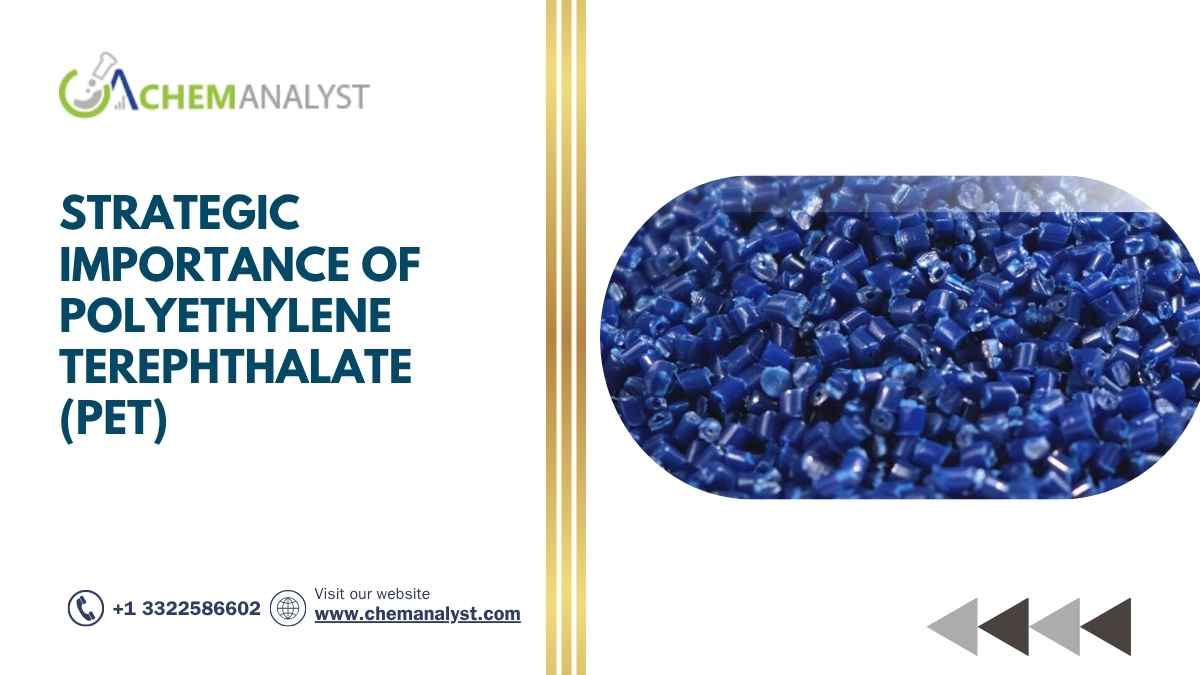
Polyethylene Terephthalate (PET) is a lightweight, durable, and recyclable thermoplastic used in packaging, textiles, and engineering. Its transparency, strength, and versatility, with the development in the forms of recycled and bio-based ones—make it pivotal for sustainable product design and circular manufacturing systems.
Polyethylene Terephthalate (PET) is a thermoplastic polyester (C10H8O4), which is manufactured through polycondensation of purified terephthalic acid (PTA) and mono ethylene glycol (MEG). Highly renowned for its superior tensile strength, chemical resistance, and clarity, PET is a staple polymer in broad industrial value chains. PET is widely utilized in fiber production, packaging, engineering plastics, and film, solidifying its position as an essential commodity in manufacturing and consumer products.
Industrial Applications by Industry

PET serves as the major input in the manufacture of polyester fibers by melt-spinning and supplies fabrics consumed in apparel, upholstery, industrial textiles, and technical nonwovens. Its mechanical performance, wrinkle resistance, and moisture-wicking characteristics make it a critical for both performance and generic textile use. This segment is a leading consumption segment for PET in the worldwide market, predominantly in developing Asian textile markets.
Through polymerization of PTA and MEG, PET resin is produced into bottles, jars, trays, and film, valued for barrier integrity, lightweight construction, and recyclability. Its excellent barrier to CO2 and O2 and FDA and EFSA compliance position PET perfectly for beverages, food packaging, and consumer goods. Increasing demand for convenience and single-serve product is driving PET application in FMCG packaging and sustainable packaging approaches.
PET's resistance to heat, dimensional stability, and electrical insulation make it suitable for engineering uses in automotive parts, electronic components, and insulating film for solar and electric applications. Glass-reinforced PET grades provide solutions for rigorous mechanical tolerances. PET films are applied in packaging, graphic arts, lamination, and industry, where precision and strength are a must.
Recycled PET (rPET) Stream
Spurred by environmental legislation and circular economy practices, rPET is being increasingly used in beverages, packaging, textiles, and nonwovens. Chemical and mechanical recycling technologies are making it possible for food-grade rPET and closed-loop models. Brand support for recycled content and growth of collection networks have driven rPET to become a mainstream product in sustainable packaging solutions.
Market Demand and End User Industries
Global PET demand is rooted in packaging, textiles, and engineering markets. More than 40% of worldwide demand is derived from packaging fostered by urbanization, convenience trends, and regulatory drives toward recyclability. In the textile market, PET fibers lead value clothing markets in Asia-Pacific. Engineering plastics are benefiting from vehicle lightweighting and electronic insulation. Developing niches are bio-PET, medical-grade PET containers, and filaments for additive manufacturing, with green chemistry trends dictating future demand.
Product Grades and Specifications

PET is sold in five major grades; each of which has been designed to meet certain industrial uses.
Bottle-grade PET, which has high intrinsic viscosity (IV), is applied for packaging of beverages where strength, clarity, and gas barrier are critical.
Film-grade PET, with regulated crystallinity and surface properties, finds application in flexible packaging, lamination films, and electrical insulation because of its dimensional stability and heat resistance.
Fiber-grade PET, which is usually of medium IV, is used in fabric production for clothing, upholstery, and industrial yarns, providing toughness, colorability, and abrasion resistance.
Engineering-grade PET, usually glass-reinforced, is used in severe technical purposes for cars, electronics, and domestic appliances, providing outstanding mechanical toughness and heat stability. The most important characteristics throughout grades are IV, crystallinity, acetaldehyde content (particularly vital in food packaging), color index, and melt flow index.
Specialty PET grades like UV-stable, fast-reheat, flame-retardant, and bio-based PET address specialized niche markets with improved performance, sustainability, and regulatory compliance.
Substitutes and Limitations
PET competes with packagings such as glass, aluminum, PC, PE, and PP. Although there can be better impact resistance or even cheaper cost, PET is still favored because it offers a balance of clarity, strength, low weight, and recyclability. Drawbacks are thermal and UV sensitivity and one-time plastic criticism. In fashion items, cotton and nylon have competition regarding comfort, but PET has better cost-performance. Regulatory and circularity barriers still exist, though better recycling and bio-PET offset drawbacks.
Innovations in Applications
PET innovation focuses on high-performance materials and sustainability. Bio-PET based on renewable feedstocks is making inroads in bottle-to-bottle and fiber uses. Chemical recycling (glycolysis, depolymerization) is making infinite recycling cycles possible. High-barrier, fast-reheat, and smart PET are optimizing packaging efficiency. In textiles, PET blends and functional finishes propel performance apparel, and PET filaments enable recyclable 3D printing solutions.
Conclusion
PET is rooted throughout packaging, textiles, engineering, and sustainability-led markets because of its performance, economy, and recyclability. Developments in bio-resins, rPET, and chemical recycling further secure PET's position in circular manufacturing. As demand rises and environmental regulations become stricter, PET will stay at the heart of sustainable industrial ecosystems, connecting conventional plastics to next-generation applications.