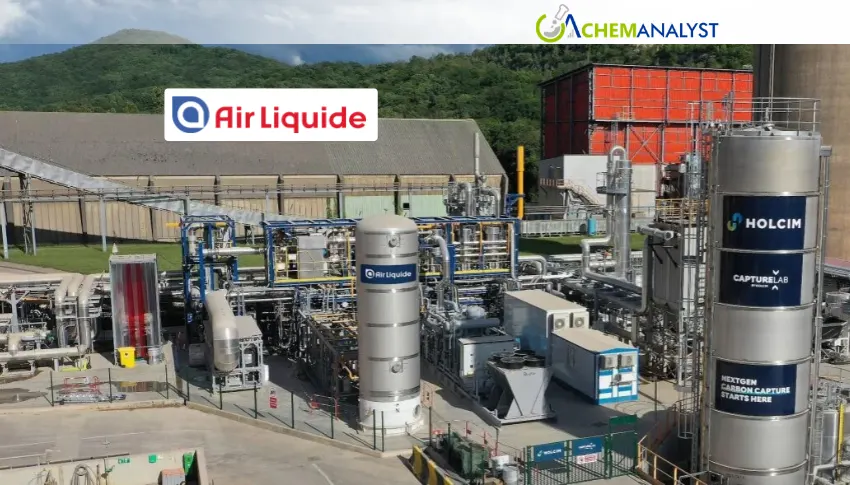
Air Liquide has announced the commissioning of its first industrial-scale carbon dioxide (CO2) capture pilot unit specifically developed for the cement industry. The pilot utilizes the company’s proprietary Cryocap™ technology and has been installed at Holcim’s CaptureLab in France. This development marks a major advancement in the effort to scale carbon capture solutions for hard-to-abate industries, particularly cement manufacturing, which is among the most challenging industrial sectors to decarbonize due to its inherent process-related emissions.
The newly introduced pilot is based on Cryocap™ FG (Flue Gas), a specialized version of Air Liquide’s Cryocap™ technology engineered to address the specific requirements of cement production. A significant challenge in capturing CO2 from cement plants lies in the treatment of flue gas, which contains various impurities that can impact the efficiency and reliability of carbon capture processes. The Cryocap™ FG pilot incorporates advanced flue gas pre-treatment technologies designed to remove these impurities and improve the concentration of CO2 before the final purification stage.
With the capability to process up to 3,000 Nm³ per hour of flue gas, the pilot unit represents an important step toward demonstrating the feasibility of large-scale CO2 capture in cement operations. By effectively pre-concentrating CO2 streams and preparing them for further purification, the technology aims to provide a reliable pathway for deploying industrial carbon capture systems across the cement sector.
The pilot unit has been developed using a modular design approach, enabling simplified transportation, installation, and potential relocation to other industrial facilities once its initial testing phase at Holcim’s CaptureLab is completed. CaptureLab is recognized as the world’s first dedicated carbon capture testing platform for the cement industry, providing a unique environment for evaluating and optimizing innovative technologies that can support the transition toward lower-carbon cement production.
Decarbonizing cement manufacturing remains particularly complex because a large portion of its CO2 emissions originates from the chemical decomposition of limestone during clinker production rather than solely from the combustion of fuels. As a result, improving energy efficiency alone is insufficient to achieve deep emissions reductions, making carbon capture a critical technology for enabling the cement industry to meet long-term climate objectives.
The Cryocap™ FG pilot builds upon Air Liquide’s extensive experience in industrial carbon capture technologies, including more than a decade of successful operation of its Cryocap™ H2 technology at the Port-Jérôme site in France. The knowledge gained from this experience has contributed to the development of solutions that can be adapted to other carbon-intensive sectors, including cement and lime production.
Armelle Levieux, a member of Air Liquide’s Executive Committee responsible for overseeing Innovation and Technology activities, highlighted the significance of the project, stating that the commissioning of the industrial-scale pilot at Holcim’s CaptureLab represents a crucial milestone in advancing the decarbonization of the cement industry. She emphasized that the project demonstrates Air Liquide’s capability to transform innovative technologies from laboratory research into practical industrial applications, providing efficient and impactful solutions that help customers reduce their carbon footprint.
Through this initiative, Air Liquide reinforces its commitment to developing scalable carbon management technologies that can support the global transition toward more sustainable industrial practices and accelerate the reduction of greenhouse gas emissions in difficult-to-decarbonize sectors.








 About ChemAnalyst
Leave a Comment
Comments (0)