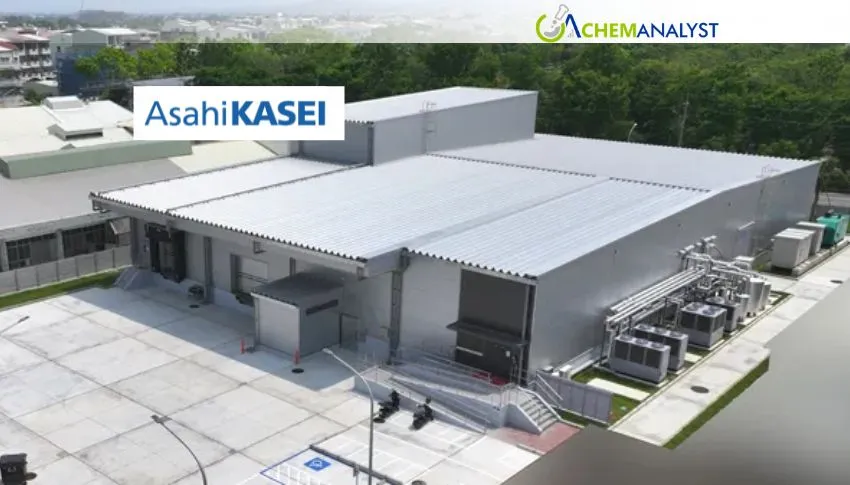
Asahi Kasei, a global diversified materials and technology company, has strengthened its semiconductor materials manufacturing capabilities by establishing a new slitting facility for its SUNFORT™ dry film photoresist (DFR) at its production site in Tainan, Taiwan. The facility was completed on July 3 and is expected to begin commercial operations later this month. This latest investment reflects the company's commitment to supporting the rapidly expanding semiconductor packaging industry, which continues to experience strong demand driven by advancements in artificial intelligence (AI), high-performance computing, and data-intensive applications.
Asahi Kasei has been carrying out slitting operations for SUNFORT™ DFR at its Tainan facility since 1997. Over the past several years, the semiconductor industry has undergone significant transformation as AI technologies have accelerated the need for more powerful chips and sophisticated packaging solutions. This evolution has substantially increased the demand for high-performance dry film photoresists capable of delivering exceptional precision and reliability during semiconductor packaging processes. Consequently, manufacturers now require materials that not only meet increasingly stringent quality specifications but also ensure consistent supply to support uninterrupted production.
Taiwan remains one of the world's most important semiconductor manufacturing and packaging hubs, hosting a dense network of chipmakers, packaging specialists, and electronics supply chain participants. Given this strategic position, maintaining production capabilities close to customers enables suppliers to respond more quickly to market needs while enhancing delivery reliability. Recognizing these advantages, Asahi Kasei has expanded its local production infrastructure to better serve semiconductor manufacturers operating throughout the region.
Slitting is a vital manufacturing process in which large master rolls of dry film are precisely cut into narrower widths based on the unique specifications of individual customers. Although it represents a downstream processing stage, slitting has a direct influence on product consistency, dimensional accuracy, and overall manufacturing quality. High-precision slitting also plays a crucial role in ensuring dependable supply and minimizing production disruptions for semiconductor manufacturers, making it an essential part of the value chain.
The newly established slitting facility incorporates advanced processing equipment and operates under some of the industry's highest cleanroom standards. These features are designed to enhance production efficiency while maintaining the strict cleanliness and quality requirements demanded by semiconductor fabrication and packaging applications. Through this investment, Asahi Kasei aims to improve operational productivity and strengthen its ability to provide customers with a stable and reliable supply of SUNFORT™ DFR products.
The company invested approximately ¥2 billion, equivalent to around US$12 million or €11 million, in developing the new facility. The expansion will increase current production capacity by approximately 40%, with sufficient flexibility to potentially double existing output in the future as market demand continues to grow. This scalable approach positions the company to respond efficiently to future increases in semiconductor packaging requirements without compromising product quality or delivery performance.
SUNFORT™ dry film photoresist is engineered to deliver ultra-high-resolution patterning performance using both conventional stepper exposure systems and laser direct imaging (LDI) technologies. These imaging methods are widely used to transfer intricate circuit patterns onto semiconductor packaging substrates. By enabling highly accurate circuit formation, SUNFORT™ contributes to improved precision, enhanced device performance, and greater manufacturing efficiency in semiconductor back-end processes, which have become increasingly critical as chip architectures continue to evolve.
The expansion also aligns with Asahi Kasei's broader corporate strategy of positioning its Electronics Business as a major engine for future growth. The company has been steadily increasing investments in advanced electronic materials to capitalize on rising global demand for semiconductors and related technologies. Complementing this latest facility expansion, Asahi Kasei introduced SUNFORT™ TA in May 2025, a next-generation dry film photoresist series specifically designed for advanced semiconductor packaging applications used in AI servers and other high-performance computing systems.
With the commissioning of the new slitting facility in Taiwan, Asahi Kasei reinforces its long-term commitment to supporting the evolving semiconductor industry through localized manufacturing, enhanced production capacity, advanced processing technology, and a resilient supply chain capable of meeting the growing requirements of next-generation electronics.
Impact on Product and Chemical Commodity Prices
The commissioning of Asahi Kasei's new SUNFORT™ dry film photoresist (DFR) slitting facility is expected to strengthen product availability, improve supply reliability, and shorten delivery times for semiconductor packaging customers across Asia. The 40% capacity expansion will enable the company to better meet the rapidly rising demand for advanced packaging materials driven by AI servers, high-performance computing, and next-generation electronic devices. Enhanced local production in Taiwan will also reduce supply chain risks while supporting higher-quality, precision semiconductor manufacturing.
From ChemAnalyst's pricing perspective, the move is unlikely to trigger any immediate or significant increase in chemical commodity prices. Instead, the additional capacity may ease supply tightness in the specialty dry film photoresist market, keeping prices largely stable or exerting mild downward pressure over the medium term. Upstream electronic chemicals, specialty resins, solvents, and photoactive materials may witness a gradual rise in consumption as semiconductor production expands, but the capacity addition itself is insufficient to materially impact broader chemical commodity pricing.







 About ChemAnalyst
Leave a Comment
Comments (0)