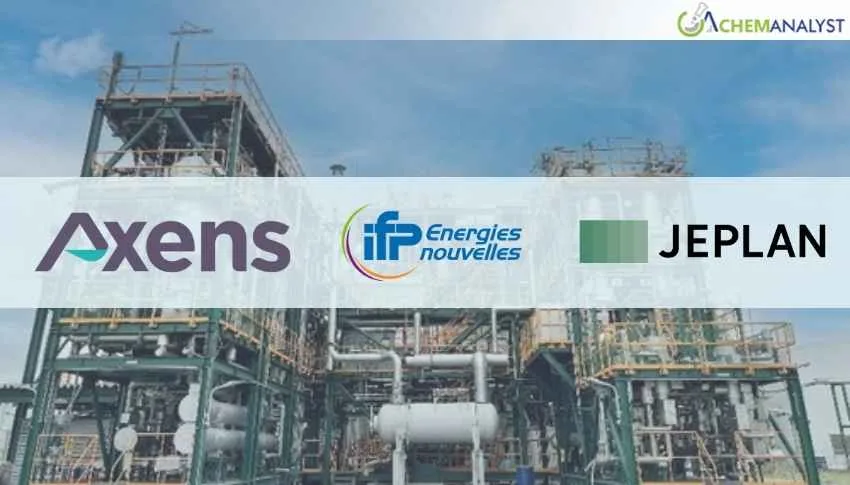
Axens, IFP Energies nouvelles (IFPEN), and JEPLAN have successfully completed an important milestone in polyester textile recycling by closing the recycling loop for post-consumer polyester-rich textiles. This achievement marks significant progress toward building a circular economy for the textile sector, especially in industries such as sportswear, home furnishings, and luxury fashion, where polyester is widely used.
In this project, several tens of tons of post-consumer textile waste collected from across Europe were sorted and prepared in France before being sent to Japan for processing. These materials were handled in the semi-industrial demonstration unit jointly operated by Axens, IFPEN, and JEPLAN. The unit, located in Japan and managed by JEPLAN, has a treatment capacity of 1,000 tons per year and uses the advanced Rewind® PET technology to recycle polyester textiles.
The textile waste used for this test came from French public collection systems and was sorted and prepared by two French partners, Nouvelles Fibres Textile and Mapea. Through the recycling process, several tens of tons of BHET (Bis(2-Hydroxyethyl) Terephthalate), which is the fundamental monomer used in polyester production, were successfully produced. BHET is an essential building block for manufacturing 100% recycled polyester. This recovered monomer will soon be transformed into polyester yarns, fabrics, and finished garments, fully completing the textile-to-textile recycling loop.
This industrial-scale trial is considered one of the first major demonstrations of chemical recycling for post-consumer polyester textiles under real industrial operating conditions. It proves that large-scale textile-to-textile recycling is technically possible and commercially promising. This success creates new opportunities for textile manufacturers and brands looking to reduce waste, lower dependency on virgin fossil-based raw materials, and improve sustainability throughout the supply chain.
One of the most important advantages of the Rewind® PET technology is that it can be integrated into existing industrial polyester production sites worldwide. This means manufacturers do not necessarily need to build entirely new facilities. Instead, they can install this innovative recycling process at current polyester production plants and replace fossil-based feedstocks with recycled alternatives. This approach makes industrial adoption faster, more practical, and economically attractive.
The technology had already been successfully proven and commercialized for recycling PET packaging, including food-contact packaging such as bottles and containers. With this latest validation for textile applications, the process now expands its industrial value significantly. Under an exclusive global license agreement granted by IFPEN and JEPLAN to Axens, industrial players around the world can now adopt this technology to establish local and regional textile-to-textile recycling systems.
The recycled PET produced through this process is designed to be converted back into textile products such as yarns, fabrics, and garments. This makes it highly suitable for sectors like sportswear and outdoor clothing, which consume large quantities of polyester; home furnishing products like curtains, upholstery fabrics, and protective covers; and certain luxury fashion applications where polyester is used selectively for design and performance purposes.
Currently, nearly 60% of global textile production depends on polyester and other synthetic fibers. However, less than 1% of textile fibers produced today come from genuine textile-to-textile recycling, according to the Textile Exchange Materials Market Report. At the same time, textile waste volumes continue to rise rapidly across the world, creating serious environmental concerns.
This successful semi-industrial demonstration provides strong evidence that circular polyester production can now be implemented at a meaningful scale using post-consumer textile waste. The Rewind® PET process supports a broader circular economy strategy by helping manufacturers reduce virgin material consumption, extend product life cycles, and minimize environmental impact. Additionally, its short-loop recycling pathway offers lower carbon emissions and better cost efficiency, making it a highly valuable solution for the future of sustainable textile manufacturing.








 About ChemAnalyst
Leave a Comment
Comments (0)