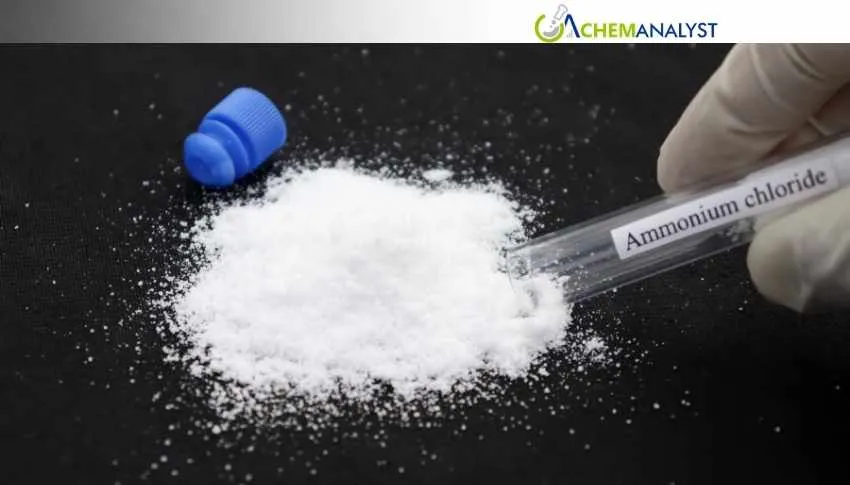
Ammonium Chloride prices in China fell 13.8% during April 2026, declining sharply against the backdrop of extraordinary international fertilizer price inflation driven by the ongoing Middle East war, as China's unique domestic supply structure, robust national policy controls, and weak downstream agricultural procurement during the spring planting transition produced one of the steepest monthly corrections in the Chinese ammonium chloride market in recent years.
The extraordinary divergence between China's domestic price decline for ammonium chloride and the global fertilizer price surge underscores the structural resilience of China's fertilizer supply chain. While international urea prices surged 50–60%, global phosphate fertilizer prices rose 20%, and potash prices climbed 15% in some regions since late February — driven by the Middle East war's disruption of the Strait of Hormuz affecting nearly half of global sulfur trade alongside rising natural gas prices — China's domestic fertilizer markets particularly ammonium chloride remained remarkably insulated from the external shock.
Three structural factors sustained China's domestic price stability while the global market surged. First, China has a unique raw material route with approximately 80% of urea produced from coal, avoiding international gas price fluctuation risks. Second, the government released nearly 10 million tons of national nitrogen, phosphorus, and compound fertilizer commercial reserves in advance to stabilise market fluctuations. Third, the entire industrial chain maintained self-reliance and controllability. For ammonium chloride specifically — a nitrogen fertilizer co-produced through the Solvay process — China's domestic ammonia production from coal-based synthesis routes insulated manufacturing economics from the extraordinary international LNG-derived ammonia cost escalation.
The 13.8% monthly decline of ammonium chloride also reflected demand-side weakness during the spring planting season transition. Industry insiders noted that while the short-term impact of Middle Eastern geopolitical factors on China's fertilizer market and farmers' production costs is limited and controllable, the long-term impact requires continued attention. Chinese agricultural cooperatives and distributors drew down strategic reserves released by the government rather than procuring fresh ammonium chloride at prevailing market prices, reducing spot buying urgency substantially through April.
The International Fertilizer Industry Association noted that the Middle East war's disruption of the Strait of Hormuz affected nearly half of global sulfur trade, with rising natural gas prices and geopolitical interference significantly increasing fertilizer production costs globally and limiting farmers' ability to apply fertilizers. Looking ahead, China's ammonium chloride prices are anticipated to stabilise in May as spring planting procurement from rice and wheat farmers begins generating renewed agricultural sector demand, while the government's ongoing macro-policy controls — including the industrial chain's collective commitment to restraining price increases to safeguard national food security — are expected to prevent both sharp recoveries and further deterioration from April's reference level for ammonium chloride.








 About ChemAnalyst
Leave a Comment
Comments (0)