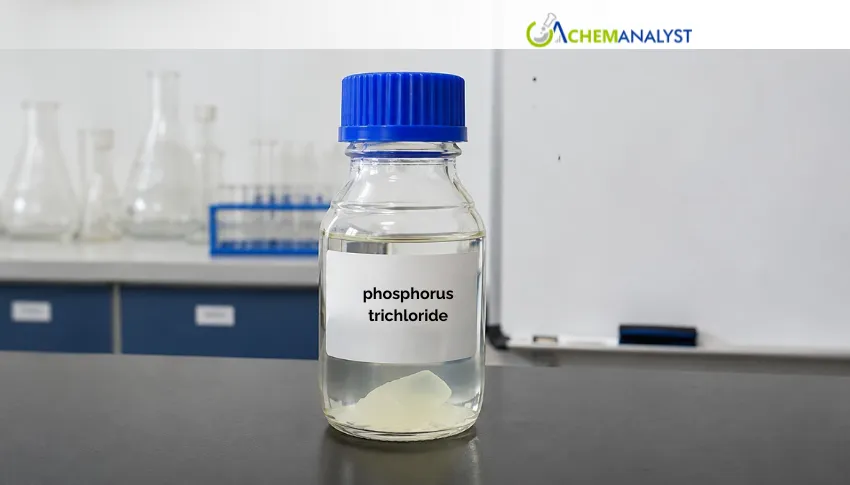
China’s phosphorus trichloride market strengthened in early August as renewed supply concerns coincided with firmer seasonal procurement. July trading had remained broadly range-bound, with earlier force-majeure disruptions in Jiangsu and Anhui largely resolved by month-end. The market balance shifted after a fire-related suspension at Yunnan Haoming on August 5, while persistent yellow-phosphorus tightness increased concern over feedstock availability. Agrochemical manufacturers also stepped up purchasing ahead of the Northern Hemisphere application season, while pre-Golden Week replenishment enquiries improved spot activity. The combination pushed phosphorus trichloride sentiment from neutral toward cautiously bullish.
Demand remained concentrated in agrochemicals. Glyphosate and phosphite producers maintained operating schedules, sustaining phosphorus trichloride consumption, while flame-retardant and specialty-chemical manufacturers provided more limited support. Battery-material applications remained comparatively steady rather than becoming a major source of incremental demand. Recent industry data also indicate that China’s glyphosate market remained subdued in July, while yellow phosphorus had retreated from earlier highs, suggesting that downstream demand was supportive but not broad-based.
Supply remained the more important market variable. Yellow phosphorus is a critical input for phosphorus trichloride, and China accounts for roughly 85% of global yellow-phosphorus production, making regional production and energy conditions particularly influential. Chlorine availability was comparatively less restrictive. Chinese chlor-alkali utilization for plants above 100,000 tonnes/year was reported at 77.1% during August 7–13, with several units undergoing maintenance while others restarted. This suggests that chlorine supply could provide some relief, but it has not fully offset concerns surrounding yellow phosphorus and regional phosphorus trichloride availability.
Production economics therefore remained sensitive to upstream movements. Higher yellow-phosphorus costs and chlorine-related expenses increased pressure on phosphorus trichloride producers, while stable or improving chlorine availability prevented a broader cost squeeze. Regional disruptions also affected prompt logistics, with weather-related transportation delays adding uncertainty to cargo movements. The market consequently remained sensitive to individual plant events rather than experiencing a uniform nationwide shortage. Recent assessments put industrial-grade phosphorus trichloride around the low-$800s/MT, with the supplied market data showing a move toward $854/MT by mid-August.
Looking ahead, the phosphorus trichloride market is likely to remain supported through September, with seasonal agrochemical demand and upstream feedstock tightness providing the principal upside drivers. The supplied outlook indicates +1.4% in August and +4.3% in September, followed by softer conditions later in the year. Improving hydropower availability could encourage higher yellow-phosphorus production, while normalization of disrupted logistics may improve prompt availability. At the same time, fading pre-Golden Week procurement and subdued broader chemical demand could limit the durability of the rally. Overall, phosphorus trichloride is expected to remain supply-sensitive rather than structurally bullish, with yellow-phosphorus availability, chlor-alkali operating rates and agrochemical purchasing likely to determine the next market direction.







 About ChemAnalyst
Leave a Comment
Comments (0)