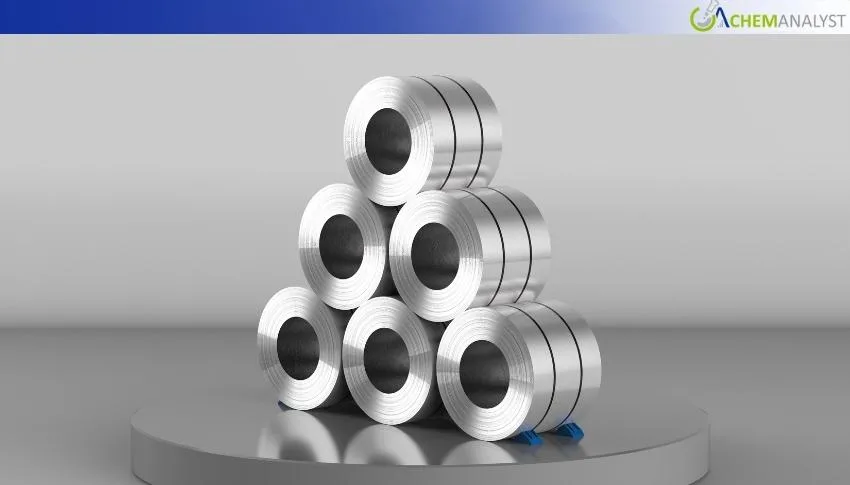
In the Chinese SS CRC market, the spot price and production cost moved downwards consistently. Forced by market pessimism, slack season demand, and upcoming off-season, a few SS CRC mills have decided to go for production cut from the end of October onwards. The synchronous fall in the cost of raw materials, especially high-grade Nickel Pig Iron and high-carbon ferrochrome, helped in stabilizing the extent of losses instead of eliminating the cost-price inversion the steel mills were going through.
The most significant downward pressure came from raw material markets. High-grade NPI prices softened continuously under the influence of low demand by SS mills currently in losses, ample existing reserves, and the need for NPI traders to liquidate inventory for year-end cash flow. Chrome-based raw materials, such as high-carbon ferrochrome and chrome ore, also weakened because supply from producers continued at a high level and inventories of chrome ore at ports grew, even as mill tender prices maintained stability. These factors kept both input costs and final SS CRC prices depressed throughout the month, reinforcing the pessimism of industry participants.
The Chinese SS CRC market is seeing unprecedented levels of new capacity additions. Xinhuang Metal Materials has obtained an environmental permit for a cold rolling project in Lianping, where it would build a high-grade, precision SS CRC production line with an annual capacity of 96,000 tons. Meanwhile, Tsingshan goes ahead with construction of a stainless steel mill with annual capacity of 700,000 tons, which was scheduled for trial production to start in November 2025 and reach full commercial production in December of the same year.
For these reasons, the Chinese SS CRC market saw prices decline at the end of November by 2.5% for 430-grade materials and by 0.3% for 304-grade materials. On the export front, China recorded a steep fall. Stainless steel exports fell 14.4% m-o-m and 14.2% y-o-y to 358,100 t in October, one of the lowest monthly levels of 2025. SS CRC was the variety that suffered the steepest correction, with exports falling by 24,000 t m-o-m. The downtick, quite distinct since the beginning of Q4, reflects weakening overseas demand due to increased trade obstacles and softer buying interest across major destinations.
Looking ahead, prices are at the cusp of a rally, as stainless steel output has fallen after Guangxi mills suspended production in December, with more cuts expected across the nation. But demand is strengthening from major Chinese projects: Louis Dreyfus Company’s Food Technology Park in Qingdao uses SS CRC in its processing and storage facilities. The use of zero-emission machinery, including electric excavators and cranes, increases SS CRC consumption in durable components. Chengdu’s new skyscraper, towering 468 meters, uses it in reinforcement and façades. An upgrade to Sinopec’s Tahe complex also drives demand for SS CRC in pipelines, tanks, and processing units. Supply and demand are clearly out of balance, supportive of higher pricing.







Leave a Comment
Comments (0)