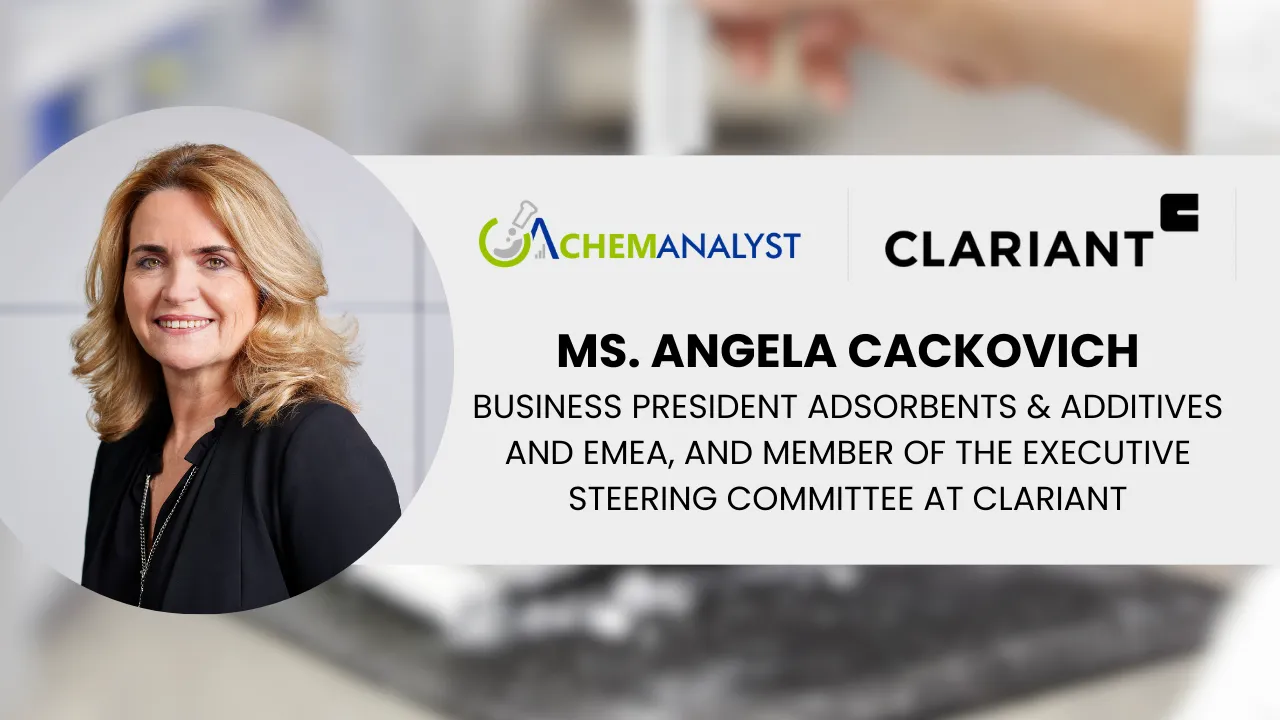
ChemAnalyst Talks with Ms. Angela Cackovich, Business President Adsorbents & Additives and EMEA, and Member of the Executive Steering Committee at Clariant
Clariant is a Swiss-based global specialty chemicals company at the forefront of advancing sustainable, high-performance materials for a wide range of industries. Through its Adsorbents & Additives business, Clariant is playing a pivotal role in supporting the global transition away from halogenated chemistries by expanding its portfolio of non-halogenated, phosphorus-based flame retardants designed to meet increasingly stringent regulatory, safety, and sustainability requirements. With a strong focus on innovation, lifecycle performance, and supply security, the company is addressing critical fire safety challenges across fast-growing sectors such as construction, automotive, electronics, and e-mobility, while aligning its solutions with circular economy principles and future regulatory expectations.
ChemAnalyst spoke with Angela Cackovich, Business President Adsorbents & Additives and EMEA, and Member of the Executive Steering Committee at Clariant, about how her extensive leadership experience across global specialty chemicals, adhesives, and advanced materials is shaping Clariant’s “outside-in” innovation approach to next-generation flame retardant development. In the discussion, she shared insights on the accelerating market shift toward halogen-free and phosphorus-based solutions, the strategic importance of Clariant’s joint venture with FUHUA in scaling sustainable flame retardant technologies, and how proactive investments in production capacity and regional manufacturing—particularly in China—are strengthening supply security and speeding commercialization. She also outlined how regulatory foresight, customer-centric collaboration, and integrated R&D-to-manufacturing partnerships are enabling Clariant to deliver flame retardant solutions that balance high performance, regulatory compliance, and long-term sustainability across global markets.

Complete Interview with Ms. Angela Cackovich
Q: Ms. Cackovich, could you begin by sharing an overview of your professional journey across specialty chemicals, additives, and sustainability-focused innovation? How have these experiences shaped your leadership vision for advancing next generation flame retardant solutions at Clariant?
Ms. Angela Cackovich: My professional journey has provided me with a comprehensive perspective across multiple segments of the specialty chemicals industry. Before joining Clariant, I served on the Executive Board at Tesa and held various management positions with P&L responsibility at Henkel, including leading the Global Building & Construction Business and Adhesives divisions for Automotive and Aviation in both Europe and the Americas. Earlier in my career, I gained significant industry experience in leadership positions at Celanese, Rohm & Haas Dow Corning, and Hoechst.
This diverse background has shaped my leadership approach at Clariant, particularly in how we develop next generation flame retardant solutions. I've implemented what I call an "outside-in approach" – continuously analyzing global megatrends and our customers' evolving needs to shape our innovation agenda. Successful innovation must address both technical performance requirements and anticipate regulatory changes before they impact on our customers.
At Clariant, this translates to viewing regulatory shifts not as obstacles but as catalysts for innovation. This mindset has been particularly valuable as we expand our flame retardant portfolio and develop new solutions for emerging applications in e-mobility, electronics, and sustainable construction materials.
Q: The newly announced joint venture between Clariant and FUHUA represents a significant milestone in developing non-halogenated flame retardants. How have your previous leadership insights influenced the strategic direction and long-term goals of this collaboration?
Ms. Angela Cackovich: My previous leadership experiences have taught me the value of strategic partnerships that combine complementary strengths to address emerging market challenges. The joint venture with FUHUA exemplifies this approach, bringing together Clariant's global R&D expertise, strong application know-how, and powerful brand in flame retardants with FUHUA's exceptional phosphorous expertise and manufacturing capabilities.
This collaboration is designed with clear strategic objectives. that reflect lessons I've learned throughout my career. First, we're focusing on developing solutions that proactively address regulatory changes rather than reacting to them after implementation. Second, we're taking a targeted approach to specific high-growth sectors, initially focusing on building and construction before expanding to automotive and electronics applications.
We also aim to create a sustainable competitive advantage by establishing a innovation pipeline that anticipates market needs and regulatory requirements. This forward-looking strategy positions both Clariant and our customers to navigate the transition away from halogenated flame retardants with minimal disruption.
Q: With global regulatory bodies intensifying restrictions on traditional halogenated flame retardants, how do you assess the market shift toward phosphorus-based and other sustainable alternatives? What major demand trends from regulators, OEMs, and sustainability-driven industries are shaping this transition?
Ms. Angela Cackovich: The market shift toward phosphorus-based and other more sustainable flame retardants is accelerating rapidly, driven by converging regulatory and market forces. Global regulatory bodies are increasingly restricting halogenated flame retardants due to environmental and health concerns. There is an urgent need for alternatives that maintain performance while addressing these issues.
From regulators, we're seeing a clear trend toward more comprehensive chemical safety frameworks that consider the entire lifecycle impact of materials. OEMs, particularly in electronics, automotive, and construction, are proactively moving beyond compliance to differentiate their products through enhanced sustainability profiles. Many are establishing their own restricted substance lists that exceed regulatory requirements.
Companies coming up with more sustainable solutions for their customers are increasingly focused on circular economy principles, seeking flame retardants that don't compromise recyclability or introduce substances of concern into material streams. The growing e-mobility sector presents unique fire safety challenges that require innovative solutions, while the expansion of renewable energy infrastructure creates demand for durable, safe materials with minimal environmental impact.
These trends collectively point to a fundamental transformation in how flame retardants are developed, evaluated, and selected, with performance and sustainability now viewed as equally essential requirements.
Q: The joint venture will focus on delivering innovative phosphorus-based flame retardants for sectors such as construction, automotive, and electronics. How do you expect this partnership to accelerate the commercialization of safer, high-performance solutions globally?
Ms. Angela Cackovich: The JV’s primary focus is on solutions for the building & construction sector. This partnership is strategically designed to accelerate commercialization through several key mechanisms. By combining Clariant's innovation capabilities with FUHUA's manufacturing excellence, we create a seamless pathway from concept to commercial-scale production. This significantly reduces development timelines and enables faster market introduction of new solutions.
Additionally, our presence in China – one of the world's largest and fastest-growing markets for these applications – provides valuable insights into emerging trends and requirements.
By establishing this integrated approach to innovation and commercialization, we expect to significantly accelerate the global availability of safer, high-performance flame retardant solutions across multiple industries.
Q: Many industries are facing immediate compliance pressures due to tightening chemical safety standards. How is Clariant preparing its production pipeline and innovation ecosystem to meet rising demand for halogen-free flame retardants across multiple end-markets?
Ms. Angela Cackovich: Clariant is taking a multi-faceted approach to address these immediate compliance pressures. First, we've strategically expanded our production capacity for halogen-free flame retardants, as evidenced by our CHF 100 million investment in the Daya Bay facility. We can now meet growing demand while maintaining supply security for customers transitioning away from halogenated solutions.
We're expanding our ExolitTM OP flame retardant portfolio with new solutions specifically designed for e-mobility or consumer electronics applications. In the area of intumescent coatings, we have been introducing our melamine-free ammonium polyphosphate, ExolitTM AP 422 A, which offers enhanced performance and sustainability benefits.
We've also strengthened our technical service capabilities to support customers through the transition process, helping them reformulate products and optimize processing conditions for new flame retardant systems. This way we ensure that compliance challenges become opportunities for performance improvement rather than obstacles to overcome.
Additionally, our region-for-region production strategy, with manufacturing facilities in key markets, improves our ability to respond quickly to local regulatory changes and customer needs.
Q: Clariant's proactive investment approach — including the CHF 100 million expansion at the Daya Bay facility — positions the company ahead of regulatory change. How will these expanded capacities influence supply security, pricing competitiveness, and global market readiness for new flame retardant chemistries?
Ms. Angela Cackovich: Our CHF 100 million investment in the Daya Bay facility represents a strategic commitment to ensuring supply security during a critical industry transition. By expanding our production capacity ahead of regulatory deadlines, we're creating a buffer that protects our customers from potential supply disruptions as demand for halogen-free solutions increases.
Also, this expanded capacity enhances our competitiveness through economies of scale and operational efficiencies, and provides better lead times and supply reliability to our Asia-based customers.
Regarding global market readiness, our expanded capacity enables us to support customers worldwide as they transition to new chemistries. We can provide sufficient quantities for extensive testing and validation, which is essential for applications with lengthy qualification processes such as automotive and construction.
Furthermore, our investment signals to the market our confidence in the long-term growth of more sustainable flame retardants, encouraging complementary investments throughout the value chain and creating a more robust ecosystem for these technologies.
Q: Partnerships such as this one with FUHUA play a critical role in scaling sustainable materials. How will combining Clariant's R&D expertise with FUHUA's manufacturing strength enhance supply chain resilience, speed-to-market, and overall customer value creation?
Ms. Angela Cackovich: This partnership creates a powerful synergy that enhances value creation throughout the supply chain. Clariant brings deep expertise in flame retardant chemistry, application development, and regulatory insights, while FUHUA contributes exceptional manufacturing capabilities, process optimization knowledge, and strong positioning in the Chinese market.
From a supply chain resilience perspective, this combination reduces dependencies on single sources and geographic regions. By establishing production capabilities in China – a key market and manufacturing hub – we create a more balanced global footprint that can better withstand regional disruptions.
The partnership significantly improves speed-to-market by creating a more integrated development process. Rather than sequential handoffs between R&D and manufacturing teams, we can pursue parallel development tracks with continuous feedback between formulation and production considerations.
For customers, this translates to multiple value creation opportunities: earlier access to innovative solutions, more reliable supply, optimized formulations that balance performance and processability, and a partner who can support their growth in key markets like China.
Q: As the industry moves away from halogenated technologies, what technological breakthroughs or material innovations do you foresee enabling the next wave of flame retardant development? How is Clariant preparing to deliver both regulatory compliance and performance excellence?
Ms. Angela Cackovich: The next wave of flame retardant development will be driven by several technological breakthroughs. We anticipate significant advances in phosphorus chemistry, with novel molecular structures that provide more efficient flame inhibition while maintaining material properties. These developments will enable lower loading levels, reducing impact on mechanical properties and processing characteristics.
We also expect innovations in synergistic systems that combine multiple flame retardant mechanisms to achieve performance that exceeds the sum of individual components.
Surface technologies represent another promising area, where treatments or coatings can provide flame retardancy without bulk modification of materials. This will prove particularly valuable for applications where maintaining the base material's properties is critical.
Q: Clariant has emphasized its commitment to developing sustainable, high-efficiency phosphorus-based solutions. How do these new chemistries improve environmental performance, product safety, and material lifecycle impacts compared with traditional flame retardants?
Ms. Angela Cackovich: Our phosphorus-based flame retardants offer significant improvements across different sustainability dimensions. From an environmental perspective, they avoid bioaccumulation and (eco-)toxicity issues associated with certain halogenated flame retardants. For product safety, our solutions are developed with a focus on human health and environmental impact considerations throughout the product lifecycle. They're designed to have favorable toxicological profiles and reduced migration potential, minimizing exposure during manufacturing, use, and end-of-life handling. This is particularly important for applications with direct human contact or those used in sensitive environments like homes and vehicles.
Regarding material lifecycle impacts, our phosphorus-based flame retardants are compatible with mechanical recycling processes. They maintain their effectiveness through multiple processing cycles, supporting circular economy objectives by enabling the use of recycled materials without compromising fire safety. Additionally, our high-efficiency formulations often require lower loading levels to achieve the same protection, reducing the overall chemical footprint of the final product.
Q: With Clariant expanding capabilities not only in Sichuan but also through new production lines in Daya Bay and Cangzhou, how do these investments strengthen the company's overall strategy in China—one of the world's fastest-growing markets for advanced additives?
Ms. Angela Cackovich: These strategic investments significantly strengthen our position in China through a comprehensive approach that addresses multiple attributes of market leadership. The expansion at Daya Bay for ExolitTM OP flame retardants, the new production line for NylostabTM S-EED stabilizer in Cangzhou with our joint venture partner Beijing Tiangang, and now our collaboration with FUHUA in Sichuan create a solid manufacturing footprint across key regions in China.
This distributed presence allows us to serve customers throughout the country with reduced lead times and transportation costs, while also providing redundancy that enhances supply security. Each facility focuses on specific product lines aligned with regional industry clusters, allowing for more specialized expertise and closer customer collaboration.
Beyond manufacturing capacity, these investments include enhanced local R&D specifically tailored to Chinese market and its unique application challenges, as well as regulatory demands..
Our expanded presence also strengthens our ability to participate in China's ambitious sustainability initiatives, including its carbon reduction goals and the transition to new energy vehicles.
We aim to see an increase of China's contribution to our global sales from 10% to 14%, positioning us to capture growth opportunities in one of the world's most dynamic markets for specialty chemicals.
Q: How is Clariant working with clients to ensure its new flame retardant solutions meet stringent safety requirements, deliver practical performance benefits, and remain aligned with future regulatory expectations?
Ms. Angela Cackovich: Our approach to client collaboration is comprehensive and forward-looking, beginning with a deep understanding of their specific application requirements and regulatory landscape. We engage in detailed technical discussions to identify performance criteria, processing constraints, and sustainability objectives before developing customized solutions.
We've established dedicated technical service teams that work alongside customers throughout the development and implementation process. These specialists provide formulation guidance, processing optimization, and troubleshooting support to ensure smooth integration of new flame retardant systems into existing production processes.
Our extensive testing capabilities allow us to validate performance across multiple dimensions, from fire protection effectiveness to mechanical properties, aging characteristics, and environmental impact. We help customers understand the full implications of transitioning to new chemistries and make informed decisions.
We also share our regulatory insights and forecasts with them, so they can anticipate future requirements and plan their product development accordingly. This foresight is particularly valuable in industries with long development cycles, where today's design decisions must account for tomorrow's regulatory environment.
Q: Looking ahead, how will this joint venture shape Clariant's longer-term innovation roadmap in additives? What role will China play in driving global development, scaling, and commercialization of next-generation flame-retardant technologies?
Ms. Angela Cackovich: Looking ahead, we expect this partnership to catalyze further innovations in adjacent technologies, as learnings from flame retardant development inform other areas such as stabilizers, processing aids, and surface modifiers. The systems thinking required for effective flame retardancy – balancing multiple performance parameters and sustainability considerations – has broad applicability in the whole additives portfolio of Clariant.
China will play an increasingly central role in our global innovation successes, serving as both a source of market insights and a platform for scaling and commercialization. The country has set meaningful sustainability goals for itself, notes rapid industrial transformation, and supports growing emphasis on indigenous innovation for technological advancement.
We anticipate that innovations developed initially for the Chinese market will increasingly find global applications.







Leave a Comment
Comments (0)