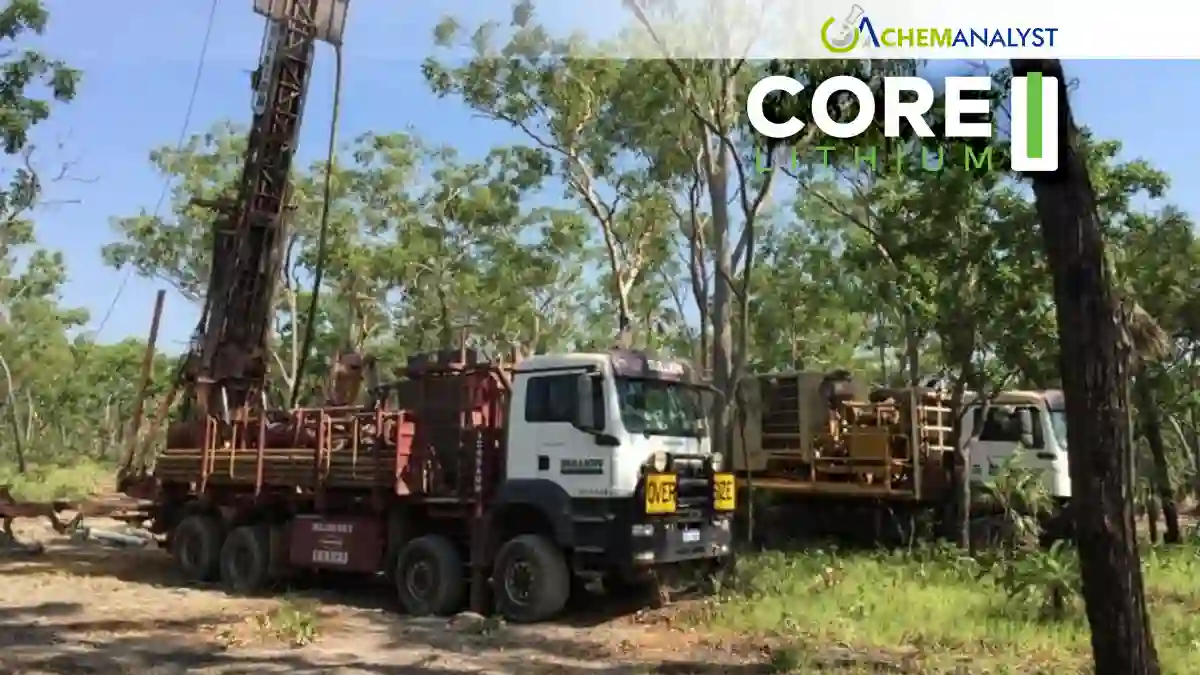
Core Lithium has reported a significant high-grade lithium discovery beyond the existing mineral resource at its BP33 deposit, part of the Finniss Lithium Operation in Australia’s Northern Territory. The latest drilling results strengthen the company’s confidence in the scale, continuity and future development potential of the deposit.
The first diamond drill hole from the latest exploration campaign, NMRD100, intersected 34.08 meters of spodumene mineralization grading 2.09% lithium oxide (Li2O) from a depth of 578.70 meters. The estimated true width of the intersection was 28.50 meters. The broad mineralized zone also contained several higher-grade sections, including 5.28 meters at 2.80% Li2O, 5.40 meters at 2.37% Li2O, 7.11 meters at 2.19% Li2O and 9.83 meters at 2.23% Li2O.
The hole also identified a separate 3.43-meter interval grading 2.44% Li2O from 616.54 meters. NMRD100 was drilled near the previously completed NMRD085 hole, which returned a much broader 90.17-meter intersection grading 1.80% Li2O from 568.83 meters, also outside the current mineral resource estimate. According to Core Lithium, the latest results confirm the continuity of the high-grade mineralization identified in the earlier drilling.
BP33 currently contains a mineral resource of 10.5 million tonnes grading 1.53% Li2O. Core Lithium views the deposit as a potential long-life, low-cost production base for the Finniss operation, located on the Cox Peninsula about 88 kilometers by sealed road from Darwin Port.
Core Lithium Managing Director Paul Brown said the results demonstrate the quality and continuity of the BP33 orebody. The company describes BP33 as a large, continuous and relatively uniform sub-vertical pegmatite with consistent grades, limited internal zoning and geometry considered favorable for underground mining.
Four additional drill holes are planned to investigate extensions down-dip and along strike from NMRD085 and NMRD100. The latest drilling did not test BP33’s previously announced exploration target of 3.9 million to 6.5 million tonnes grading 1.5%-1.6% Li2O. This conceptual target extends to approximately 1,200 meters below the surface and could be evaluated through underground drilling as mining progresses.
Core Lithium is also advancing exploration at its Blackbeard prospect, where up to 12,150 meters of drilling is planned. A second diamond rig is expected to accelerate the program, with results anticipated in the coming months.
Impact on Product & Chemical Commodity Prices
The discovery is positive for lithium and spodumene supply prospects, as successful resource expansion at BP33 could support higher future lithium concentrate production from the Finniss operation. In the near term, however, the drilling result is unlikely to materially change physical lithium supply because the mineralization still requires further drilling, resource evaluation, mine development and production investment. If subsequent exploration confirms a larger, economically mineable resource, it could increase long-term spodumene concentrate availability and place modest downward pressure on lithium chemical prices by improving supply expectations. Conversely, stronger resource quality and lower-cost production potential could improve Core Lithium’s competitiveness as lithium demand grows.







Leave a Comment
Comments (0)