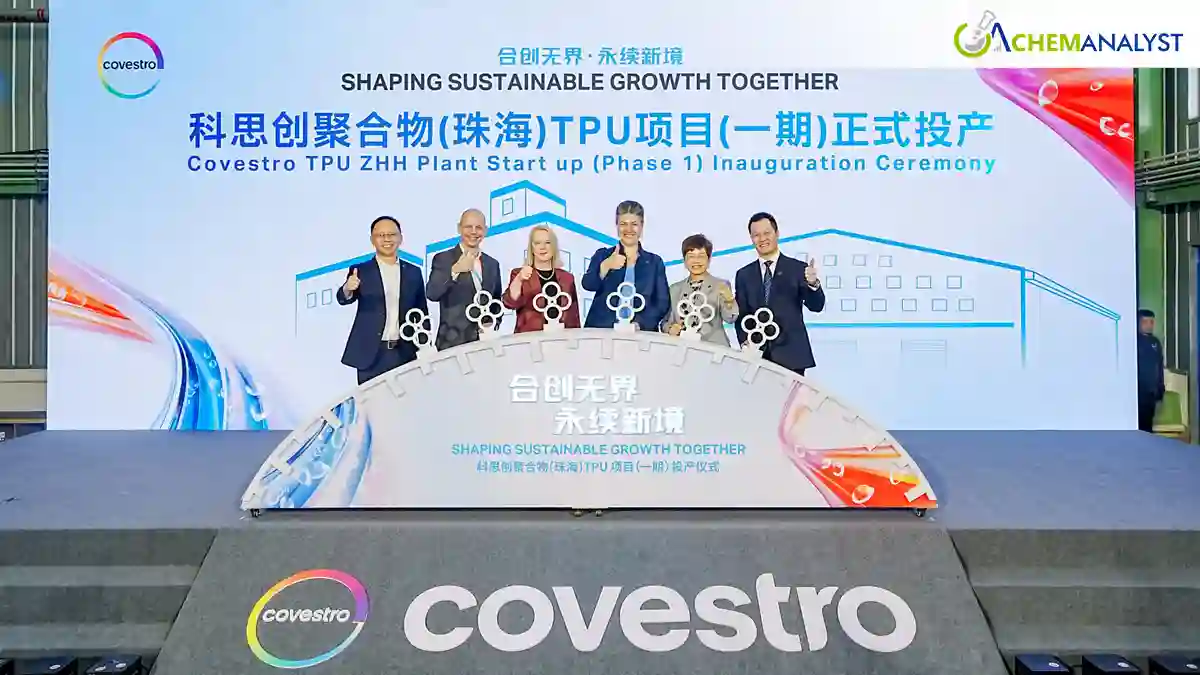
Covestro has officially started operations at its newly built thermoplastic polyurethanes (TPU) production facility in Zhuhai, a prominent coastal city in South China. This marks a major expansion of the company’s manufacturing footprint in the Asia Pacific region and reflects its strategic focus on serving fast-growing end markets more effectively. The first phase of the project represents a mid-double-digit million-euro investment and is designed to deliver an annual production capacity of around 30,000 tons of TPU. These materials are widely used across multiple industries, including information technology, automotive manufacturing, consumer electronics, and footwear, where demand continues to rise steadily.
The Zhuhai facility was initially announced in 2023 and stands as a key milestone in Covestro’s long-term “region-for-region” strategy. This approach emphasizes producing materials close to customer locations, ensuring faster delivery, greater flexibility, and improved responsiveness to local market needs. The site is part of Covestro’s broader growth ambitions within its Solutions & Specialties business, which focuses on high-value, application-driven materials.
Developed across a total area of approximately 45,000 square meters, the Zhuhai site is planned to be constructed in three phases. Once all phases are completed—currently expected in the 2030s—the facility will have a maximum production capacity of up to 120,000 tons of TPU per year. At that point, it will become Covestro’s largest TPU manufacturing site worldwide, reinforcing the company’s leadership position in this segment.
Commenting on the development, Monique Buch, Chief Commercial Officer of Covestro, highlighted the strategic importance of the investment. She noted that the commissioning of the Zhuhai site represents a critical step in Covestro’s growth journey and underscores its commitment to customers across Asia Pacific. By manufacturing TPU solutions closer to key markets, the company aims to enhance service levels, accelerate innovation cycles, and respond more quickly to evolving customer requirements in high-growth industries.
The new production site is supported by a strong regional ecosystem that includes a TPU research and development center in Changhua and a newly established application development (AD) center in nearby Guangzhou. These facilities work in close coordination with the Zhuhai plant, integrating fundamental research, technical expertise, and customer-oriented application testing. This regional setup is expected to create strong synergies, allowing Covestro to develop tailored solutions that meet specific performance, processing, and sustainability requirements.
Dr. Andrea Maier-Richter, Head of TPU at Covestro, emphasized that the Zhuhai site and its supporting R&D and AD capabilities represent state-of-the-art infrastructure. She explained that the expanded production network not only strengthens Covestro’s market position in South China but also enhances its ability to innovate across industries ranging from automotive and consumer electronics to footwear and lifestyle products.
From a regional perspective, the project also reinforces Covestro’s long-term commitment to China. According to Holly Lei, President of Covestro China, the Zhuhai investment aligns closely with China’s high-quality development goals and sustainability agenda. Along with Shanghai, Guangdong—particularly the Greater Bay Area—has now emerged as a strategic hub for Covestro in China, enabling the company to deliver innovative solutions locally while supporting customers across the wider Asian market.
Importantly, the Zhuhai facility is capable of producing TPU grades under Covestro’s “CQ” label. These materials contain at least 25 percent alternative, non-fossil-based raw materials, helping customers reduce the carbon footprint of their end products. This capability is especially relevant for sectors such as electronics and automotive, where sustainability considerations are becoming increasingly central to global supply chains.







Leave a Comment
Comments (0)