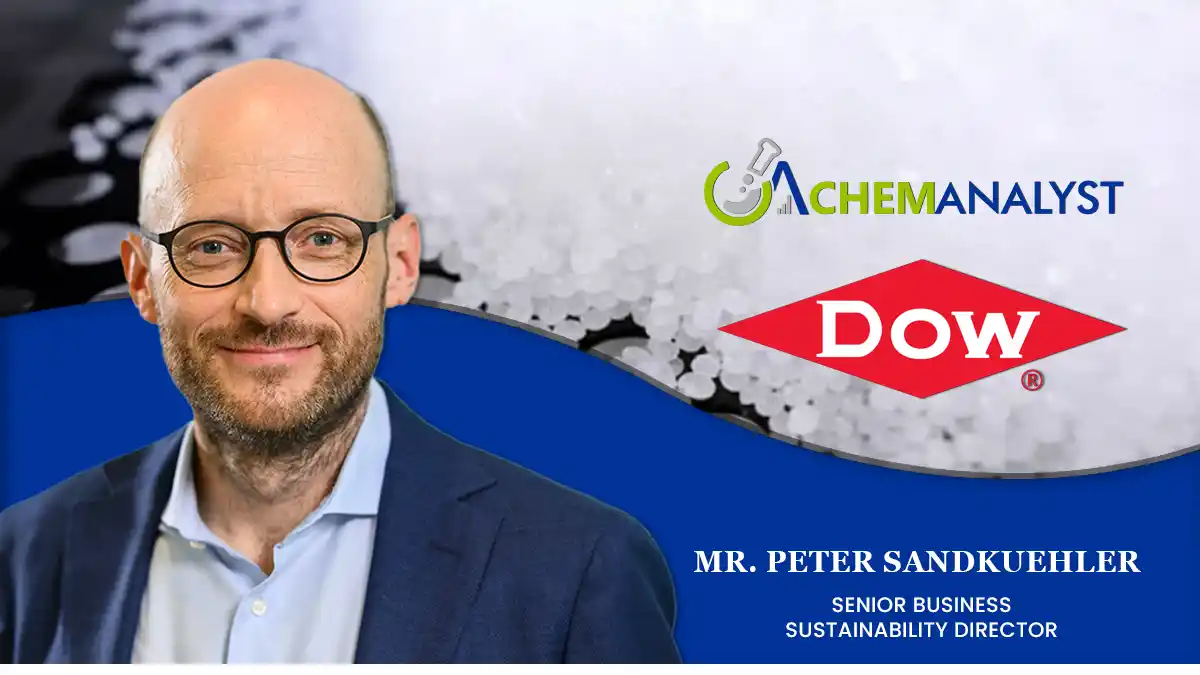
Dow, a global materials science leader, is advancing its low-carbon growth strategy by expanding sustainable materials, circularity solutions, and decarbonized value chains. With strong global scale and integrated manufacturing, the company delivers next-generation materials for packaging, mobility, infrastructure, and consumer markets. Dow is rapidly increasing the use of bio-circular feedstocks, renewable electricity, and advanced technologies to reduce the carbon footprint of elastomers and adhesives. Its long-standing partnership with Henkel further accelerates decarbonization and drives innovation in hot melt adhesives and sustainable elastomer solutions. ChemAnalyst spoke with Mr. Peter Sandkuehler, Senior Business Sustainability Director at Dow, to gain insights into the company’s evolving sustainability agenda, its pioneering work in bio-based materials such as AFFINITY™ RE, and the strategic levers enabling 20–40% product carbon footprint reductions across key adhesive technologies. Sandkuehler shared how his extensive R&D and customer-focused experience has shaped his approach to scaling low-carbon solutions, the decade-long collaboration with Henkel, and Dow’s broader ambition to build a technology-enabled, collaborative ecosystem that accelerates the industry’s transition toward net-zero and circular-economy goals.
Complete Interview with Mr. Peter Sandkuehler
Q: As Senior Business Sustainability Director at Dow, could you provide an overview of your professional journey and leadership experience in the chemicals industry? How have these experiences influenced your strategic vision at Dow, particularly in driving innovation, sustainability, and low-carbon solutions across global materials and care businesses?
Mr. Peter Sandkuehler: I am a chemical engineer by training, and spent my first 15 years at Dow in technical service and R&D. During that time, I collaborated with customers globally across packaging, consumer and sports applications to bring innovative and improved products to market. Many of these innovations were sustainability-driven – initially focused on using less material for a given purpose, and later, on designing products for circularity and advancing recycling technologies. Over the last 5 years, in my current sustainability role, one of my key focus areas has been enabling investments for emission reduction projects by exploring the market demand for low-carbon products and solutions. Working across cutting-edge technologies, innovation, and new business models has given me deep insight into what it takes to turn ideas into reality and create value. And partnerships and collaboration, being aligned in a strategic direction and then making it work, is one critical element on the journey.
Q: Dow and Henkel have maintained a decade-long partnership. How did this collaboration originally begin, and what core values have helped sustain and evolve it over the years?
Mr. Peter Sandkuehler: Our collaboration began years ago with a shared market opportunity and our technical and business teams coming together to turn an idea into reality. From there, we built a relationship founded on trust – growing our businesses by solving challenges together and celebrating successes along the way. It all starts with alignment on key business principles – innovation and creating value for customers drives business growth, supported by a deep commitment to developing the best possible solutions for market needs. Henkel is a leader in their markets, and Dow in ours – making this partnership a powerful combination.
Q: In your view, what distinguishes Henkel as a strategic partner for Dow in advancing sustainability and innovation across multiple business divisions?
Mr. Peter Sandkuehler: Henkel’s long-standing commitment to sustainability and innovation as core pillars of business success aligns closely with Dow’s decades of progress toward sustainability, and continuous investment in innovation. Such strategic alignment fosters trust, deepens collaboration, particularly in enabling and supporting long-term net zero ambitions. Together, we can design practical, meaningful steps to take today, ensuring that each action lays the foundation for future milestones and accelerates the journey towards a sustainable future.
Q: How has the partnership in hot melt adhesives created unique value that wouldn’t be achievable through standalone initiatives?
Mr. Peter Sandkuehler: Dow’s advanced materials and Henkel’s expertise in hot melt adhesives have enabled a level of innovation that would not be possible independently. To achieve further improvements in end-product performance, collaboration must begin much earlier in the innovation process. This joint approach has driven the development of new adhesive formulations, establishing the foundation of our hot melt innovation partnership.
Today, sustainability has become an integral part of these innovation processes. A key dimension is Dow’s commitment to deliver low carbon products to our customers. Dow supports Henkel by decarbonizing production and raw materials through renewable electricity and low-carbon feedstocks. In turn, Henkel provides its customers with best-in-class low-carbon solutions, reinforcing both companies’ efforts to reduce emissions further. This synergy strengthens Henkel’s value proposition while amplifying Dow’s climate objectives.
At its best, this partnership combines business success with the opportunity to significantly reduce emissions across the value chain – helping both companies meet ambitious climate targets.
Q: The launch of bio-based AFFINITY™ RE is a notable milestone. Could you share the innovation process and key challenges in developing a bio-based elastomer that matches the performance of fossil-based alternatives?
Mr. Peter Sandkuehler: The launch of bio-based AFFINITY™ RE represents a significant milestone in sustainable innovation. At Dow, the key advantage of our process lies in the ability to replace virgin fossil-based feedstocks with bio-circular alternatives. These second-generation biobased feedstocks are derived from waste sources and do not compete with food.
Currently, Dow utilizes several biobased feedstocks, all certified under ISCC PLUS to ensure chain of custody and full traceability using the mass balance credit method. A critical step in the innovation process is ensuring that biobased feedstocks meet the stringent specifications required for Dow’s raw materials, enabling seamless integration into our existing elastomer production processes and ensuring that AFFINITY™ RE delivers performance equivalent to fossil-based alternatives, without compromise.
Q: What differentiates AFFINITY™ RE and other sustainable elastomers in terms of carbon impact, scalability, and commercial viability?
Mr. Peter Sandkuehler: Elastomers produced from biobased feedstocks have a significantly lower carbon footprint (between 25-40%) compared to those made from fossil-based sources. This is due to the inherently lower product carbon footprint of most biobased feedstocks and the presence of biogenic carbon – the CO2 originally absorbed by plants – which remains embedded in the product. If the material is recycled at end-of-life, this biogenic carbon is not re-released into the atmosphere, delivering a clear climate benefit.
There is a growing demand for renewable (biogenic) carbon in elastomers and hot melt adhesives, and commitment from these end markets has enabled successful implementation, creating a commercially viable pathway for sustainable innovation.
Q: Henkel and Dow have expanded their partnership to accelerate decarbonization in adhesives manufacturing. What prompted this expansion, and why are adhesives a strategic focus area for sustainability?
Mr. Peter Sandkuehler: For both Henkel and Dow, adhesives are a strategically important business segment. Both companies have clear climate and emissions reduction targets, so collaborating to accelerate decarbonization was a natural step.
This partnership goes beyond renewable carbon use. Together, we identified opportunities to reduce emissions across the broader market, including sourcing feedstocks with lower carbon footprints and implementing the use of low-carbon electricity in elastomer production. To create a larger impact, both companies recognized the need for additional levers to decarbonize our portfolios beyond biobased elastomers. Adhesives represent a critical area where these efforts can deliver meaningful change, given their widespread application and influence across industries.
Q: The initiative targets a 20–40% reduction in product carbon footprint through low-carbon feedstocks and renewable electricity. Could you elaborate on how these levers are implemented across hot melt adhesive technologies?
Mr. Peter Sandkuehler: We use two key levers to achieve a 20–40% reduction in product carbon footprint for AFFINITY™ GA Polyolefin Elastomers (POEs):
• Renewable electricity: We utilized renewable electricity at the sites where AFFINITY™ GA is produced. This significantly reduces the emissions associated with energy-intensive processes.
• Low-carbon feedstocks: We identified a source for a waste-based feedstock that has a lower carbon footprint than virgin fossil-based sources and were able to use that in our production process.
With these levers, the AFFINITY™ GA product carbon footprint was significantly reduced, and Henkel was able to use these reductions in the production of their hot melt adhesive product range.
Q: How does this partnership align with broader industry climate goals, including Scope 3 reduction targets for 2030 and 2050, and how does it complement Dow’s decarbonization strategy?
Mr. Peter Sandkuehler: This partnership directly supports broader industry climate goals, including Scope 3 reduction targets for 2030 and 2050, while complementing Dow’s decarbonization strategy in several ways:
• Driving scalable decarbonization: Achieving meaningful reductions at scale depends on market demand and investment in low-carbon production technologies. By collaborating with Henkel, we demonstrate that such solutions are commercially viable and can be implemented today.
• Verification and accountability: Progress must be measurable and auditable. Dow prioritizes transparency in tracking emissions reductions to ensure alignment with both our own targets and those of our partners, reinforcing trust and credibility across the value chain.
• Proactive leadership: Rather than waiting for industry shifts, Dow takes an active role in shaping the sustainability ecosystem. Our approach focuses on creating tangible emission reductions and value throughout the supply chain, setting new benchmarks for climate action.
By adopting this proactive stance, we position ourselves as a leader in driving change – fostering innovation, influencing industry standards, and accelerating progress towards global climate commitments.
Q: The program initially focuses on Europe, with plans to expand to North America. What considerations go into scaling low-carbon solutions across geographies and diverse value chains?
Mr. Peter Sandkuehler: Scaling low-carbon solutions across regions and diverse value chains requires more than technology – it demands a strong, collaborative ecosystem. Success hinges on aligning multiple factors: investment in advanced technologies, market readiness, customer demand, agile commercial models, incentives, and a shared approach to carbon accounting. Collaboration across the value chain is therefore essential to drive meaningful progress.
Europe was our starting point because Dow had key enablers ready for use – such as renewable electricity deployed at several Dow sites and access to low-carbon feedstocks – combined with customer demand for low-carbon solutions. As we expand to North America, we are actively developing suitable decarbonization strategies for the products we supply to Henkel and for Dow’s production footprint in other geographies and businesses. This ensures that each region’s unique infrastructure and market dynamics are addressed effectively.
Q: Henkel and Dow presented their progress at K2025. How do events like these help drive dialogue, showcase innovation, and accelerate adoption of sustainable solutions in the adhesives industry?
Mr. Peter Sandkuehler: Trade shows like K2025 and other key industry events and conferences bring together decision makers, innovators, and stakeholders from across the value chain, creating a unique platform for dialogue and collaboration. These forums enable us to learn about and explore new concepts, cutting edge innovations, and engage in direct dialogues that go far deeper than what’s possible via other channels. While K2025 is not specific to adhesives, its broad focus on chemicals and plastics allows to leverage ideas and diverse perspectives to accelerate the adoption of sustainable solutions across industries and value chains.
Q: Is Dow leveraging any procurement or market intelligence tools to monitor raw material pricing, supply chain volatility, and emerging trends—particularly for low-carbon feedstocks and renewable materials used in adhesives? How does this data inform your strategic sourcing and product development decisions?
Mr. Peter Sandkuehler: Dow employs various proprietary tools to strategically understand the dynamics in raw material markets, and in general relevant market trends across all the major markets Dow is serving with our material science solutions. These market trends are analyzed by applications like adhesives, or as well mobility and packaging, and drive strategic alignment across the company.







Leave a Comment
Comments (0)