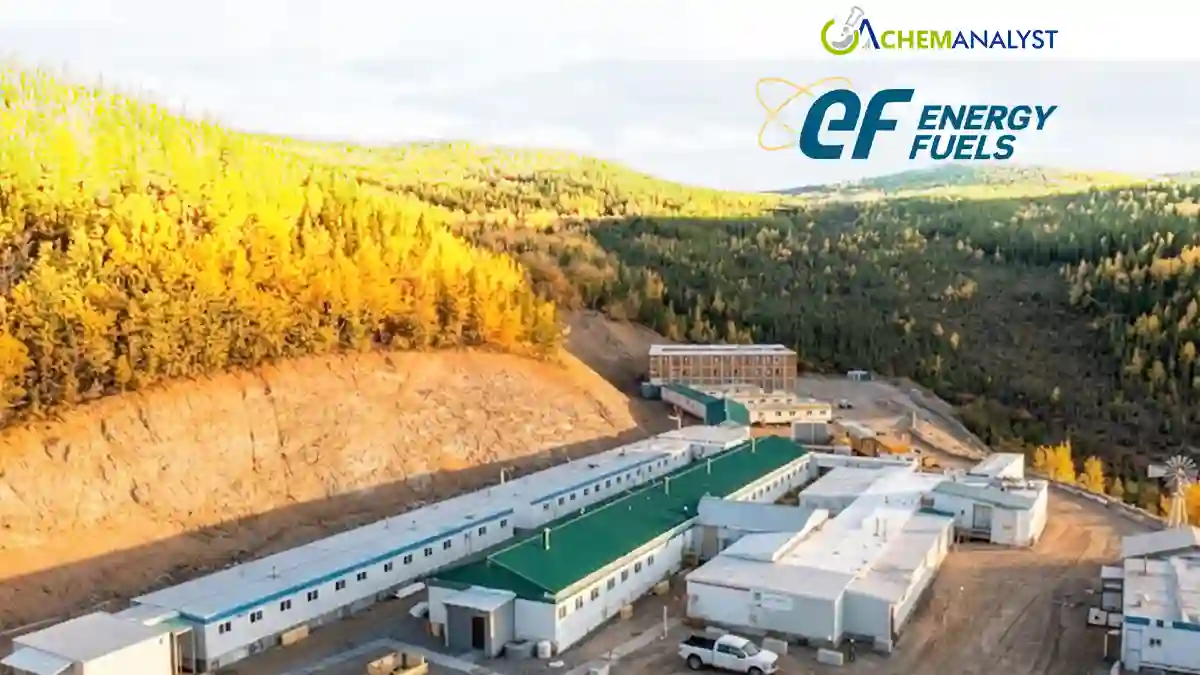
Energy Fuels Inc. has started construction on a major expansion of its White Mesa Mill in Utah to establish commercial-scale production of heavy rare earth oxides. The project marks a significant milestone in the company's strategy to build an integrated Western mine-to-magnet supply chain that supports industries such as electric vehicles, robotics, data centers, renewable energy, and defense.
The expansion will add heavy rare earth processing capabilities to the mill's existing light rare earth oxide production. According to the company, commercial production of heavy rare earth oxides addresses a major supply bottleneck in North America and Europe, where dependence on imported rare earth materials remains high. The company has already demonstrated successful pilot-scale production and is now moving toward full-scale operations.
Once completed, the facility will have the capacity to produce approximately 20 tonnes per year of terbium oxide, 120 tonnes of dysprosium oxide, 140 tonnes of samarium oxide, 20 tonnes of europium oxide, and 140 tonnes of gadolinium oxide. Terbium and dysprosium are particularly important for manufacturing high-performance permanent magnets that improve electric motor efficiency, enhance heat resistance, and enable lighter, more compact designs.
The first phase of the expansion, including terbium and dysprosium processing circuits, is expected to become operational by the end of 2027. Additional circuits for samarium, europium, and gadolinium are scheduled for completion by the end of 2028.
The project is designed to process monazite concentrate from the Donald Project joint venture in Australia, which is expected to begin production in 2028, subject to a final investment decision. The anticipated feedstock, combined with third-party supply agreements, is expected to fully utilize the expanded production capacity. The resulting rare earth oxides will support downstream operations, including metal and alloy production in South Korea and permanent magnet manufacturing in the United States through Energy Fuels' proposed acquisitions of Australian Strategic Materials and Vacuumschmelze.
In addition to rare earth processing, the expansion will incorporate a mixed rare earth carbonate processing circuit, enabling the facility to process a wider range of global feedstocks while simultaneously producing uranium and rare earth oxides.
The expansion carries an estimated capital investment of approximately $104 million. Funding is expected to come through a combination of U.S. government loans, grants, and the company's strong cash position. Looking ahead, Energy Fuels plans a second expansion in 2029 that would significantly increase production capacity and create an integrated supply chain capable of supporting manufacturing volumes for millions of electric vehicles, industrial robots, wind turbines, and other advanced technologies annually.
Impact on Product and Chemical Commodity Prices
The expansion will strengthen the long-term availability of heavy rare earth oxides, particularly dysprosium, terbium, samarium, europium, and gadolinium, which are essential for high-performance permanent magnets used in electric vehicles, wind turbines, robotics, and defense applications. While the project will not affect supply immediately, it is expected to improve future supply security outside China and reduce long-term supply risks. For ChemAnalyst-tracked commodities, rare earth oxide prices may remain firm in the near term due to limited global production. However, as new commercial capacity comes online between 2027 and 2029, prices of selected heavy rare earth oxides could gradually stabilize amid improving supply fundamentals.






Leave a Comment
Comments (0)