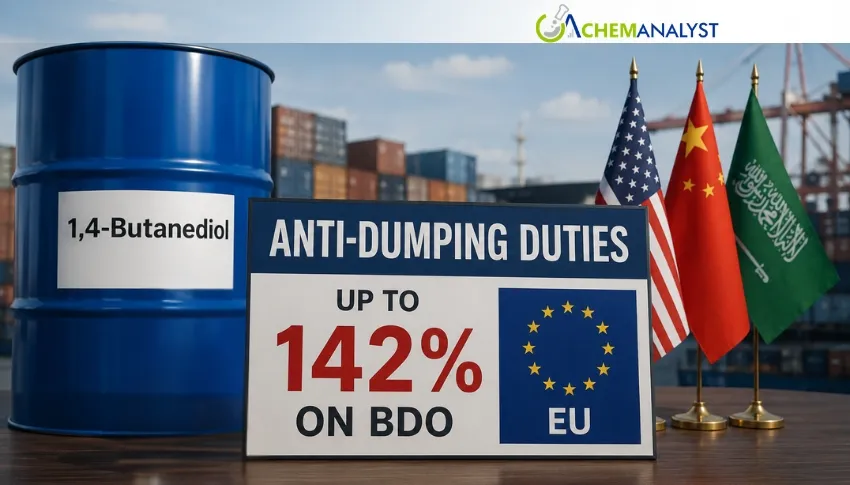
The European Union has slammed the door on its three largest external sources of 1,4-Butanediol, imposing definitive anti-dumping duties of as much as 142.5% on BDO imported from China, Saudi Arabia and the United States — a decision that effectively prices the three origins out of the European market and forces a structural redrawing of the region's diol supply map.
Commission Implementing Regulation (EU) 2026/1373, adopted on 22 June 2026 and published in the Official Journal on 24 June, confirms and makes permanent the provisional duties that had been in place since February. It applies to BDO under CAS number 110-63-4 (CN codes 2905 39 26 and 2905 39 28) and entered into force the day after publication. The provisional duties already collected will be definitively retained up to the new rates, with any excess released.
For BDO buyers and the THF, PBT, spandex and polyurethane chains that sit downstream, this is one of the most consequential European trade-defence actions in the diols space in years. The duties don't shave a few points off landed cost — at these levels they remove Chinese, Saudi and US material from competitive consideration almost entirely.
The duty rates
The definitive duties, applied to the net free-at-frontier price before customs duty, are steep across the board, though the level varies sharply by origin and producer:
|
Origin |
Company |
Definitive AD duty |
|
China |
Wanhua Chemical (Sichuan) |
113.70% |
|
China |
Xinjiang Markor Chemical Industry |
105.60% |
|
China |
Other cooperating producers |
107.50% |
|
China |
All other imports |
113.70% |
|
Saudi Arabia |
International Diol Company (Sipchem) |
52.40% |
|
Saudi Arabia |
All other imports |
52.40% |
|
United States |
Lyondell Chemical Company |
135.70% |
|
United States |
All other imports |
142.50% |
A nuance worth flagging for anyone modelling landed cost: the headline dumping margins were far higher than the duties actually imposed — Chinese margins ran as high as 522% and US margins above 135% — but the EU's lesser-duty rule capped most rates at the level needed to remove injury rather than the full dumping margin. Saudi Arabia is the exception that proves the rule: its duty of 52.4% reflects a comparatively low dumping margin, which fell below its injury margin and therefore became the binding constraint. The practical upshot is that Saudi BDO, while still heavily penalised, lands at less than half the duty burden of US or Chinese material.
Why the measures landed
The case was brought in April 2025 by INEOS Solvents, on behalf of a Union industry of four BDO producers — INEOS, Novamont, BASF and the European arm of LyondellBasell. The investigation, covering calendar year 2024, found that cumulated imports from the three origins had inflicted material injury on EU producers, principally through price depression and collapsing profitability.
The backdrop is chronic Chinese overcapacity. China accounts for well over half of global BDO capacity, much of it built on coal-based acetylene and Reppe-route economics, and persistent oversupply has pushed Chinese producers into loss-making territory and out into export markets. The Commission found China to be the price-setter on the European market, with Saudi and US sellers tracking the same depressed price levels — the textbook conditions for a cumulative injury finding. EU producers were left carrying roughly 60% spare capacity through the investigation period, unable to cover their own production costs against the imported tide, and in INEOS's case idling capacity altogether.
What it means for European supply
The immediate effect is a tighter, more regionally concentrated European BDO market. Provisional duties had already begun curbing Chinese inflows and firming Northwest European availability through the first quarter of 2026; the definitive measures cement that shift for the duration of the duties, which ordinarily run for five years subject to review.
With China, Saudi Arabia and the US effectively walled off, European buyers have two realistic levers. The first is non-duty import origins — South Korea and Taiwan, home to integrated producers such as Hyosung and Dairen, which the Commission itself pointed to as available alternatives. Expect those origins to command a scarcity premium as flows redirect. The second is restarting domestic capacity: INEOS has signalled a BDO production restart in 2026 targeting a 70–90% operating rate, BASF is lifting output at Ludwigshafen, and Novamont's bio-based BDO adds a smaller, sustainability-linked stream. Whether that restored European supply can cover demand without the cushion of imports — and how quickly — is the central question for procurement teams over the next several quarters.
The directional read is clear: less import competition, a structurally tighter balance, and firmer European BDO pricing than the depressed levels of 2023–2024. This is precisely what trade defence is designed to do, and buyers should plan their 2026–2027 contracts around a higher, more domestically anchored price floor.
The downstream squeeze
The harder story sits one step down the chain. BDO is the gateway molecule to tetrahydrofuran (THF) and onward to PTMEG for spandex, to PBT engineering resins for automotive and electronics, to gamma-butyrolactone, and to thermoplastic polyurethane and PU dispersions. European converters — among them Lubrizol and Covestro in TPU and PUD, and Envalior in PBT and THF — pushed hard during the investigation, warning that higher BDO costs erode their competitiveness against imported finished polymers, particularly Chinese PBT.
The Commission acknowledged the tension but came down firmly on the side of the Union producers, finding that BDO represents on average around 14% of downstream product cost — higher for PBT specifically — and that most BDO derivatives remained profitable. Critically, it declined to extend protection to the downstream products themselves, and rejected requests for a tariff-free quota mechanism of the kind granted in the recent fused-alumina case. That leaves European PBT, THF and TPU producers absorbing higher feedstock costs without a parallel shield on their own output against imported finished goods — a competitive asymmetry that bears watching, and a plausible trigger for downstream margin pressure or sourcing shifts toward Korea and Taiwan.
Undertakings rejected, no retroactivity
Both Lyondell and Sipchem's International Diol Company offered price undertakings to avoid the duties; the Commission rejected both. Lyondell's proposal — a duty-free quota for emergency supply to its European affiliate during outages — was deemed unworkable to monitor and contrary to the basic requirement that an undertaking eliminate injurious dumping. IDC's minimum-import-price offer, even with a butane-cost adjustment mechanism, was rejected over the cross-compensation risk inherent in the Sipchem group's multi-product sales channels. The Commission also declined to collect duties retroactively, finding no further substantial rise in imports after the investigation period.
What to watch
Three things will tell the story from here. First, the pace and reliability of restored European supply — the INEOS restart and BASF ramp are the swing factors in whether the market tightens smoothly or sharply. Second, the redirection of trade toward South Korea and Taiwan, and whether those origins absorb the displaced volume or simply re-price. Third, the downstream response: if European PBT and TPU producers cannot pass through higher BDO costs, the competitive pressure the converters warned of could begin to materialise in 2026–2027. Layer on China's removal of BDO export VAT rebates and the broader carbon-cost drift on coal-based diols, and the structural case for firmer, more regionally sourced European BDO only strengthens.
For now, the message to the European diols market is unambiguous: the era of cheap, import-led BDO is over, and the price of supply security is a tighter, more expensive, and more domestically anchored market.







Leave a Comment
Comments (0)