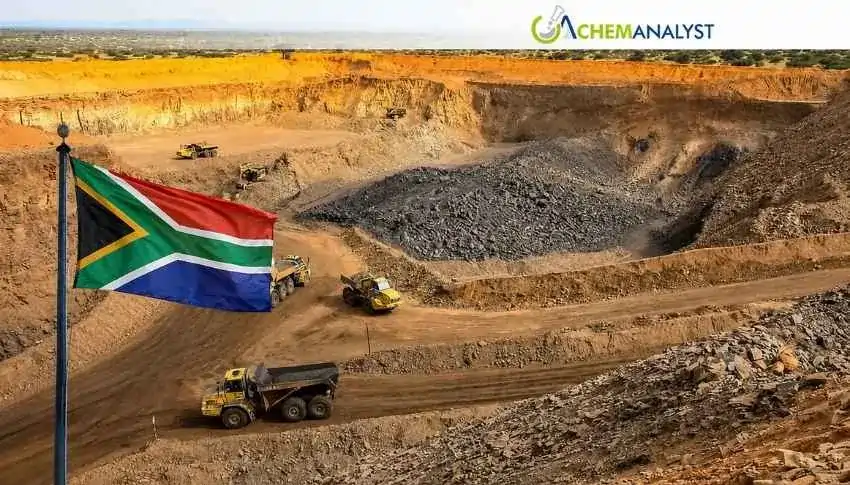
The European Union has launched a significant investment roadshow in South Africa, advancing a EUR12 billion (USD13.98 billion) plan aimed at bolstering the critical minerals sector and fostering industrial development in the Southern African nation. This initiative, part of the 2025 EU-South Africa Clean Trade and Investment Partnership (CTIP), saw approximately 200 companies attend events in Johannesburg, Cape Town, and Durban, seeking to translate the investment pledge into concrete projects.
The primary driver behind this substantial investment is the EU's strategic imperative to diversify its critical mineral supply chains. Following disruptions and export restrictions from countries like China, particularly on minerals vital for military applications, renewable energy technologies, artificial intelligence, and advanced manufacturing, the EU is keen to reduce its dependence on single suppliers. European policymakers, having learned lessons from past reliance on Russian energy, view South Africa as a crucial partner in securing essential raw materials such as platinum group metals, manganese, and vanadium.
For South Africa, the partnership offers a significant opportunity to move beyond merely exporting raw materials. The country's Trade, Industry and Competition Minister, Parks Tau, emphasized a strong commitment to "beneficiation, processing, and industrial development on South African soil". This aligns with a broader trend across Africa to capture more value from natural resources through local manufacturing, refining, and processing industries. The EUR12 billion investment is expected to support mining, processing, and industrial development, creating jobs and stimulating economic growth within South Africa.
Beyond critical minerals, the EU's plan also encompasses support for South Africa's green energy, port, and railway infrastructure projects. Existing agreements under the partnership include a EUR600 million framework loan to the Development Bank of Southern Africa for 1,200 megawatts of renewable energy capacity and a EUR1.48 billion financing facility for Transnet to modernize the country's rail and port infrastructure. These investments are integral to South Africa's Just Energy Transition, aiming to shift away from coal-dominated electricity production towards cleaner energy systems.
Geopolitically, this partnership underscores intensifying global competition for critical minerals, with Africa's resource development and local processing capacity gaining increasing importance. The EU, as South Africa's largest trade and investment partner, with bilateral trade reaching EUR46 billion in 2025 and over 1,700 European companies operating in the country, is shifting its engagement from traditional development assistance to investment-driven partnerships. This strategic collaboration aims to create a more diversified and resilient global mineral supply chain while fostering sustainable development and industrialization in South Africa.








 About ChemAnalyst
Leave a Comment
Comments (0)