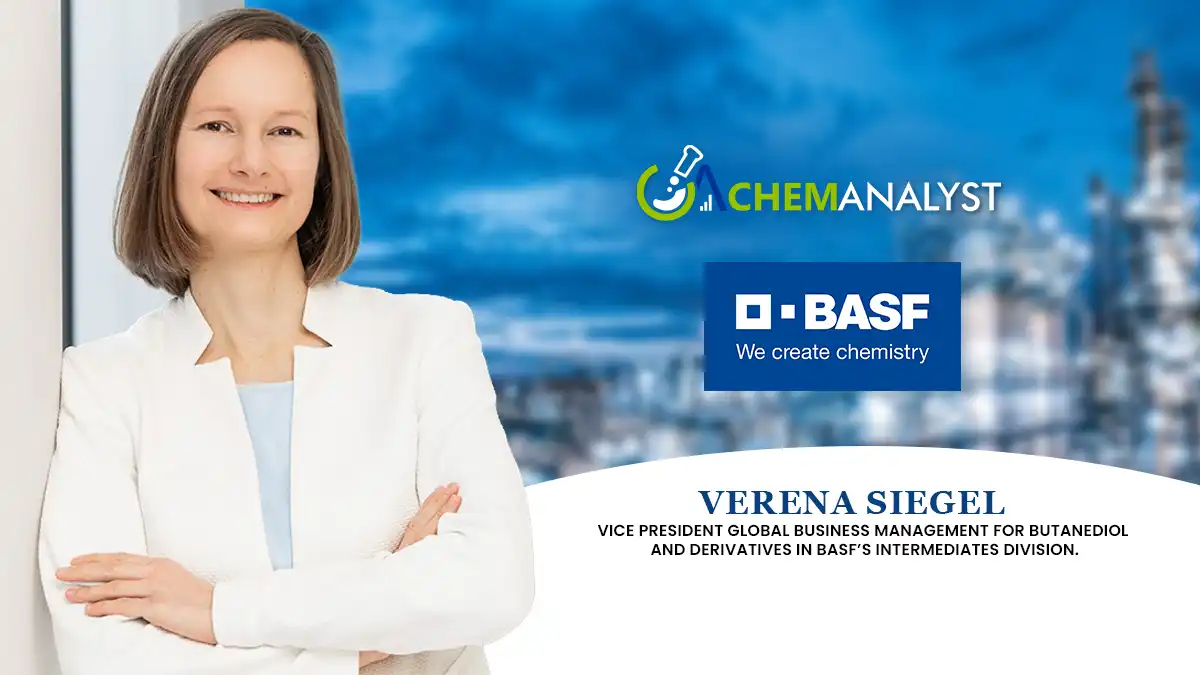
ChemAnalyst Talks with Verena Siegel, Vice President Global Business Management for Butanediol and Derivatives in BASF’s Intermediates division
BASF, a global leader in the chemical industry, is committed to creating chemistry for a sustainable future by combining economic success with environmental protection and social responsibility. With a workforce of around 108,000 employees worldwide and a presence across nearly all industries and regions, BASF aims to be the preferred chemical company enabling its customers’ green transformation. Its diversified portfolio spans core segments including Chemicals, Materials, Industrial Solutions, and Nutrition & Care, alongside standalone businesses in Surface Technologies and Agricultural Solutions. In 2025, the company reported sales of approximately €60 billion, reflecting its strong global footprint and integrated business model. ChemAnalyst spoke with Verena Siegel, Vice President Global Business Management for Butanediol and Derivatives in BASF’s Intermediates division, to discuss the company’s strategy for advancing low-carbon intermediates such as BDO, THF, PolyTHF®, and NMP. She highlighted the introduction of reduced Product Carbon Footprint (rPCF) variants as a key step in BASF’s broader decarbonization roadmap, offering customers cost-effective solutions to reduce Scope 3 emissions without compromising product performance. Siegel also elaborated on BASF’s focus on CO2 management, mass-balance approaches, and low-emission feedstocks, as well as the importance of transparency through certified carbon footprint methodologies and third-party validation. Additionally, she shared insights on growing demand for sustainable intermediates across industries including automotive, textiles, electronics, and batteries, and emphasized BASF’s strong global production network and Verbund integration in ensuring reliable supply and long-term market resilience.
Complete Interview with Verena Siegel
Q: As Vice President of Global Business Management for Butanediol and Derivatives at BASF’s Intermediates division, could you provide an overview of your professional journey within the chemical industry and your leadership experience in Intermediates and sustainable chemical solutions? How have these experiences shaped your strategic vision for advancing lower-carbon intermediates such as BDO, THF, PolyTHF® and N-methyl-2-pyrrolidone (NMP), and for strengthening BASF’s role in enabling more sustainable value chains across multiple industries?
Verena Siegel: I joined BASF in 2001 through the company’s International Business Traineeship Program, with assignments in Ludwigshafen and Buenos Aires. Since then, I have held a range of roles across Europe, North America, and Asia. These include Product Management for Amines, leading the Product Management team for Intermediates China in Shanghai, positions in BASF’s Corporate Strategy department, and shaping the Petrochemicals division’s global strategy for Basic Petrochemicals and CO2 Management. Since 2026, I have been heading Global Business Management for Butanediol and Derivatives. Working across different regions and businesses has shown me how important it is to understand evolving customer needs and connect them with meaningful CO2 reduction measures. These experiences shaped my conviction that intermediates like BDO, THF, PolyTHF® and NMP can play a decisive role in enabling entire value chains transition to lower carbon materials, without compromising performance or reliability. Our new rPCF variants are a concrete example of this approach.
Q: BASF recently introduced rPCF variants of BDO, THF, PolyTHF® and NMP. What strategic role do these lower-carbon intermediates play in BASF’s broader decarbonization roadmap and portfolio transformation?
Verena Siegel: In BASF’s intermediates division, we aim to be the preferred partner for sustainable intermediates for our customers. With a focus on CO2 management, recycled and renewable carbon, we offer products which support our customers in achieving their sustainability goals. The introduction of rPCF variants is an important step in our broader decarbonization journey. They strengthen our portfolio which already includes Standard, BMBcert®, Biobased, and ChemCycling® solutions, and expand it with a new, cost competitive solution. This variety enables our customers to choose the option that best supports their own sustainability goals and fits their needs.
Q: How does the introduction of rPCF variants strengthen BASF’s position in the global intermediates market and support customers’ sustainability goals across industries such as automotive, textiles, electronics, and pharmaceuticals?
Verena Siegel: In addition to what I said before, we see a growing interest across major industries when it comes to reducing CO2 emissions in the value chain. With our rPCF variants, we offer our products with at least 10% product carbon footprint reduction compared to our BASF standard products from Ludwigshafen. For our customers, this offers a practical, immediate lever to reduce upstream Scope 3 emissions while maintaining the same quality and reliability they expect from BASF. For us, it reinforces our position as a global leader for intermediates and supports our ambition to be the preferred partner for sustainable intermediates.
Q: From a long-term perspective, how important are low-carbon chemical intermediates in enabling downstream industries to reduce Scope 3 emissions, and how does BASF plan to expand this rPCF product portfolio in the coming years?
Verena Siegel: Many customers are increasingly seeking cost-competitive products with a lower carbon footprint to help reduce their Scope 3 emissions and fulfill their corporate sustainability targets. Our intermediates are at the beginning of several value chains, and as such, they contribute to the overall downstream CO2 emissions. We are still at the beginning of this new product offering. After launching NEOL® NPG rPCF AP from Zhanjiang in October, we have now introduced rPCF variants of BDO, THF, PolyTHF® and NMP. We plan to expand the rPCF category as further technically and economically viable PCF reduction opportunities become available.
Q: BASF states that the reduced carbon footprint is achieved through low-emission feedstocks and utilities at its Verbund site in Ludwigshafen. Could you elaborate on the key technologies and process innovations enabling this reduction?
Verena Siegel: Our rPCF products are technically identical to our BASF standard products and offer the same quality and performance. Their cradle to gate carbon footprint, which is at least 10% lower than that of our standard products produced in Ludwigshafen, results from active measures: specifically, the use of low emission fossil feedstocks attributed to the products via a mass balance approach, and low emission utilities within our own production assets.
Q: How does BASF verify and measure the product carbon footprint (PCF) of these intermediates, and what certification or transparency mechanisms are in place to assure customers of these reductions?
Verena Siegel: When we talk about the PCF values of our products, including for rPCF products, we rely on validated internal calculations based on BASF’s certified PCF methodology called SCOTT.* This is the same methodology we use across the company, and it follows the requirements of ISO 14067:2018 as well as the Together for Sustainability PCF Guideline. For the rPCF variants of BDO, THF, PolyTHF® and NMP, we are now taking the next step: the product specific PCF calculations are currently undergoing an additional third party review by TÜV Rheinland. Once completed, customers will receive the corresponding PCF report certificates.
Q: What is your outlook for the global BDO value chain, including THF and PolyTHF®, particularly in sectors such as spandex fibers, thermoplastic polyurethanes, and engineering plastics?
Verena Siegel: BDO, THF, PolyTHF® and NMP are essential raw materials used across a wide range of industries, from spandex fibers and TPU to engineering plastics and pharmaceuticals. Demand fundamentals remain robust, particularly as customers increasingly look for highquality materials with reliable supply and credible sustainability attributes. Earlier this year, we announced that we are increasing BDO production in Ludwigshafen to further strengthen supply security in Europe. As a major Western producer of BDO and its derivatives, BASF plays an important role in providing reliable, local supply for customers, especially in periods of market uncertainty. Our global footprint, with production sites in Europe, North America and Asia, enables us to reliably serve customers around the world. By leveraging our strong backward integration across the acetylene value chain, we are well positioned globally to support longterm growth and stability for both our customers and our business.
Q: Which industries or regions are showing the strongest interest in low-carbon intermediates, and how significant is sustainability becoming as a purchasing criterion for customers?
Verena Siegel: Overall, we see growing demand from both global and regional players for intermediates with a reduced carbon footprint across major industries, from automotive and electronics to consumer goods and textile value chains. More specifically, we see Europe as a front-runner, while other regions are steadily making progress. In BASF’s Intermediates division, our ambition is to be the preferred partner for sustainable intermediates for our customers and to support our customers in their sustainability transformation. Our rPCF products help the industry on this journey: they rely on low emission feedstocks and utilities and provide measurable PCF reductions without requiring cost-intensive process changes. This contributes to making sustainability progress more affordable at scale.
Q: The ongoing geopolitical tensions and conflict across the Middle East have raised concerns about disruptions in global energy markets and chemical supply chains. In your view, how could such developments influence the availability of feedstocks, supply dynamics, and pricing trends for BDO and its derivatives across global markets?
Verena Siegel: We cannot speculate about potential developments in the industry. What we can say is that BASF leverages from a very robust global and regional presence. Our global footprint and integrated Verbund structure provide relative stability and enable us to serve our customers even in more volatile environments.
Q: Demand for NMP has been influenced by its growing use in lithium-ion battery production and electronics. How do you see this application segment shaping the future growth of NMP?
Verena Siegel: NMP plays an essential role in lithium ion battery electrode production and in advanced electronics, and both application areas continue to grow rapidly. We see a momentum here, not only in terms of volume but also regarding rising sustainability expectations. More and more customers are seeking solvents with a reduced product carbon footprint to support their own sustainability targets. Our rPCF NMP addresses exactly this need. Because it is a true drop in solution with unchanged performance, customers can use it immediately without adapting their processes while at the same time lowering their upstream Scope 3 emissions. This makes NMP rPCF a very relevant option for battery and electronics producers as these markets continue to scale.
Q: With BASF operating significant BDO and PolyTHF production capacity globally, how do you assess the current supply–demand balance in the intermediates market?
Verena Siegel: BASF is one of the world’s leading producers of BDO and PolyTHF®, with large-scale, highly integrated capacities in Europe, North America, and Asia. While we do not comment on detailed market balances, our global footprint and Verbund model allow us to serve customers reliably even in dynamic market environments.







 About ChemAnalyst
Leave a Comment
Comments (0)