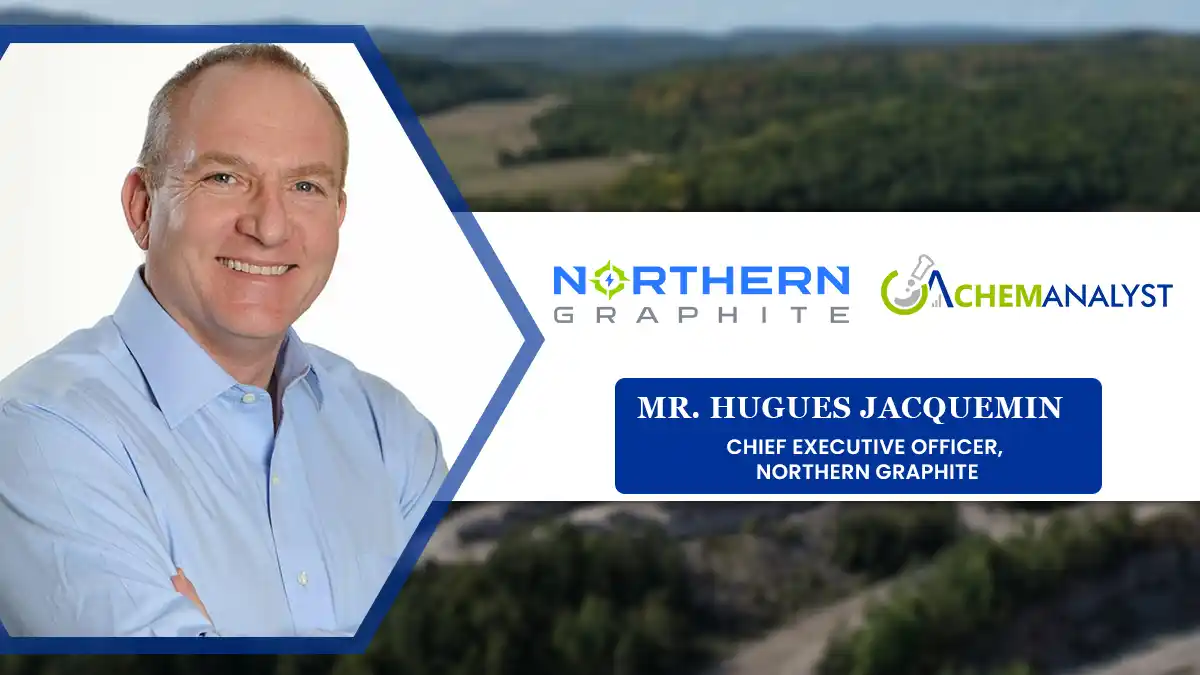
ChemAnalyst Talks with Mr. Hugues Jacquemin, Chief Executive Officer, Northern Graphite
Northern Graphite, a TSX Venture Exchange-listed company, is the only flake graphite producer in North America, focused on developing a fully integrated mine-to-battery supply chain. The company is advancing the production of high-value graphite materials for lithium-ion batteries, EVs, and other clean energy applications, supported by its Battery Materials Group and a state-of-the-art laboratory in Frankfurt. Its key assets include the Lac des Iles mine in Quebec, the Bissett Creek project in Ontario, and the Okanjande mine in Namibia. ChemAnalyst spoke with Hugues Jacquemin, CEO of Northern Graphite, about the company’s strategy to build a sustainable, non-China graphite supply chain, its focus on innovative processing and recycling technologies, and its expansion plans, including a planned battery anode material facility in Saudi Arabia.
Complete Interview with Mr. Hugues Jacquemin
Q: Please outline your professional journey in the graphite and battery materials sector, and explain how your experience has shaped Northern Graphite’s strategic vision of becoming a mine-to-battery supplier for the global energy transition.
Mr. Hugues Jacquemin: My vision for turning Northern Graphite into a fully integrated, mine-to-battery company has been informed by over 30 years in the industrial minerals space, including in graphite mining and processing, graphene and carbon nanotubes, synthetic graphite and carbon materials; as the former CEO of the Graphite and Carbon Division of Imerys SA, I spearheaded the investment program for Li-ion battery material for the EV markets. Before becoming CEO of Northern Graphite in June 2022, I acted as an independent advisor to the Company as it acquired the graphite mining assets of Imerys and went from being an explorer to a producer of graphite, the leading component of lithium-ion batteries. We followed that in early 2024 with the launch of our Battery Materials Division, through the acquisition of the assets and R&D team of the battery division of Germany’s Heraeus Group, which included a team of PhDs and a state-of-the-art laboratory. We are now moving toward becoming a full producer of battery anode material by 2028, when our Yanbu plant, the first of three planned facilities, is forecast to start production. Our objective is to become the largest producer of battery anode material outside of China that is made from natural graphite.
Q: What is the strategic rationale behind Northern Graphite’s participation in the German-funded USE-G R&D program, and why is this initiative particularly important for strengthening Europe’s battery materials ecosystem today?
Mr. Hugues Jacquemin: Northern Graphite plans to build up a Western supply chain to produce graphitic battery anode materials (BAM). Participating in several funding projects, like USE-G, helps to build up and deepen the relationship between our partners like Rain Carbon or H.C. Starck Tungsten. Additionally, the cooperation with the University of Jena helps us to work on new topics which are more present in academia and which might become relevant in a few years for us. With our partners, we will address all key aspects of BAM processing, from milling and shaping to purification, sustainable coating and recycling of BAM in one project. The recycling of BAM in this project is especially crucial to strengthening Europe’s battery material ecosystem.
Q: From a technology standpoint, how do the purification, coating, shaping, and recycling innovations being developed under USE-G differentiate themselves from existing graphite processing routes, particularly those currently dominated by Chinese supply chains?
Mr. Hugues Jacquemin: The purification in China is usually carried out with hazardous hydrofluoric acid, which works well and is easy to carry out in China. Nevertheless, it is challenging to scale this process in Europe or Canada due to the high toxicity of hydrofluoric acid. One alternative to this approach is thermal purification at elevated temperature (>2000°C), but this needs large amounts of energy. The University of Jena will develop a method which does not use any hydrofluoric which will work at moderate temperatures. A first approach will use chlorine to remove all metallic impurities. With respect to coating, our partners from Rain Carbon and the University of Jena will use sustainable resources instead of petroleum-based carbon coatings. This will become increasingly relevant as the world reduces its dependence on fossil fuels. Last but not least, we believe in real recycling of BAM for BAM. Our partner H.C. Starck Tungsten can recycle the graphite out of the black mass that is obtained during battery recycling. Most competitors burn the graphite and only focus on the metals like Lithium, nickel, manganese and copper. Recycling the BAM for the use in Lithium Ion batteries as well is a major lever to increase their sustainability.
Q: The project emphasizes chlorine-based purification as an alternative to hydrofluoric acid and energy-intensive thermal methods. How do you assess the environmental, regulatory, and scalability implications of this approach for battery-grade graphite production in Europe?
Mr. Hugues Jacquemin: In this project, we will first identify optimal conditions to remove all metal impurities out of the graphite, with plans to take this approach to a large kg scale. We have already identified some companies that operate large furnaces that are suited for chlorine-based purification and if this works as planned we will likely cooperate with one of these companies to scale this approach in Europe as well.
Q: With graphite representing up to 40% of lithium-ion battery anode materials, how do you view the global demand outlook for natural graphite over the next three to five years, particularly driven by EV adoption and stationary energy storage growth?
Mr. Hugues Jacquemin: The long- and even medium-term fundamentals for graphite are strong, and it is clear that demand will far outstrip supply in coming years as the energy transition and widescale electrification progress. Conservative estimates suggest that by 2030 global demand for batter capacity could be 4TWh, with some suggesting that it could go as high as 6 TWh of battery capacity needed on an annual basis, which translates into about 6 million tonnes of graphite.
Q: Despite strong long-term demand fundamentals, the graphite market has experienced pricing volatility in recent years. What structural challenges in mining, processing capacity, and downstream qualification are influencing current market dynamics?
Mr. Hugues Jacquemin: The volatility in global graphite markets reflects an industry that is heavily centralized, where China controls most natural graphite production and more than 90% of anode processing capacity. That dominance is reinforced by long-standing state support that has allowed Chinese producers to expand aggressively and, at times, sell into global markets at prices that make it extremely difficult for new entrants elsewhere to compete. That imbalance will right itself in time as ex-China production and processing increases and as global demand outstrips what China can currently supply. The volatility we are seeing today is a symptom of an industry that is still heavily centralized and not yet globally diversified, but that is changing.
Q: Do you anticipate a growing price and market differentiation between conventional graphite and battery-qualified, sustainably processed graphite, and how is Northern Graphite positioning itself for this shift?
Mr. Hugues Jacquemin: We expect increasing differentiation between conventional graphite and battery qualified, sustainably processed graphite. While customers may accept a moderate price premium for qualified, traceable material, pricing is not the primary driver. More important is long term security of supply, qualification reliability, and sustainability. Northern Graphite is positioning itself through an integrated mine to battery strategy with a strong focus on sustainable processing and future partial closure of the recycling loop, supporting long term graphite availability and affordability rather than short term commodity pricing.
Q: Geopolitics and trade policy have increasingly shaped critical mineral strategies. How are export controls, regional industrial policies, and supply-chain localization influencing investment decisions in graphite mining and processing outside China?
Mr. Hugues Jacquemin: Geopolitics and trade policy are at the heart of the global critical minerals industry, and graphite is a case in point. For decades, the sector has been shaped almost entirely by China as the dominant producer and processor. What happens next will depend less on geology and more on political will in the West. Export controls, tariffs, industrial policy and localization rules are now decisive factors in where capital flows. Investors are asking whether North America and Europe are truly committed to building an anode supply chain close to their gigafactories. If governments provide consistent, long-term policy support, investment will follow and a domestic industry will emerge. If that commitment wavers, dependence on China will continue.
Q: Europe remains highly dependent on imported graphite processing technologies. In your view, what are the biggest barriers—cost, technology readiness, or policy alignment—to establishing a fully localized European graphite value chain?
Mr. Hugues Jacquemin: Europe faces several barriers to establishing a fully localized graphite value chain, but cost is currently the dominant one. European-developed processing technologies can deliver high quality, but they are highly CAPEX intensive, and long term OPEX performance at industrial scale is still unproven. New European projects also lack economies of scale and must compete with established Chinese suppliers, resulting in structurally higher OPEX, further amplified by higher labor and energy costs. This raises a fundamental question for battery manufacturers: why source locally if comparable or better quality material is available at lower cost from overseas? Without targeted policy mechanisms—such as demand side incentives, risk sharing, or long term offtake support—the seeding and scaling of a competitive European graphite value chain remains difficult, despite strong strategic and sustainability arguments.
Q: Northern Graphite operates producing assets in Canada alongside development-stage and restart-ready projects in Ontario and Namibia. How do these assets complement one another in terms of scale, cost structure, and speed to market?
Mr. Hugues Jacquemin: Our strategy is to become an integrated, mine-to-battery producer of graphite and graphite battery anode material. In order to do that we need to build mine production capacity from our assets in Canada and Namibia in sync with our plans to build battery anode material production facilities in Canada, France and the Kingdom of Saudi Arabia. Pending demand from battery makers and OEMs, these plants can all be brought into production within a two-year period, but we expect our plant in Yanbu, in the Kingdom of Saudi Arabia, to be developed first and provide a model that can be replicated in our planned Canada location of Baie-Comeau and in our location in Northern France. Yanbu provides ready infrastructure and economics that include highly competitive energy and labor costs and the execution strength of our majority partners in the joint venture, the Obeikan Investment Group. Yanbu is forecast to come on line in 2028 at initial capacity of 25,000 tonnes per year.
Q: What are the key development milestones and timelines investors and customers should track across the Lac des Iles, Bissett Creek, and Okanjande projects over the next three to five years?
Mr. Hugues Jacquemin: We expect over the next three- to five years to be executing on milestones across our operations. In the shorter term, key catalysts will include restarting our Lac des Iles mine following a pit extension, restarting the Okanjande mine in Namibia next year and advancing the BAM plant project in Saudi Arabia. Our strategy is to build a fully integrated, mine-to-battery supply chain for graphite materials outside of China in line with forecast growth in demand for those materials.
Q: How does the Frankfurt-based Battery Materials Group and laboratory capability enhance Northern Graphite’s ability to work directly with battery manufacturers and accelerate product qualification?
Mr. Hugues Jacquemin: Our laboratory in Frankfurt can optimize milling and shaping of graphite and assess the material and electrochemical properties of our BAM to these and other benchmarks required by our potential customers. Frankfurt is ideally situated in the middle of Europe. We are able to communicate with our suppliers and customers in Asia, Europe and North America on the same day. A close relationship with them is the key to drive our innovation forward.
Q: Recycling and circularity are central themes of the USE-G program. How significant is the recovery and reuse of graphite from battery black mass in improving supply security and reducing the environmental footprint of anode materials?
Mr. Hugues Jacquemin: A combination of natural graphite and reused graphite might be the best solution to combine sustainability and performance. Reused graphite out of black mass has the biggest potential impact to reduce the environmental footprint of anode materials. This material does not need to be extracted out of the ground or to be graphitized at 3000°C.
Our project partner H.C. Starck Tungsten plans to build facilities to recycle up to 20,000 t/a of black mass. In theory we could obtain up to 8,000 t/a of graphite out of this process. That would be enough for ~120’000 EVs, depending on battery capacity of course.
Q: How do Northern Graphite’s ESG priorities—particularly around emissions reduction, chemical safety, and responsible sourcing—translate into competitive advantages in global battery supply chains?
Mr. Hugues Jacquemin: Northern Graphite does not expect to compete with established Chinese suppliers on cost. Instead, ESG is a key differentiator, providing a responsible, Western aligned alternative that meets local regulatory and customer requirements. This includes lower emission processing, safer chemical routes, and full supply chain traceability.
As ESG and compliance become decisive procurement criteria for battery and automotive OEMs, these priorities translate into a competitive advantage by positioning Northern Graphite as a dependable, long term partner for secure and sustainable battery material supply.
Q: Looking ahead, how do you see innovation in graphite purification, advanced coatings, recycling, and blending shaping Northern Graphite’s long-term role in the global anode materials value chain?
Mr. Hugues Jacquemin: We believe that innovation will become more and more relevant in the long-term because of the potential to significantly reduce the CO2 and environmental footprint of graphite materials. Customers and the regulatory regime will demand the use of BAM with a lower environmental footprint in the long-term, and the diversification of the supply chain helps us as a non-Chinese supplier to get into the market with our products.







Leave a Comment
Comments (0)