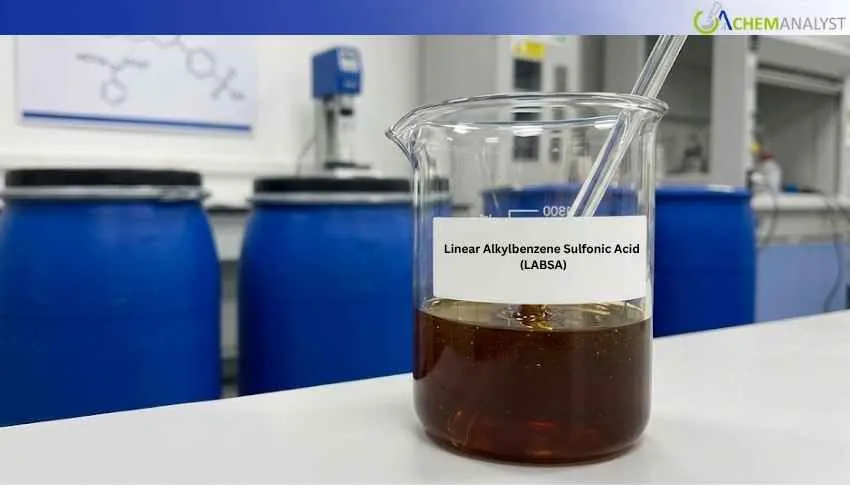
Linear Alkylbenzene Sulfonic Acid (LABSA) prices at DEL Houston recorded a sharp 10.68% weekly advance during the week of March 20, 2026, extending the extraordinary price surge that began the prior week and confirming a structural market repricing driven by the ongoing Middle East conflict's devastating impact on the global petrochemical supply chain. The advance marks one of the most significant single-week price movements in the US LABSA market in recent memory, overturning the broadly stable-to-recovering pricing environment that had characterized the domestic market through the first two months of 2026.
The primary driver of the weekly surge was a simultaneous and severe spike in LABSA's two critical feedstocks — Linear Alkyl Benzene (LAB) and sulfuric acid. LAB feedstock costs represent 60–70% of total LABSA production expenses, with sulfuric acid contributing a further 15–20% of costs — meaning the production cost structure of US Gulf Coast LABSA sulfonation facilities was simultaneously pressured from both directions in the week of March 20. When oil prices soar, LABSA production costs follow suit, directly affecting the pricing of final consumer products — with the synthesis of LABSA tying its production intricately to fluctuations in the global oil market through the LAB-benzene-crude oil value chain. US FOB Louisiana LAB prices advanced 4.35% in the same week — directly transmitting into LABSA production cost revisions at Houston-area sulfonation facilities operated by Huntsman, CEPSA, and Sasol.
On the demand side, the price advance was powerfully reinforced by an accelerating pre-spring restocking wave from LABSA's key downstream consuming sectors. LABSA — a biodegradable surfactant extensively used in the production of laundry powders, industrial cleaners, and dishwashing liquids — sees demand driven primarily by the household and industrial cleaning sectors, with heavy-duty laundry liquids representing the largest application segment by both volume and revenue. US detergent, institutional cleaning, and personal care manufacturers entered an active spring procurement cycle simultaneously with the supply shock, competing urgently for available Houston DEL allocation. The complete elimination of Middle Eastern LABSA import competition — previously a key price-dampening mechanism for the US market through Red Sea and Gulf Coast arrivals — removed the import parity ceiling that had historically capped domestic LABSA price advances, granting Houston-area producers full pricing power for the first time in years. Feedstock cost volatility — driven by LAB prices derived from benzene alongside crude oil and chemical feedstock markets — pressured production costs, while end-users stocked up during seasonal peaks— a dynamic that played out with extraordinary intensity in the week of March 20 as buyers front-loaded purchases against the prospect of further weekly gains.
Looking ahead, US LABSA prices are anticipated to remain elevated and subject to further upside pressure through the remainder of March and into Q2 2026, as the Middle East conflict continues to sustain disruption to the benzene-LAB-LABSA value chain with no clear resolution timeline. The Trump–Xi Beijing summit in late March 2026 will be closely monitored as a potential diplomatic catalyst, though its outcome and direct impact on Hormuz shipping remains deeply uncertain.







Leave a Comment
Comments (0)