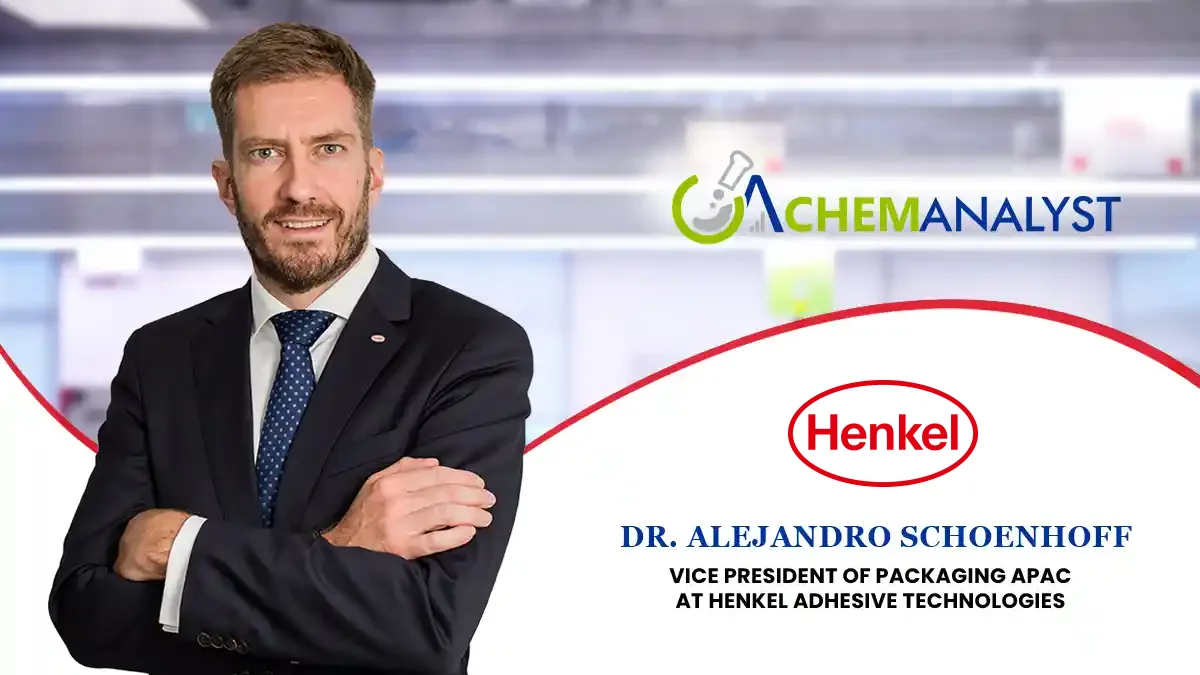
ChemAnalyst Talks with Dr. Alejandro Schoenhoff, Vice President of Packaging APAC at Henkel Adhesive Technologies
Henkel is a German multinational company founded in 1876, with leading positions across both industrial and consumer markets. Headquartered in Düsseldorf, the company operates globally through its Adhesive Technologies and Consumer Brands businesses, offering a broad portfolio that includes industrial adhesives, sealants, functional coatings, and well-known laundry and hair care brands. Innovation and sustainability are central to Henkel’s strategy, with a strong focus on circular economy solutions and reducing environmental impact across product lifecycles. ChemAnalyst spoke with Dr. Alejandro Schoenhoff, Vice President of Packaging APAC at Henkel Adhesive Technologies, about how Henkel is advancing sustainable packaging innovation across the Asia-Pacific region. Drawing on his extensive international leadership experience, Dr. Schoenhoff shared insights on enabling recyclability through advanced adhesive and coating technologies, the strategic role of the Packaging RecycLab in China, and the importance of collaboration across the packaging value chain to balance performance, cost efficiency, and regulatory compliance.
Complete Interview with Dr. Alejandro Schoenhoff
Introductory Questions
Q: Can you briefly share your journey in packaging and adhesives, and what led you to your current role at Henkel APAC?
Dr. Alejandro Schoenhoff: My journey in adhesives and packaging started with marketing and sales roles in Europe, followed by several years of sales management positions in flexible packaging and tapes & labels in the Americas. This global path led me to APAC, a region where the packaging industry is transforming at a remarkable pace, with diverse and fast-evolving customer needs. My experience leading the business across various regions prepared me for my current role as Vice President, where from Shanghai I focus on driving growth and innovation for our customers.
Q: What motivated Henkel to establish the Packaging RecycLab in China, and how does it fit within your larger sustainability goals?
Dr. Alejandro Schoenhoff: Henkel established the Packaging RecycLab as a direct response to the growing need for actionable sustainability in the packaging industry. Sustainability is a key competitive advantage and sits at the heart of our strategic blueprint toward 2030 and beyond. A core mission within that is enabling the best possible use of post-consumer recycled (PCR) materials, which is critical for driving a true circular economy.
The RecycLab fits perfectly into these goals by translating commitment into practical support. Henkel is dedicated to providing customers with higher added value beyond the product itself. By offering advanced and convenient recyclability testing and assessment locally in China, the RecycLab empowers our customers to design more sustainable packaging, effectively fulfilling our commitment to the market and to society’s broader environmental goals.
Technical & Innovation
Q: Let’s talk about the RecycLab in China. What is it & how does RecycLab test adhesive compatibility with various substrates—paper, plastic, and hybrids—during recycling?
Dr. Alejandro Schoenhoff: The RecycLab is Henkel's in-house testing laboratory dedicated to assessing the recyclability of fiber-based & film-based packaging materials. Established in Shanghai as the second facility of its kind for Henkel, it now is able to provide recyclability test services for fiber-based packaging and will further extend to film-based packaging in the near future. The test results enable material development and optimization in support of a circular economy. This is especially relevant in light of regulations such as the PPWR (Packaging and Packaging Waste Regulation), which aims to make all packaging on the EU market recyclable in an economically viable way by 2030.
Q: What new adhesive formulations are you developing to improve recyclability of paper packaging and multi-layer flexible packaging?
Dr. Alejandro Schoenhoff: We are taking a dual approach to address the specific needs of both fiber and film streams. For paper packaging, we are formulating functional coatings and adhesives that replace plastic barriers while remaining fully repulpable, ensuring they separate easily and do not contaminate the paper recycling process.
For multi-layer flexible packaging, we are developing specific adhesive and coating formulations that allow different layers of the same material (such as PE-to-PE or PP-to-PP) to bond effectively while achieving the same barrier performance as traditional multi-material structures. In this system, our coatings provide the necessary barrier properties, while our certified compatible-to-recycle adhesives deliver high performance, such as chemical resistance, without creating issues in the recycling stream. This makes mono-materials a viable alternative to complex laminates, ensuring the final package can be processed as a single, high-quality material stream in existing recycling facilities.
Q: What progress are you making in developing low-temperature or water-based adhesives to lower packaging’s carbon footprint?
Dr. Alejandro Schoenhoff: We are proud to introduce several innovations last year aimed at reducing packaging’s carbon footprint. For example, in the metal packaging industry, we’ve launched a low-temperature cleaner that significantly lowers energy consumption. At the same time, we continue to expand our portfolio of solvent-free adhesive grades for flexible packaging, supporting both sustainability and high-performance requirements.
Q: How do you balance adhesive performance requirements across different APAC climates while maintaining recyclability?
Dr. Alejandro Schoenhoff: Operating across more than 10 diverse APAC markets means we must account for varying climate conditions when designing adhesive performance. While these environmental factors influence formulation, our commitment to sustainability remains constant. We continue to expand our RE range—our portfolio that is designed for recycling—making these solutions available across the region to ensure recyclability without compromising performance.
Collaboration & Circular Economy
Q: How is Henkel working with converters, brand owners, and recyclers to develop closed-loop recycling in APAC and particularly in China?
Dr. Alejandro Schoenhoff: From the outset, we recognized that driving meaningful change in packaging recycling requires collaboration across the entire value chain. Henkel holds a unique position—not only as a raw material supplier for packaging but also as a brand owner using significant packaging in the consumer market. This dual role gives us both credibility and practical insight when partnering with converters, other material suppliers, and recyclers. In APAC, and particularly in China, we work closely with our consumer brands teams and external partners to co-develop solutions that enable closed-loop recycling and accelerate the transition toward a truly circular packaging economy.
Q: How does RecycLab help you align with EU PPWR and China’s sustainability regulations? PPWR aims to minimize the quantities of packaging and waste generated while lowering the use of primary raw materials and fostering the transition to a circular, sustainable and competitive economy. It’s all about the better use of our resources in an efficient way.
Dr. Alejandro Schoenhoff: China is a big packaging producer, but also a big packaging exporter. The establishment of RecycLab in China can effectively enable Henkel packaging adhesive business unit to offer not only the additional service business of recyclability test but also a series of corresponding know-how behind of the test figures which indeed is a great add-on for packaging export-oriented enterprises when it comes to business compliance.
In the meantime, China Government departments at all levels have introduced relevant regulations, policies, and standards to better regulate the treatment of post-consumer waste, among which fiber-based & film-based packaging accounts for a significant proportion. The establishment of Henkel’s RecycLab not only provides practical tests & assessments of recyclability but also facilitates mutual exchange with relevant authorities regarding the methodologies, rationales, and even higher-level management frameworks behind such assessment. This potentially lays a solid foundation for harmonization of policies and standards in the near future.
Q: How do you balance customer needs for cost efficiency with your push for more sustainable adhesives?
Dr. Alejandro Schoenhoff: We believe cost efficiency and sustainability must coexist to achieve scale. Complementing the low carbon emission solutions—like the solvent-free adhesives Henkel pioneered introducing to the market decades ago—we now focus on the advanced capabilities of our RE and ECO ranges to drive value.
Rather than competing solely on price, we focus on recyclability as a key differentiator. Our current innovations are designed to be versatile enough to use on recycled materials, are composed of recycled and bio-based content, and are fully compatible with recycling processes. This ensures that while we maintain the cost-efficiency customers expect, we deliver superior value by solving complex circularity challenges.
Q: What future directions do you see for RecycLab—such as digital simulations, pilot recycling, or wider industry collaborations?
Dr. Alejandro Schoenhoff: With the completion of the China laboratory in September 2025, the recyclability testing capabilities for paper packaging have been fully deployed in global HQ & APAC regional HQ. In Germany, it has even been operating for nearly two years already.
The expansion of the RecycLab to include film-based testing capabilities is under consideration and is expected to be implemented gradually in the coming months.
Since the physical recyclability test is considered always as the last option, Henkel is also digitizing the guideline of DfR (design for recycling), which will to maximum extent enable a better packaging design from the very beginning. This also supports the fruitful and constructive exchanges Henkel has with relevant associations, for example with the China Packaging Federation in China. Both sides have agreed to jointly build up collaboration on knowledge enhancement, digital application, establishment of Chinese standards and utilization of laboratory resources for local market.







Leave a Comment
Comments (0)