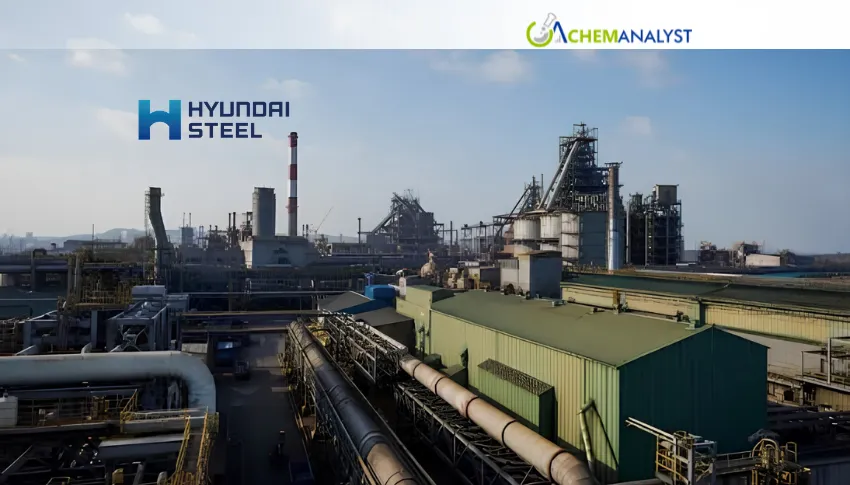
South Korean steelmaker Hyundai Steel has reached a collective bargaining agreement with labor unions representing employees of four subsidiaries, marking the first agreement of its kind since the country’s revised labor union legislation came into force six months ago.
The agreement was signed at Hyundai Steel’s Dangjin steel plant in South Chungcheong Province between the steelmaker and unions representing workers from Hyundai ITC, Hyundai IEC, Hyundai IMC, and Hyundai ISC. South Korea’s Ministry of Employment and Labor announced the development on Thursday, highlighting the deal as an important early example of how the amended Trade Union and Labor Relations Adjustment Act is influencing relations between major companies and subcontracted or affiliated workers.
The amendments to Articles 2 and 3 of the legislation, widely referred to as the “Yellow Envelope” law, took effect on March 10. One of the major changes was an expanded definition of an employer. Under the revised framework, a company can be considered an employer when it “substantially and significantly controls” workers’ employment conditions, even when those employees are formally employed through another company. The change has consequently increased the ability of unions representing outsourced and indirect workers to negotiate directly with principal contractors.
In April, the National Labor Relations Commission determined that separate bargaining units should be established for unions representing employees of Hyundai Steel’s four subsidiaries and workers employed by other in-house subcontractors. Following that decision, Hyundai Steel began formal discussions with the four subsidiary unions.
The company conducted four rounds of negotiations, with the first meeting held on August 20. The discussions ultimately resulted in commitments aimed at improving workplace conditions, particularly occupational safety and health.
Under the agreement, Hyundai Steel and the unions will work toward continuously strengthening occupational safety and health management systems across the subsidiaries. They also agreed to develop a mid- to long-term roadmap designed to progressively improve workplace safety and health standards.
Labor Minister Kim Young-hoon described the agreement as a significant development because it demonstrates the revised law’s objective of encouraging dialogue and mutually beneficial relationships between principal contractors and subcontractors. He also said the agreement could provide an important foundation for creating safer working environments at Hyundai Steel.
The deal could become a reference point for other South Korean industrial companies as they navigate expanded bargaining obligations under the revised labor framework.
Chemical Commodity Price Impact
The agreement is unlikely to create an immediate material change in Hyundai Steel’s steel production volumes, but improved labor relations and stronger safety systems could reduce operational disruptions, accidents and unexpected shutdown risks over the longer term. Greater stability at subsidiary operations may support more consistent production of steel products, including hot-rolled and cold-rolled steel, potentially improving supply reliability. For chemical commodities tracked by ChemAnalyst, the direct price impact should remain limited because the agreement does not alter feedstock demand or production capacity. However, stable steel output could sustain demand for industrial gases, coke-related inputs, lubricants and other process chemicals, providing modest support to prices if demand remains firm.








 About ChemAnalyst
Leave a Comment
Comments (0)