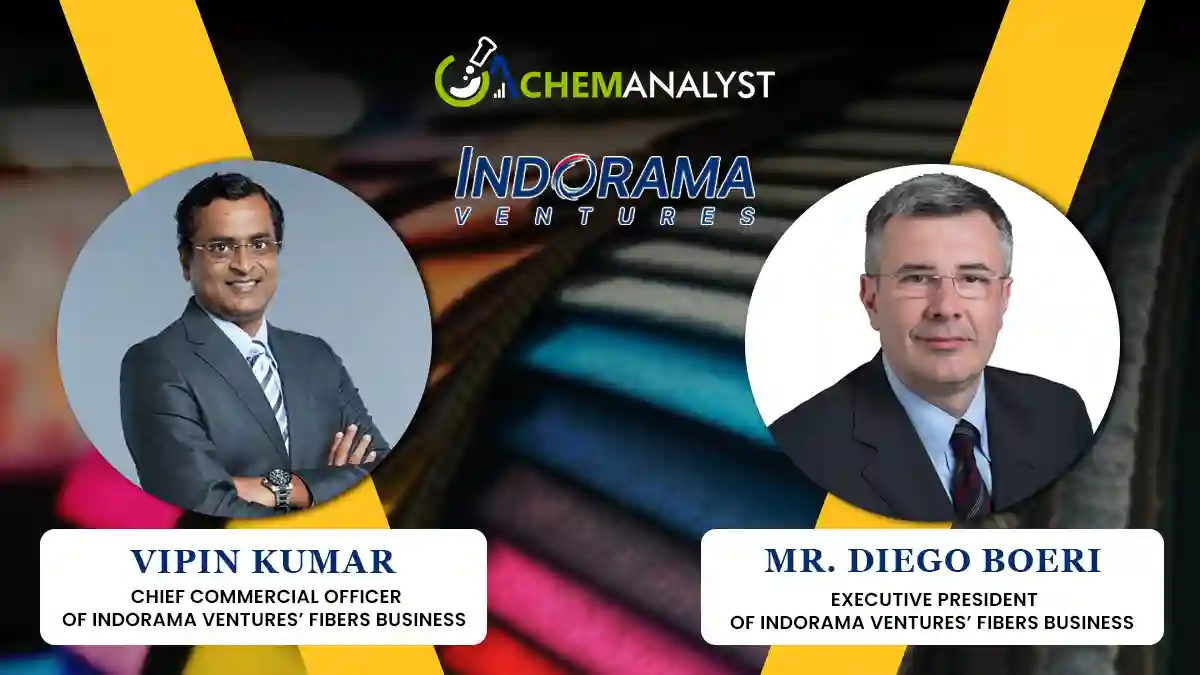
Indorama Ventures, one of the world’s leading manufacturers and recyclers of PET, is strengthening its leadership in sustainable fibers by advancing large-scale textile circularity through chemical recycling and strategic partnerships. With sustainability at the core of its global resins, packaging, recycling, and specialty chemicals businesses, the company supports customers producing everyday consumer essentials across industries such as food and beverages, pharmaceuticals, cosmetics and personal care, technical polymers, and textiles. ChemAnalyst engaged in a discussion with Diego Boeri, Executive President, and Vipin Kumar, Chief Commercial Officer of Indorama Ventures’ Fibers Business, to explore how the company is fast-tracking the shift toward circular, low-carbon textile solutions.
Drawing on more than three decades of global leadership experience across the chemical and fibers sectors, Boeri explains how Indorama Ventures’ joint venture with Jiaren Chemical Recycling is enabling commercially available textile-to-textile recycled PET fibers and yarns at scale. The partnership addresses critical industry challenges related to performance, availability, and supply stability while helping brands reduce reliance on fossil-based raw materials. Vipin Kumar highlights growing global demand for recycled polyester, particularly in Asia-Pacific, and outlines how Indorama Ventures’ global manufacturing footprint, long-term offtake agreements, and certified sustainability practices support stable pricing and reliable supply. Together, the executives share insights into regulatory developments, environmental impact measurement, and future collaborations that will be essential to building a fully circular and commercially viable textile economy.
Complete Interview with Mr. Diego Boeri and Vipin Kumar
Q: Mr. Diego Boeri, as Executive President of Indorama Ventures’ Fibers business, could you provide an overview of your professional journey and leadership experience within the global fibers, recycling, and sustainability sectors?
Diego Boeri: Sure, I’ve held regional and global leadership roles in different chemical sectors and geographies for more than 30 years now. On that journey, I got to know the nonwovens, man-made fibers and personal protection industry. That means I know the fragmented global textile value chain from different perspectives, and with it, the unique challenges the industry faces. One of them is to pioneer innovative pathways that turn textile waste into circular materials to help accelerate the shift away from fossil-based production. From my experience in air-conditioning gases, I learnt the importance of regulations in driving this type of game changing industry transformations and the effort it takes to align all the value chain players through collaboration.
Q: How have these experiences shaped your strategic vision for leading Indorama Ventures’ role in this joint venture with Jiaren Chemical Recycling and advancing large-scale circularity in the textile industry?
Diego Boeri: I know from my time in the packaging industry, for instance, that closed-loop recycling solutions take their time to be fully established. They require bold investments in technology and operations. They call for regulatory support as well as close collaboration among all value chain partners, even if those may be competitors in day-to-day business. Accomplishing all that isn’t easy, and it’s never only one company alone who makes it happen. However, companies who are early movers and take calculated risks to lead fundamental new pathways for an entire industry, are often rewarded in the long run. Our joint venture with Jiaren Chemical Recycling delivers ready-to-use textile-to-textile fibers and yarns today, at scale, and we will unlock more capacity in 2026. I consider this a big step for the entire industry, because many other solutions on the market are either not yet commercial or available in smaller quantities only.
Q: The joint venture aims to unlock up to 100,000 tonnes of textile-recycled PET spinning capacity annually. From an industry standpoint, how do you assess the current market trajectory for circular textiles, and what demand trends—both from brands and consumers—are influencing this investment today?
Diego Boeri: If you look at the big brands globally, from automotive to sportswear and fashion, almost all have given themselves ambitious recycling and climate targets. Expectations from investors and consumers are high, because many stakeholders today are a lot more aware of circularity than maybe 10 years ago, and people want to act upon it. However, there is one critical enabler that needs to fall in place, too. This is regulatory support. In order to invest significant resources into circularity, we need to be confident that regulatory frameworks will turn into effect soon to further drive the transformation, while giving us sufficient flexibility to still earn money. We see that things are moving in the right direction, for instance related to mandatory recycled-content mandates and Extended Producer Responsibility schemes. That’s why we consider the joint venture with Jiaren Chemical Recycling a calculated, well-invested risk.
Q: Mr. Vipin Kumar, you are Indorama Ventures’ Chief Commercial Officer for the Fibers business. What is the projected demand outlook for recycled-PET-based textiles in Asia-Pacific and globally, and to what extent can this joint venture meet or stimulate that demand?
Vipin Kumar: We know from various independent market studies that the demand for polyester in the textile industry has been on an ever-rising trend globally for the past 30 years. This trend continues for the coming years because polyester fibers and yarns deliver so many advantages to the textile industry. The recycled portion of that demand, though, is still comparably low, say around 10-15%. This is mainly because technologies are not yet mature enough to deliver the required performance for all applications in scope, and not yet available at sufficient scale to create a significant shift in demand from fossil to recycled. That’s exactly why we joined forces with Jiaren Chemical Recycling. They have scaled up their de- and repolymerization technology in the past 12 years to very stable, high-quality levels. They are running at 30kt annually capacity already today and will put additional 50kt on stream in 2026. Together with our global spinning footprint at Indorama Ventures, this partnership delivers the scale the industry needs to make tangible progress in implementing textile-to-textile loops without compromising on material performance.
Q: How might this joint venture help stabilize supply and price forecasts for textile manufacturers, whether through secured feedstock channels, new product specifications, or strengthened supply chain integration?
Vipin Kumar: Supply stability is one of the top priorities for textile manufacturers and brands. Many companies have implemented clear strategies to diversify their supply, so they won’t be dependent on only one supplier in one country. At Indorama Ventures, we have the advantage of running a global manufacturing footprint across all regions. That means we can help to build regionalized sourcing hubs wherever brands and customers they need them. Together with longer-term offtake agreements, such setup will also help to agree on stable prices, because demand becomes more predictable, which increases efficiency of supply and production planning.
Q: Asia-Pacific is currently the largest and fastest-growing recycled polyester market. How will regional factors such as China and India’s production capacity, local regulatory incentives, and evolving fashion-brand requirements shape your supply chain strategy, pricing approach, and market positioning?
Vipin Kumar: South-East Asia is certainly a key relevant market for us. We observe a continuous trend for local “China for China” supply chains, which is where our own local Chinese business benefits from. Other than that, we focus on direct customers outside China, as well as brands in Europe and the Americas. This is where many big brands have their headquarters, and where key relevant decision-makers are based.
Q: Chemical recycling of polyester requires advanced capabilities such as sorting, de-colorizing, depolymerization, and re-polymerization. What major supply chain challenges do you foresee in scaling high-quality textile-to-textile recycling globally, and how will the combined strengths of Indorama Ventures and Jiaren help address them?
Vipin Kumar: Our joint venture currently builds on locally sourced pre- and post-consumer textile waste, with many years of experience within the Jiaren team to sort, de-color, de- and re-polymerize. What I see as major challenges for the entire industry are three things: 1. There is hardly any country in the world that has established a functioning and large-scale collection infrastructure for post-consumer textile waste. That means for most textiles, we still miss the opportunity to give them a second life at the end of their lifecycle. 2. Regulatory frameworks have not yet clearly defined whether pre-consumer textile waste qualifies for textile circularity. That puts insecurity on the shoulders of many value chain players, which slows down willingness to invest. And thirdly, a lot more educational work is required globally to help consumers understand today’s material flows and how they can contribute themselves to reducing waste and protecting the environment.
Q: You have emphasized that mismanaged textile waste and climate expectations require collaborative investment across the value chain. How do you quantify and validate the environmental impact of this joint venture, particularly in carbon reduction, waste diversion, and increased availability of circular feedstock?
Vipin Kumar: Quantifying and validating the environmental impact of our joint venture is a critical part of demonstrating that textile-to-textile recycling is not only technologically feasible but also environmentally meaningful. We provide Product Carbon Footprints (PCF) per producing site and apply internationally recognized methodologies such as Life Cycle Assessment (LCA) to measure reductions in carbon emissions compared to virgin polyester production. Early results show that chemical recycling can cut greenhouse gas emissions significantly as compared to virgin products, while diverting large volumes of textile waste from landfills or incineration.
Equally important is the creation of reliable circular feedstock. By sourcing and processing pre- and post-consumer textile waste through our joint venture with Jiaren Chemical Recycling, we are able to validate the amount of material re-introduced into the textile value chain. This transparency is essential for brands and regulators alike, as it provides measurable proof of progress against recycling and climate targets.
Finally, across our portfolio, we work with independent bodies, for instance for recycling certifications, ISO, or ISCC+ to verify our processes and outputs. This ensures that the fibers and yarns we deliver meet both performance and sustainability standards, giving our customers confidence that their products contribute to real environmental impact.
Q: Looking ahead, what transformative opportunities do you foresee for scaling textile circularity beyond this partnership? Are there upcoming innovations, ecosystem collaborations, or technological breakthroughs that could accelerate progress toward a fully circular textile economy while ensuring commercial viability for all stakeholders?
Vipin Kumar: The textile industry is on a constant hunt for solutions that enable textile circularity. We will certainly see more collaborations, further advancements in technology, and a stabilization of price points. At Indorama Ventures, we have our own dedicated investment team screening the market for promising scale-ups to partner with. That’s our way to keep track with ever-evolving innovations in this space. Most important to us is that we remain technology-agnostic, because we fully believe that the future of textiles lies in a mix of technologies. Their utilization will depend on market application, performance requirements, and price stability.







Leave a Comment
Comments (0)