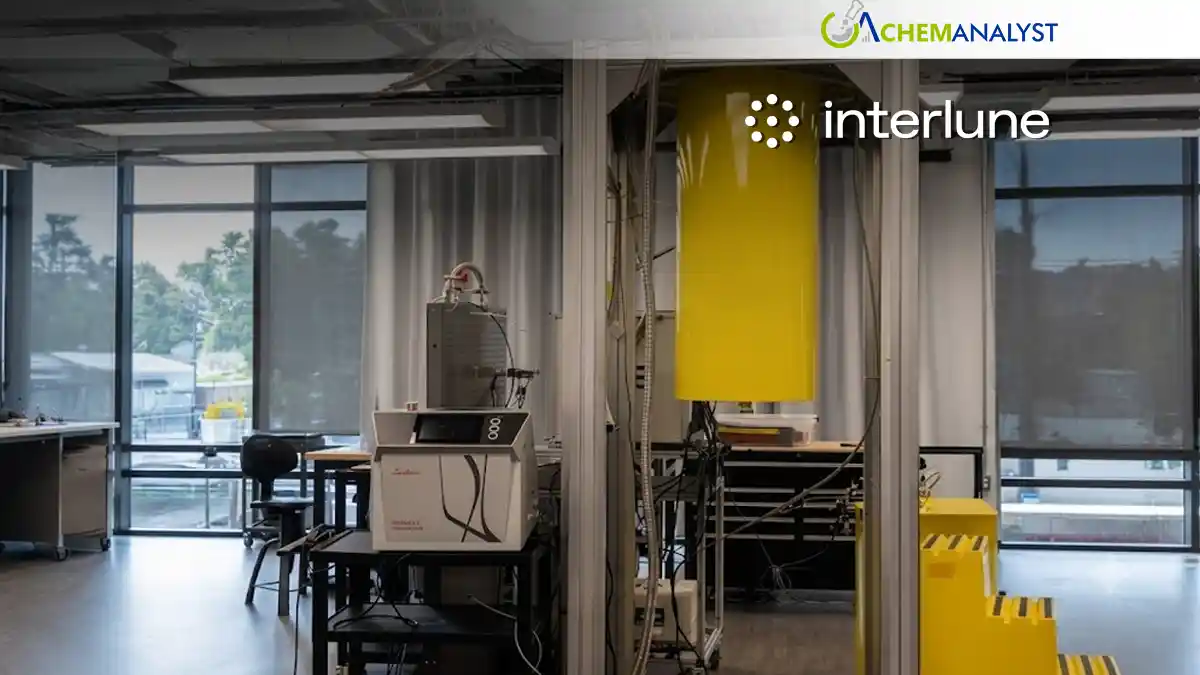
Interlune, a company focused on developing space infrastructure and resource technologies, has announced a significant milestone in helium-3 production by successfully generating 99% pure helium-3 from Grade A helium using its proprietary Cold Capture cryogenic separation technology. The breakthrough highlights a new approach to recovering one of the world's rarest and most valuable isotopes from existing terrestrial helium supplies, potentially strengthening domestic availability for high-tech and strategic industries.
The company stated that the technology has demonstrated its capability to efficiently separate helium-3 from conventional helium streams. If implemented across existing helium liquefaction facilities in the United States, the process could substantially increase the country's annual helium-3 output, helping to meet the rapidly growing demand from sectors such as quantum computing, scientific research, and national defense.
Interlune first validated the Cold Capture technology in early 2025. Later that year, the company secured an AFWERX Small Business Innovation Research (SBIR) Direct-to-Phase II contract, aimed at expanding the technology from laboratory demonstrations to industrial-scale helium processing. The U.S. Air Force has shown particular interest in helium-3 because of its role in advanced research programs involving superconducting quantum computing systems.
According to Interlune, every volume of naturally produced helium contains extremely small quantities of helium-3. Traditionally, these trace amounts have remained unrecovered during helium processing. Cold Capture is designed to integrate directly with existing helium liquefaction infrastructure, allowing operators to extract helium-3 from helium streams that are already being processed commercially. This approach creates additional value without requiring new helium production facilities.
Beyond its immediate commercial applications, the technology is expected to play an important role in Interlune's long-term vision of extracting helium-3 from lunar resources. The company intends to adapt the same cryogenic separation principles for future operations on the Moon, where helium-3 is believed to be present in lunar regolith in greater abundance than on Earth.
The Cold Capture system was developed at Interlune's headquarters in Seattle using advanced cryogenic distillation techniques. Operating at temperatures approaching absolute zero, the process exploits the subtle physical differences between helium-3 and the more common helium-4 isotope. Although the two isotopes possess nearly identical chemical properties, the system is able to separate them with high precision, producing helium-3 suitable for commercial and industrial applications.
Interlune estimates that the United States produced approximately 81 billion liters of gaseous and Grade A helium during 2025 across multiple production facilities. If Cold Capture technology were adopted throughout these plants, domestic helium-3 production could reach around 2.5 kilograms annually, representing roughly three times the current national supply.
The company also addressed several common misconceptions regarding helium-3 availability. At present, most commercially available helium-3 originates from aging tritium reserves. Tritium naturally decays into helium-3 over extended periods, making these stockpiles the primary global source of the isotope. However, these reserves are finite, and increasing tritium production requires substantial investment and long development timelines, limiting the ability to rapidly expand helium-3 supply.
Interlune further noted that while new terrestrial helium discoveries occasionally attract attention as potential helium-3 sources, all natural helium deposits contain only minute concentrations of helium-3. Therefore, the primary challenge is not locating additional helium reserves but developing efficient technologies capable of recovering helium-3 from the vast quantities of helium already being processed worldwide. Since Cold Capture can be integrated into helium liquefaction plants that combine helium from numerous production fields, it offers the potential to recover significantly larger quantities of helium-3 than relying on any individual gas reservoir.
Demand for helium-3 continues to rise alongside the expansion of superconducting quantum computing technologies. These systems depend on dilution refrigerators that require helium-3 to achieve temperatures only fractions of a degree above absolute zero, enabling quantum processors to function effectively. As quantum computing advances toward broader commercial deployment, reliable helium-3 supplies are becoming increasingly important.
Reflecting strong market confidence, Interlune has already secured nearly $500 million in legally binding helium-3 purchase agreements, primarily with quantum refrigeration companies Maybell Quantum and Bluefors. In addition, the company has raised $23 million in venture capital while obtaining approximately $18 million in non-dilutive funding from the U.S. government and other organizations.
While the Cold Capture technology is intended to help alleviate today's helium-3 supply limitations, it also serves as a technological foundation for Interlune's broader objective of commercializing extraterrestrial resources. By demonstrating scalable cryogenic isotope separation on Earth, the company aims to support future lunar helium-3 production that could contribute to advanced computing, scientific exploration, and long-term human activities beyond Earth.
Impact of the News
Interlune's successful production of high-purity helium-3 could significantly improve the availability of this critical isotope for quantum computing, defense, and advanced scientific applications. Wider deployment of its Cold Capture technology may gradually ease supply constraints and reduce dependence on aging tritium reserves, although meaningful market expansion will take time. For chemical commodities tracked by ChemAnalyst, the direct pricing impact is expected to be minimal, as helium-3 is a niche isotope with limited integration into mainstream chemical value chains. However, increased helium processing could marginally strengthen demand for industrial helium and cryogenic equipment, while prices of bulk chemicals, petrochemicals, fertilizers, and polymers are likely to remain largely unaffected in the near term.








 About ChemAnalyst
Leave a Comment
Comments (0)