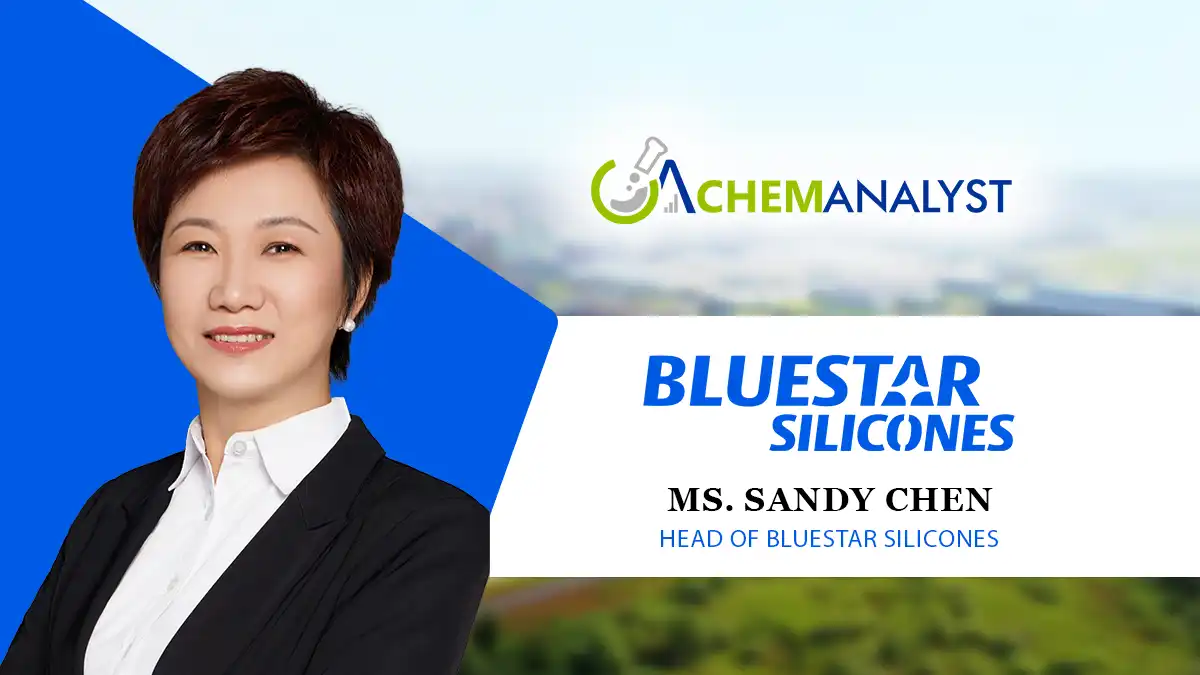
ChemAnalyst Talks with Ms. Sandy Chen, Head of Bluestar Silicones
Bluestar Silicones, a world-leading, fully integrated silicone manufacturer, leverages more than 80 years of expertise in silicone chemistry and application development to deliver advanced silicone solutions across industries including mobility, electronics, energy, aerospace, healthcare, personal care, construction, textiles, and release coatings. With 11 manufacturing sites across four continents, approximately 3,500 employees worldwide, and around 400 research and development scientists, the company combines global manufacturing capabilities with strong application expertise and innovation to address evolving technical and sustainability challenges. ChemAnalyst spoke with Ms. Sandy Chen, Head of Bluestar Silicones, about the company's renewed identity following its transition from Elkem Silicones, its long-term growth strategy, and the evolving opportunities in the global silicone industry. Drawing on more than 27 years of leadership experience in the global chemicals sector, Ms. Chen highlighted Bluestar Silicones' commitment to customer-centric innovation, operational excellence, sustainability, and resilient supply chains. She also discussed the company's strategic focus on electrification, advanced electronics, healthcare, renewable energy, digital manufacturing, and circular silicone solutions, while emphasizing continued investments in manufacturing, research and development, and low-carbon technologies to strengthen Bluestar Silicones' position as a trusted global partner in advanced silicone materials..
Complete Interview with Ms. Sandy Chen
Q1: Please share an overview of your professional journey in the global chemicals and silicones industry, and how your leadership experiences have shaped your vision for Bluestar Silicones as it embarks on this new chapter following its transition from Elkem Silicones.
Ms. Sandy Chen: My professional journey has been shaped by more than 27 years in the global chemical industry, working across different business environments — from Chinese industrial organizations to Japanese, American, and international companies. These experiences have given me a broad perspective on how the silicones industry evolves across regions, customer segments, and industrial models, and have reinforced my conviction that long-term value is created when commercial discipline, operational excellence, innovation, and customer intimacy come together.
Throughout my career, I have led businesses, regions, and global product lines, with responsibilities spanning P&L, strategy, sales and marketing, operations, R&D coordination, organization building, and team development.
These experiences are especially relevant as Bluestar Silicones enters this new chapter. As Head of Bluestar Silicones, my vision is to build on a strong foundation: more than 80 years of silicone chemistry experience, global manufacturing capabilities, deep application expertise, and teams who have demonstrated remarkable resilience and passion through many chapters of our company’s history. This transition is not a break from that history. It is an opportunity to reconnect with a recognized heritage while opening a more focused and ambitious future for our people, our customers, and our partners.
Q2: The decision to revive the Bluestar Silicones brand marks an important milestone for the company. What strategic factors influenced this transition, and how does the new identity reflect the company's long-term ambitions?
Ms. Sandy Chen: For Bluestar, silicones are a highly strategic asset, fully aligned with their ambition to invest in essential materials for society and for the future. The acquisition of the majority of Elkem’s silicones division was therefore more than a portfolio decision. It was a long-term industrial commitment to support the growth of the business, sustain investment, and further strengthen innovation capabilities.
In that context, returning to the Bluestar Silicones name was a natural and strategic choice. The name reconnects the company with an established and globally recognized identity, already familiar to many customers, partners, and employees, while reaffirming a strong industrial and scientific heritage in silicones.
At the same time, this is not simply a return to the past. The new visual identity expresses the company as it stands today: more focused, more distinct, and forward-looking. It reflects Bluestar’s ambition to develop Bluestar Silicones as a leading global player in advanced silicone materials.
The new tagline, “Living the difference,” captures our commitment to bring the Bluestar Silicones difference to life in every partnership and every application — through innovation, sustainability, technical expertise, and the way we work with customers.
Q3: Bluestar Silicones is reconnecting with a globally recognized brand while maintaining continuity for customers. How do you balance preserving a strong legacy with positioning the company for future growth and innovation?
Ms. Sandy Chen: We balance legacy and future ambition by being very clear about what changes and what does not change. What changes is our name, our visual identity, and the way we express our renewed ambition to the market. What does not change is equally important: our products, formulations, manufacturing sites, production processes, commercial trademarks, teams, quality systems, and service commitment remain in place.
For customers and partners, this transition is designed to be seamless. We are preserving the industrial foundation, application expertise, and trusted relationships that have been built over decades. At the same time, the Bluestar Silicones identity gives us a stronger platform to express where we are heading: a more distinctive, customer-oriented, innovation-driven, and globally ambitious silicones company.
In other words, we are not choosing between heritage and transformation. We are using our heritage as a foundation for the next stage of growth.
Q4: The transition has been designed to ensure that manufacturing operations, product portfolios, and customer relationships remain unchanged. What steps have been taken to guarantee business continuity throughout this transformation?
Ms. Sandy Chen: Business continuity has been a priority from the start. The transition has been managed through a phased approach, supported by transitional service agreements and, most importantly, a long-term sourcing agreement.
This sourcing agreement secures our continued access to siloxane intermediates produced from Elkem’s silicon-based materials. It ensures continuity in the raw material base behind our silicone solutions and allows customers to keep benefiting from the same quality standards they know today.
It also preserves an important environmental advantage: access to silicon-based materials associated with the lowest carbon footprint in the industry.
For customers, the message is clear: the products and services they receive from us remain unchanged. Our manufacturing sites, industrial footprint, production processes, product names, formulations, and commercial trademarks are not affected by the brand launch. Existing contracts, technical agreements, and quality agreements remain valid unless formally amended.
We remain committed to transparent, proactive communication. Whenever legal, regulatory, administrative, or operational updates require stakeholder action, we will communicate in advance through the appropriate channels.
Q5: Beyond the rebranding itself, what strategic priorities will define Bluestar Silicones over the next five years in terms of global expansion, operational excellence, and market leadership?
Ms. Sandy Chen: Our strategic priorities for the next five years are anchored in three objectives: value creation, innovation leadership, and operational excellence. They reflect Bluestar’s ambition to strengthen Bluestar Silicones as a leading global silicone player, while making the strengths that already define our company more visible and more valuable to customers.
The first priority is value creation through differentiated customer value. In specialty silicones, customers are not only looking for materials; they are looking for a trusted partner who understands their applications, their local constraints, and their long-term performance needs. This is why customer centricity will remain central to our strategy, supported by stronger application expertise, closer collaboration, and a more consistent global customer experience.
The second priority is innovation leadership. We will continue to invest in technology-driven growth, especially in high-value applications linked to electrification, healthcare, energy transition, advanced manufacturing, digital technologies, and more sustainable solutions. Our ambition is to make our culture of innovation more visible, while strengthening the connection between R&D, application development, and customer needs.
The third priority is operational excellence. This means improving safety, reliability, productivity, quality, and industrial performance across our global footprint. It also means using Bluestar’s scale and long-term investment commitment to reinforce our competitiveness, modernize assets where needed, and build a more resilient platform across Asia, Europe, and the Americas.
Market leadership will come from bringing these priorities together under a clear and differentiated identity. Bluestar Silicones is not trying to invent a new positioning; we are amplifying authentic strengths that already exist: customer centricity, a culture of innovation, sustainability leadership, trusted expertise, and global scale with local proximity. Together, these strengths define us as a trusted global partner, able to combine deep technical expertise, integrated scale, customer intimacy, innovation, and sustainability to deliver differentiated value worldwide.
Q6: Silicone materials continue to play an increasingly important role across industries such as electric vehicles, electronics, healthcare, construction, renewable energy, and personal care. Which application segments do you expect to be the strongest drivers of future demand?
Ms. Sandy Chen: We see strong long-term drivers across several application areas. Electric mobility and advanced electronics are major growth fields because silicones provide thermal management, insulation, protection, sealing, bonding, and durability in increasingly demanding environments. Renewable energy and energy infrastructure are also important, especially where materials must perform reliably over long lifetimes.
Healthcare and medical applications will remain attractive because they require high-performance, safe, and reliable materials supported by strong quality and regulatory capabilities. Construction, personal care, textile, and release coatings also continue to offer opportunities, especially as customers look for solutions that combine performance, durability, process efficiency, and sustainability.
Rather than focusing on only one segment, our approach is to leverage the versatility of silicone chemistry across multiple megatrends: electrification, digitalization, healthcare, energy transition, advanced manufacturing, and more sustainable consumption.
Q7: Innovation has always been central to the silicone industry. How is Bluestar Silicones strengthening its research and development capabilities to address emerging customer requirements and next-generation applications?
Ms. Sandy Chen: Bluestar Silicones brings together more than 80 years of silicone chemistry experience and application development expertise, supported by around 400 research and development scientists worldwide. We also benefit from three main innovation hubs located in France and China, complemented by extended local technical service capabilities close to customers across the world. This gives us both the scientific depth and the field proximity needed to address complex, application-specific challenges.
At the same time, we define innovation in a very practical and customer-centered way. We are not trying to measure innovation only by the number of patents filed or by the volume of new products launched. In specialty silicones, the most valuable innovation is often the one developed in close partnership with a customer to solve a specific technical challenge.
This is where our model is distinctive. By combining global R&D capabilities, deep application expertise, and close customer intimacy, we can co-create solutions that are not simply new, but truly relevant — the right innovation for the right application, at the right level of performance.
We will continue strengthening this approach in high-value markets such as electric mobility, electronics, healthcare, energy, advanced industrial processes, and more sustainable solutions. Our ambition is to connect scientific expertise, sustainability objectives, and customer needs more effectively, so that innovation translates into practical, scalable, and meaningful value.
Q8: Sustainability is becoming a key competitive differentiator across specialty chemicals. How is Bluestar Silicones integrating sustainability into product development, manufacturing processes, and long-term business strategy?
Ms. Sandy Chen: Sustainability is one of the areas where we have a clear and demonstrable leadership position. Our first strength is the carbon footprint of our upstream raw material base. Through continued access to silicon-based materials associated with the lowest carbon footprint in the industry, we can help customers reduce the embedded carbon footprint of the silicone solutions they use in their own applications.
We are also actively shaping the circularity agenda for silicones. This is a critical challenge for the industry, and we are working on breakthrough innovations in both chemical and mechanical recycling to extend the life cycle of silicone materials and create new circular pathways. In addition, we are moving forward with the allocation of mass-balance circular feedstock, supported by the certification of our Saint-Fons (France) plant under ISCC PLUS — a first for silicone production in Europe.
A third pillar is transparency. Customers increasingly need reliable, comparable, and verified data to make informed decisions and meet their own sustainability commitments. This is why we provide high data transparency on product carbon footprints through a third-party verified documentation system.
Taken together, these elements define our sustainability leadership: a low-carbon raw material base, pioneering work on silicone circularity, certified circular feedstock allocation, and robust product carbon footprint transparency. Our role is to help customers improve the sustainability profile of their own applications with solutions that are both technically reliable and supported by credible data.
Q9: Customers increasingly seek partners that can deliver both technical expertise and supply reliability. How is Bluestar Silicones strengthening customer collaboration while expanding its global presence?
Ms. Sandy Chen: Our strength lies in combining global scale with market proximity. Bluestar Silicones has 11 manufacturing sites across four continents, a broad international footprint, and strong application expertise close to customers. This allows us to support global customers consistently while remaining attentive to local market needs.
Customer collaboration is not only about responding to requests. It is about understanding the customer’s application, constraints, regulatory environment, performance needs, and long-term ambitions. We want to be a trusted partner that helps customers imagine the future and make brighter horizons possible.
As we expand our global presence, we will continue to focus on reliability, responsiveness, and technical support.
Q10: Supply chain resilience has become a major priority for chemical manufacturers worldwide. How is Bluestar Silicones adapting its sourcing, manufacturing, and distribution strategies to navigate geopolitical uncertainties and evolving market conditions?
Ms. Sandy Chen: Supply chain resilience is indeed one of the defining priorities for our industry, especially in a more uncertain geopolitical environment. For Bluestar Silicones, resilience starts with the strength of our global footprint and our ability to combine regional proximity with international scale across Asia, Europe, and the Americas.
A key part of this resilience is our east-west dual sourcing capability. It allows us to support customers who need greater security of supply by offering more flexibility across regions, while reducing dependency on a single geography. This is particularly important for global customers who want to secure continuity across their own manufacturing footprint.
We also focus on disciplined operational planning, supplier relationship management, inventory and logistics robustness, and close coordination with customers. The objective is to anticipate risks, maintain reliable service, and respond with agility when market conditions evolve.
The transition to Bluestar Silicones has been designed with continuity in mind. Our manufacturing organization and supply commitments remain in place, and we will continue to communicate transparently with stakeholders whenever a change could affect them.
Q11: Energy costs, environmental regulations, and raw material availability continue to reshape the silicone industry. Which of these factors do you believe will have the greatest influence on the sector over the next few years?
Ms. Sandy Chen: All three factors will continue to shape the silicone industry, and their impacts are closely linked. Energy, raw materials, and environmental regulations all influence competitiveness, supply reliability, production requirements, and customer expectations. The key challenge is therefore not to prioritize one over the others, but to navigate volatility with resilience, responsibility, and agility.
At the same time, silicones benefit from important structural strengths. Silicon, the core element behind silicone chemistry, is the second most abundant element in the Earth’s crust, which makes resource scarcity a less immediate constraint than in some other chemical value chains. Bluestar Silicones also benefits from a strong global footprint, with major industrial sites in China, where energy is competitively available, and in France, where low-carbon electricity is abundant.
Our priority is to build on these advantages while strengthening our ability to serve customers reliably and responsibly. This means reinforcing operational excellence, investing with discipline in compliance and material purity, advancing sustainability, and staying agile in a changing market environment.
Q12: The global silicone market has experienced periods of price volatility driven by fluctuations in upstream raw materials such as silicon metal, methanol, and methyl chloride. How do you expect these market dynamics to evolve over the next 12 to 24 months?
Ms. Sandy Chen: The silicone value chain has experienced volatility in recent years, as have many industrial value chains. Raw materials, energy, logistics, demand cycles, and regulatory requirements can all influence market dynamics.
Over the next 12 to 24 months, upstream raw materials for silicones are likely to remain subject to short-term price volatility, globally, partly due to oversupply in certain areas of the value chain. Our focus is on maintaining strong market intelligence, disciplined operational planning, and transparent customer dialogue. We monitor the relevant factors closely and work to manage volatility through reliability, efficiency, and long-term partnerships.
Our customers expect us to be a stable and responsible partner. That means being attentive to market realities while avoiding speculation and focusing on what we can control: quality, supply reliability, technical support, and operational excellence.
Q13: From a pricing perspective, what are currently the most significant cost drivers for silicone manufacturers, and how does Bluestar Silicones manage these fluctuations while maintaining competitiveness?
Ms. Sandy Chen: Silicone manufacturing is influenced by a combination of factors, including raw materials, energy, logistics, regulatory compliance, industrial maintenance, quality requirements, and the investments needed to operate safely and reliably. These factors can vary by region and by product family.
Our approach is to focus on competitiveness through operational excellence, efficiency, innovation, and customer value. We continuously work to improve productivity, strengthen industrial reliability, and optimize our processes. At the same time, we invest in technical expertise and application development, because in specialty silicones, competitiveness is not only about cost. It is also about performance, reliability, quality, and the ability to help customers solve complex challenges.
We believe long-term competitiveness comes from balancing efficiency with value creation.
Q14: Do you anticipate that future investments in manufacturing capacity, technology upgrades, and operational efficiencies will contribute to greater stability in silicone supply and pricing across global markets?
Ms. Sandy Chen: Investments in manufacturing capabilities, technology upgrades, and operational efficiencies are essential to strengthen supply reliability and industrial performance. For Bluestar Silicones, targeted investment is part of our long-term ambition to improve safety, modernize assets where needed, enhance operational excellence, and support high-value applications.
These investments help us serve customers more reliably, respond to technical requirements, and build a stronger platform for sustainable growth. They also support resilience by improving the robustness and flexibility of our operations.
Regarding pricing, many factors influence global markets, including raw materials, energy, demand cycles, logistics, and regulatory developments. Our role is to manage our own operations responsibly and competitively, while maintaining transparent and constructive relationships with customers.
Q15: Sustainability regulations are becoming increasingly stringent across Europe, North America, and Asia. How do these evolving regulatory frameworks influence production costs, product innovation, and pricing strategies for specialty silicone materials?
Ms. Sandy Chen: Evolving sustainability regulations are raising expectations across the specialty chemicals sector in areas such as compliance, transparency, product stewardship, environmental performance, and data quality. We see this not only as a requirement to meet, but also as an opportunity to differentiate. For companies with strong sustainability capabilities, regulation can help accelerate innovation and reward solutions that deliver both performance and credible environmental value.
This is where Bluestar Silicones is well positioned. We already have a strong leadership position in silicone sustainability, supported by low-carbon raw material access, pioneering work on circularity, certified circular feedstock allocation, and robust product carbon footprint transparency. As customers face more demanding regulatory and sustainability requirements, we can help them move faster with materials, data, and technical expertise they can trust.
For Bluestar Silicones, the priority is therefore not simply to adapt to stricter regulations, but to use them as a catalyst for progress. We will continue integrating sustainability into product development, manufacturing practices, and customer collaboration, while accelerating innovations that support durability, efficiency, circularity, lower environmental impact, and high-performance applications.
Q16: Digital manufacturing, automation, and advanced process technologies are transforming the chemical industry. How is Bluestar Silicones leveraging digitalization to improve operational efficiency, product quality, and customer responsiveness?
Ms. Sandy Chen: Digital manufacturing and automation are already core strengths for Bluestar Silicones. Our Xinghuo plant in China is a strong example of what the future of silicone manufacturing can look like: highly automated processes, AI-enabled quality and safety practices, video-monitored production lines, robotic assistance, and visual recognition systems for inventory management. This level of digital maturity gives us a practical model for improving safety, reliability, quality consistency, productivity, and operational responsiveness.
What is important is that this is not a theoretical ambition. It is a model we already master and want to progressively expand across our global manufacturing footprint. By deploying digital tools, automation, advanced process control, and data-driven decision-making more consistently across our plants, we can strengthen operational excellence while creating a safer, more connected and resilient industrial platform.
For customers, the value is very concrete: more reliable operations, stronger quality control, better traceability, faster response capabilities, and a higher level of service. Our ambition is to keep investing in this direction, making digital manufacturing a differentiating capability for Bluestar Silicones and a key enabler of long-term competitiveness.
Q17: As industries accelerate their transition toward electrification, renewable energy, and advanced electronics, what new opportunities do you see emerging for high-performance silicone materials?
Ms. Sandy Chen: Electrification is one of the major transformations shaping future demand for high-performance silicone materials, and mobility is clearly one of the pioneering sectors. In electric vehicles, batteries, power electronics, charging infrastructure, and broader electrical systems, silicones can contribute to thermal management, insulation, sealing, bonding, protection, durability, and long-term reliability. As electrification expands across industries, these performance requirements will become increasingly important.
We also see strong opportunities linked to the rapid growth of digital infrastructure. The surge in AI-driven applications is accelerating demand for data centers and advanced electronics, which creates a growing need for materials able to manage heat, protect sensitive components, support miniaturization, and ensure stable performance over time. This is another area where silicone technologies can play a critical enabling role.
The transition to renewable energy is creating similar needs. Solar panel farms, for example, depend on reliable materials that can protect electronics, withstand outdoor exposure, support long service life, and contribute to the durability and performance of energy infrastructure. As renewable power generation expands, high-performance silicones can help strengthen the reliability of the systems that support this transition.
More broadly, society is becoming increasingly connected. From connected buildings in the construction sector to digitally monitored medical devices and wearables, more products and systems now integrate sensitive electronics, sensors, and data capabilities. This creates growing demand for materials that can protect components, ensure reliability, support miniaturization, and perform safely in demanding environments.
What connects these opportunities is the same underlying need: materials that combine thermal performance, electrical protection, durability, reliability, and design flexibility. This is exactly where Bluestar Silicones’ application expertise, innovation capabilities, and global footprint can create value for customers.
Q18: Looking ahead, what investments can the industry expect from Bluestar Silicones in terms of manufacturing expansion, new product development, sustainability initiatives, and technological innovation?
Ms. Sandy Chen: Bluestar considers silicones a strategic priority, and our ambition is to continue investing in the long-term development of the business. Our focus will be on strengthening our industrial capabilities, supporting innovation in high-value applications, improving operational excellence, and advancing sustainability.
This includes targeted investments to improve safety, modernize assets where needed, support specialization, and reinforce our ability to serve markets shaped by megatrends such as electrification, healthcare, energy transition, advanced manufacturing, and digital technologies.
We will also continue investing in people, skills, culture, and customer-facing capabilities. In specialty chemicals, technology matters, but people and expertise are what transform technology into customer value.
Q19: How do you envision the global silicone industry evolving over the next decade, and what role do you expect Bluestar Silicones to play in shaping the future of advanced silicone technologies?
Ms. Sandy Chen: Over the next decade, I expect the silicone industry to become even more strategic. Silicones are already essential in many critical applications, and their role will expand as industries demand materials that combine performance, durability, safety, efficiency, and sustainability.
The industry will likely become more application-driven, more innovation-intensive, and more connected to major societal transformations such as electrification, digitalization, healthcare, renewable energy, and sustainable infrastructure. Customers will increasingly look for partners who can bring not only products, but also technical insight, reliable supply, regulatory understanding, and long-term collaboration.
Bluestar Silicones intends to play an active role in this evolution. We want to be recognized as a trusted global partner in advanced silicone technologies — combining scientific expertise, industrial and innovation strengths, customer proximity, and a robust brand identity setting us apart.
Q20: Finally, what message would you like to share with ChemAnalyst's global audience regarding Bluestar Silicones' renewed identity, future ambitions, and commitment to creating long-term value for customers, partners, and the broader specialty chemicals industry?
Ms. Sandy Chen: My message is one of continuity, confidence, and ambition. Bluestar Silicones is entering a new chapter, but we are doing so with the same teams, the same industrial foundation, the same product quality, and the same commitment to customers and partners.
Our renewed identity reconnects us with a recognized heritage while expressing a forward-looking ambition. We want Bluestar Silicones to be a trusted partner to imagine the future and make brighter horizons possible. That means delivering reliable silicone solutions, strengthening innovation, supporting sustainability, and building long-term partnerships across the industries we serve.
To customers, partners, employees, and industry stakeholders, I would say: we are proud of our heritage, confident in our capabilities, and fully committed to the future. Bluestar Silicones is ready to live the difference — together with you.








 About ChemAnalyst
Leave a Comment
Comments (0)