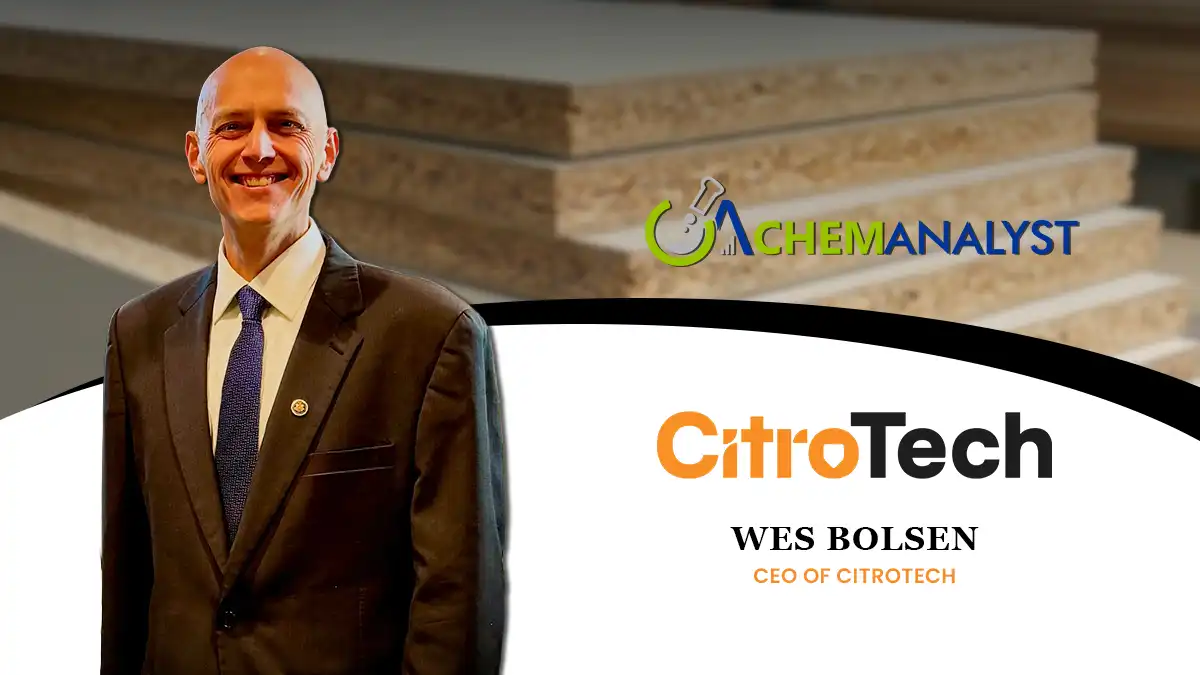
ChemAnalyst Talks with Wes Bolsen, CEO of CitroTech
CitroTech Inc. is manufacturing and deploying innovative, environmentally safe fire prevention solutions for homes, engineered wood products, wildfire prevention, and critical asset protection. Recognized as the only long-term fire inhibitor under the EPA Safer Choice program and tested to UL GREENGUARD Gold standards, CitroTech is advancing scientifically validated wildfire mitigation technologies while prioritizing human and environmental safety. Supported by a growing patent portfolio, scalable manufacturing approach, and recurring-revenue business model, the company is positioning itself at the forefront of next-generation fire-resistant materials and wildfire resilience solutions. ChemAnalyst spoke with Wes Bolsen about the company’s strategy to transform fire protection technologies across construction and infrastructure markets. Drawing on his experience in ag-tech, biofuels, and wildfire prevention technologies, Bolsen emphasized sustainable chemistry, integrated fire-resistant building materials, and long-term industry partnerships. He also highlighted CitroTech’s strategic joint venture with Hexion to accelerate commercialization and global adoption of advanced fire-protected wood solutions. Looking ahead, the company aims to establish fire-resistant engineered wood products as an industry standard while expanding applications across utilities, infrastructure protection, and wildfire defense systems.
Complete Interview with Wes Bolsen
Q1. Can you share a bit about your professional background and what specifically drew you to the field of fire protection and advanced wood protection technologies?
Wes Bolsen: My background is actually rooted in agriculture. I grew up raising cattle and quarter horses in Southern Illinois before moving into engineering and later attending business school. Throughout my career, I’ve been passionate about commercializing breakthrough technologies that can make a meaningful impact.
Before CitroTech, I worked extensively in biofuels, ag-tech, and wildfire prevention technologies. What attracted me to wildfire protection specifically was the opportunity to combine environmental responsibility with innovative science. Wildfire prevention is still a relatively small and underserved industry, which means there is enormous room for innovation.
At CitroTech, we saw an opportunity to introduce technologies that are not only effective in fire prevention but also environmentally safer and more sustainable than traditional solutions.
Q2. What was the defining market gap that motivated CitroTech to develop next-generation fire-protected wood solutions?
Wes Bolsen: Traditional fire-retardant wood treatments have relied heavily on pressure-treatment methods using chemicals such as borates or zinc borates. These methods often require wood to be incised or impregnated, which can weaken the structural integrity of the material itself.
We recognized a major gap in the market for a solution that could provide Class A fire protection without compromising wood strength or environmental safety. CitroTech’s chemistry works differently. Our technology penetrates the cellulosic fibers of wood at the molecular level without damaging the wood structure.
That creates a fundamentally different approach to fire protection—one that is safer, easier to integrate into manufacturing, and better suited for next-generation engineered wood products such as plywood, OSB, and LVL materials.
Q3. What was the strategic vision behind the joint venture between CitroTech and Hexion?
Wes Bolsen: The joint venture with Hexion was about combining best-in-class technology with global manufacturing and distribution strength.
CitroTech brought proprietary fire-retardant chemistry, extensive intellectual property, and innovation capabilities to the table. Hexion brought decades of industry relationships, manufacturing expertise, and trusted global access to major wood product manufacturers.
Instead of scaling through isolated partnerships, the joint venture allows us to accelerate adoption across the broader wood products industry globally. It creates an ecosystem where advanced fire-protected materials can become an industry-wide standard rather than a niche product.
Q4. Why was Hexion the ideal partner to scale CitroTech’s fire-retardant technology globally?
Wes Bolsen: Hexion already has deep relationships with many of the world’s largest wood products manufacturers. Their reputation, technical expertise, and global infrastructure are incredibly strong.
For CitroTech, partnering with Hexion allows us to move significantly faster in commercialization, manufacturing integration, and market expansion. Hexion understands engineered wood products, resins, and industrial-scale deployment better than almost anyone in the sector.
It truly became the perfect combination of CitroTech’s breakthrough chemistry and Hexion’s industrial execution capabilities.
Q5. How is CitroTech’s fire-retardant chemistry different from traditional borate-based fire inhibitors?
Wes Bolsen: Traditional treatments often rely on harsh chemicals and pressure-treatment systems that physically alter or weaken wood fibers. CitroTech’s chemistry is fundamentally different because it uses a citric-acid-based formulation derived from naturally occurring materials found in grains, fruits, and vegetables.
Our solution is designed to soak directly into the wood fibers at the molecular level. When exposed to high heat, it forms a protective char barrier that prevents the fire from penetrating deeper into the material.
What makes this especially important is that we can achieve fire protection while maintaining—or in some cases potentially improving—certain structural characteristics of the wood.
Q6. CitroTech is the only long-term fire inhibitor recognized under the EPA Safer Choice Program. How important is this validation commercially?
Wes Bolsen: It’s extremely important because it provides scientific credibility rather than marketing claims.
The Environmental Protection Agency’s Safer Choice recognition is not something companies can simply market themselves into. Either your product meets the environmental and safety criteria or it does not. CitroTech became the first and currently only fire retardant to receive this recognition.
In addition, certifications such as UL GREENGUARD Gold and ASTM E84 compliance reinforce that our technology delivers both environmental safety and real-world fire performance. Those certifications are critical when speaking with regulators, manufacturers, builders, and municipalities.
Q7. Do you believe the construction industry is moving toward built-in fire protection rather than post-treatment methods?
Wes Bolsen: Absolutely. The industry is increasingly shifting toward integrated fire protection systems.
The traditional approach of sending lumber out for pressure treatment is labor-intensive and less efficient. Manufacturers are now looking for technologies that can be integrated directly into the manufacturing process itself.
With CitroTech, we believe fire protection can eventually become built directly into products like OSB boards, plywood, engineered lumber, and other construction materials during production. Once the industry sees that this approach is more efficient, environmentally safer, and commercially viable, adoption accelerates quickly.
Q8. How are stricter building codes and wildfire risks influencing market demand?
Wes Bolsen: We are seeing tremendous demand growth driven by wildfire risks, insurance challenges, and stricter building codes.
Communities located near wildland-urban interfaces are increasingly difficult to insure. Builders, municipalities, and homeowners are actively looking for solutions that improve resilience and reduce fire risk exposure.
I believe future communities will increasingly prioritize Class A fire-rated building materials as a standard feature rather than an optional upgrade. This applies not only to residential housing, but also to commercial buildings, multifamily housing, utility infrastructure, and critical assets.
Q9. Beyond lumber, where else could CitroTech’s technology be applied?
Wes Bolsen: The opportunities extend far beyond wood products.
We see strong potential applications around utility infrastructure, power lines, railroads, military training areas, data centers, roadside vegetation management, and residential wildfire defense systems.
One major advantage of CitroTech is that the product can be applied proactively to high-risk areas before fires begin. Because the solution remains effective until physically washed away by significant rainfall, it offers long-lasting wildfire prevention capabilities compared to traditional water-based suppression systems.
We also see future opportunities involving drones, ground-based rapid deployment systems, and wildfire firebreak applications.
Q10. How is CitroTech addressing supply-chain risks and geopolitical uncertainties?
Wes Bolsen: One of the advantages of our chemistry is that many of the raw materials are derived from agricultural feedstocks rather than mined minerals.
Traditional phosphate-based retardants rely heavily on mining and global fertilizer supply chains, which are more exposed to geopolitical disruptions. Our production model allows for more localized and domestically scalable manufacturing.
We can manufacture CitroTech products using agricultural resources available across multiple regions globally, which creates a much more resilient and flexible supply chain.
Q11. What are the biggest challenges in introducing a fundamentally new fire-protection standard to the global construction market?
Wes Bolsen: The biggest challenge is always industry inertia. Many existing players have operated the same way for decades and naturally resist disruptive innovation.
However, when a technology demonstrates better performance, stronger environmental credentials, and improved economics simultaneously, the industry eventually shifts. That is what we believe is happening with CitroTech.
Our focus is not simply replacing older technologies—it’s helping create a safer and more proactive approach to wildfire prevention and fire-resistant construction globally.
Q12. Looking ahead five years, what does success look like for the CitroTech-Hexion partnership?
Wes Bolsen: Success means becoming the new industry standard for fire-protected building materials.
We envision a future where fire-resistant engineered wood products become widely adopted across residential, commercial, and industrial construction markets. Ideally, five years from now, builders and manufacturers will simply expect advanced fire-retardant technology to be integrated into the products they use every day.
That is the long-term vision we are working toward through the CitroTech-Hexion partnership.
Q13. What is the biggest leadership lesson from your previous wildfire technology ventures that you now apply at CitroTech?
Wes Bolsen: One of the biggest lessons I’ve learned is that relationships matter tremendously.
Wildfire prevention is still a relatively small industry, and long-term trust is critical. When you bring scientifically validated solutions that genuinely help communities, infrastructure providers, and environmental stakeholders, people recognize that value.
At CitroTech, our focus is not just selling a product—it’s delivering a practical, safer, and more sustainable solution to people and industries we’ve worked alongside for many years.








 About ChemAnalyst
Leave a Comment
Comments (0)