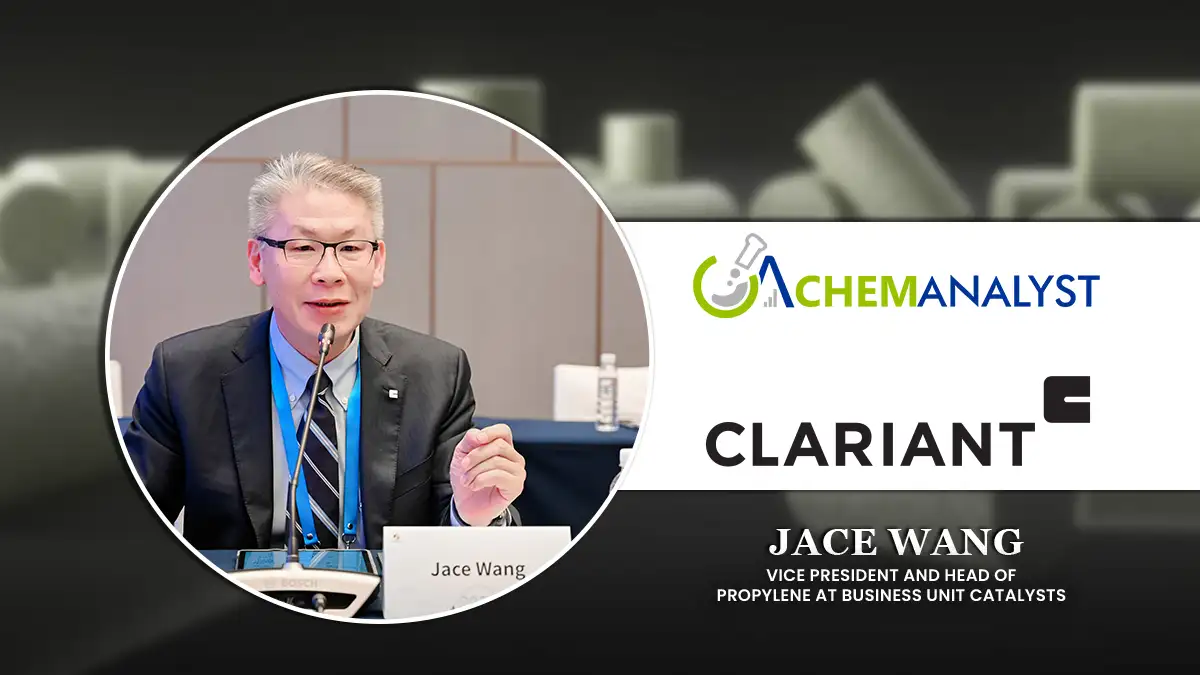
ChemAnalyst Talks with Jace Wang, Vice President and Head of Propylene at Business Unit Catalysts
Clariant, a leading Swiss specialty chemical company, develops innovative and sustainable solutions for industries including agriculture, automotive, packaging, and energy. Through its three core business divisions—Care Chemicals, Adsorbents & Additives, and Catalysts—the company addresses key global trends such as emission-free mobility, renewable raw materials, and energy efficiency. ChemAnalyst spoke with Jace Wang, Vice President and Head of Propylene at Clariant’s Business Unit Catalysts, about the company’s strategic vision for advancing next-generation propane dehydrogenation (PDH) technologies. Drawing on more than 25 years of leadership and industry experience, Wang highlighted the launch of CATOFIN™ 1000, Clariant’s latest breakthrough catalyst technology designed to improve selectivity, productivity, operational reliability, and catalyst lifetime while reducing tar formation and downtime. He also emphasized the importance of Clariant’s long-standing partnership with Lummus Technology, digital solutions such as CLARITY™, and innovations focused on decarbonization and circularity. Looking ahead, Clariant aims to strengthen its position in the global olefins market through continuous catalyst innovation, digital integration, and sustainable process technologies that support the evolving needs of the petrochemical industry.
Complete Interview with Jace Wang
Q1: Please provide an overview of your professional journey and leadership experience as Vice President and Head of Propylene at Clariant, and how your expertise has shaped your strategic vision for advancing next-generation PDH technologies, including the development of CATOFIN™ 1000.
Jace Wang: Leadership Role and Experience: As Vice President and Head of Propylene at Clariant's Business Unit Catalysts, I lead a strategically important segment. My 25-years journey included roles as Head of Sales Region China, Country Representative Taiwan, and Head of BU Catalysts China from February 2022, providing deep technical and commercial insights.
Strategic Vision for PDH Technology: My vision centers on continuous innovation and customer value. The PDH market is rapidly growing, with emphasizing the critical importance of technological leadership in this expanding space.
Development of CATOFIN™ 1000: CATOFIN™ 1000 represents breakthrough innovation, building on 60 years of proven performance. Key improvements include enhanced selectivity and productivity, extended lifetime, and up to 20% lower tar precursors. This significantly reduces fouling-related downtime, delivering superior plant economics and operational reliability for our customers.
Partnership and Market Success: Our partnership with Lummus Technology drives continuous CATOFIN process improvements, including Heat Generating Material (HGM) innovations. Since 2017, CATOFIN has been selected for over 40 new projects worldwide, including a recent 1,200 KTA PDH award in China, demonstrating strong market acceptance.
Looking Forward: My strategic focus remains on advancing next-generation technologies addressing evolving propylene industry needs. By combining technical excellence with market understanding and customer-centricity, we maintain CATOFIN's position as a globally leading catalyst technology and drive future PDH innovation.
Q2: What is the strategic vision behind the launch of CATOFIN™ 1000, and how significant is this development in strengthening Clariant’s position in the global PDH market?
Jace Wang: The strategic vision behind the launch of CATOFIN™ 1000 centers on continuous innovation leadership and strengthening Clariant's competitive position in the rapidly growing global PDH market. The launch demonstrates Clariant's unwavering commitment to delivering cutting-edge solutions that drive superior performance for our customers in the propylene industry, representing a major step forward in PDH technology.
Market Timing: The launch aligns with sustained global propylene demand growth (~3-4% annually) and continued PDH growth globally. PDH is among the fastest-growing technologies for propylene production due to lower costs and greater availability of propane feedstock.
Q3: From a technology standpoint, what are the key innovations behind CATOFIN™ 1000, particularly in terms of improved selectivity, higher productivity, reduced tar formation, and extended catalyst lifetime?
Jace Wang: CATOFIN™ 1000 represents a significant advancement achieved through the precise optimization of key catalyst promoters. This innovative approach delivers enhanced performance characteristics, including improved selectivity, extended catalyst lifetime, and substantially reduced fouling.
Q4: How do these performance enhancements translate into tangible economic benefits for PDH operators in terms of plant efficiency, maintenance cycles, and overall cost optimization?
Jace Wang: The economic impact is substantial: a mere 1% productivity improvement generates approximately $6 million in additional revenue for a standard 600 KTA plant. Equally significant, reduced fouling minimizes costly downtime and strengthens operational reliability—particularly valuable when considering that a single plant shutdown can incur losses up to or exceeding $2 million.
Q5: In comparison to other PDH catalyst technologies available in the market, how does CATOFIN™ 1000 differentiate itself in terms of performance, operational reliability, and lifecycle cost advantages?
Jace Wang: CATOFIN™ 1000 demonstrates superior performance with selectivity enhancements exceeding 1% versus previous generation catalysts and a reduction in tar precursors of up to 20%.
Q6: What unique strengths does the CATOFIN platform, particularly in collaboration with Lummus Technology, offer that set it apart from competing process technologies?
Jace Wang: CATOFIN™ technology delivers excellent reliability and high on-stream factors compared to alternative technologies, consistently meeting and exceeding design capacity. The technology offers exceptional economies of scale, low investment and operating costs, and attractive return on investment.
Q7: With the growing global demand for propylene, what key market trends are currently driving investments in PDH technologies, and how is this shaping the competitive landscape?
Jace Wang: We see strong demand in South America, the Middle East, and China despite the overcapacity in the market. Large capacity plants of up to 1200 KTA demonstrate that higher economies of scale are shaping the landscape.
Q8: How do you see the demand outlook for propylene evolving over the next three to five years across key end-use sectors such as packaging, automotive, and construction?
Jace Wang: Polypropylene demand is experiencing robust growth, driven by rising living standards, the expansion of e-commerce, and the electrification of the automotive sector.
Q9: To what extent is PDH technology expected to complement or compete with traditional steam cracking routes in meeting future propylene demand?
Jace Wang: PDH technology is expected to complement traditional steam cracking routes as the industry shifts toward lighter feedstocks such as ethane.
Q10: How important is the integration of digital solutions such as CLARITY™ in optimizing catalyst performance, and how does this enhance decision-making for plant operators?
Jace Wang: The integration of digital solutions like CLARITY™ is highly important for optimizing catalyst performance and enhancing plant operator decision-making. CLARITY™ cloud-based platform that provides 24/7 access to real-time catalyst performance data, advanced analytics, and automated alerts that trigger when key parameters exceed optimal levels. This enables operators to shift from infrequent quarterly evaluations to continuous, data-driven reactor optimization with features like performance projection tools, simulation capabilities, and direct access to Clariant's technical experts. The platform helps customers achieve improved plant productivity, reduced downtime, extended catalyst life, and reduced energy consumption. As of mid-2025, CLARITY™ has been adopted by over 185 customer plants and 700 users in 35 countries, demonstrating its significant value in transforming catalyst management from reactive to proactive. Ultimately, CLARITY™ enables data-driven decisions that optimize performance and improve overall plant economics.
Q11: From a supply chain perspective, how have recent geopolitical tensions and global conflicts impacted propane availability, pricing volatility, and PDH project economics?
Jace Wang: The conflict has significantly impacted PDH producers in Asia, where propane prices have spiked and supply availability has been constrained due to the closure of the Strait of Hormuz. In contrast, U.S. producers benefit from an advantaged feedstock position with access to abundant domestic propane supplies.
Q12: How can advanced catalyst technologies like CATOFIN™ 1000 help operators mitigate risks associated with supply disruptions, energy price fluctuations, and uncertain global trade conditions?
Jace Wang: CATOFIN 1000 Increases lifetime and gives the customer more flexibility for catalyst change-out planning. As a global company, CLARIANT has dual production sites for CATOFIN catalyst in both US and China, reducing geopolitical risks and supply disruption.
Q13: How are global PDH investments and trade flows evolving amid shifting geopolitical dynamics, including China-plus-one strategies and capacity expansions in regions like the Middle East and Asia?
Jace Wang: Global propane supply flows are shifting in response to U.S. trade policy changes. Asian customers are increasingly sourcing propane from the Middle East, while new PDH projects in South America are being driven by local demand and regional self-sufficiency policies. The Middle East is expected to maintain its position as a major propane exporter, leveraging its advantaged feedstock position.
Q14: What are the key commercialization challenges and opportunities associated with scaling the adoption of CATOFIN™ 1000 across existing and new PDH plants globally?
Jace Wang: CATOFIN 1000 is a drop-in solution and is being rolled out for both existing and new PDH plants.
Q15: How does this launch align with Clariant’s broader growth strategy in catalysts, and what role will innovation play in maintaining long-term competitiveness?
Jace Wang: We are a leader in innovation which aligns with the company’s growth strategy “Greater Chemistry—Between People and Planet.”
Q16: Looking ahead, what are the most critical areas of catalyst innovation that will shape the future of efficient olefins production, and how is Clariant preparing for these advancements?
Jace Wang: Decarbonization, and Digitalization are all shaping the future of olefin production.
Clariant's OxyMax™ E catalyst stands at the core of Linde Engineering’s revolutionary EDHOX™ process, utilizing oxidative dehydrogenation (ODH) of ethane to produce ethylene and acetic acid, fundamental building blocks that shape our modern world.
PDH customers selecting CATOFIN™ prioritize improved economics, reduced feedstock consumption, and enhanced reliability. Clariant provides innovative HDMax™ catalysts and Clarit™ adsorbents to enable effective chemical recycling of mixed plastic waste into high-quality feedstock. Regardless of process configuration or plastic waste feedstock, our adaptable products ensure highly effective purification to remove a broad range of contaminants at low total cost of ownership.








 About ChemAnalyst
Leave a Comment
Comments (0)