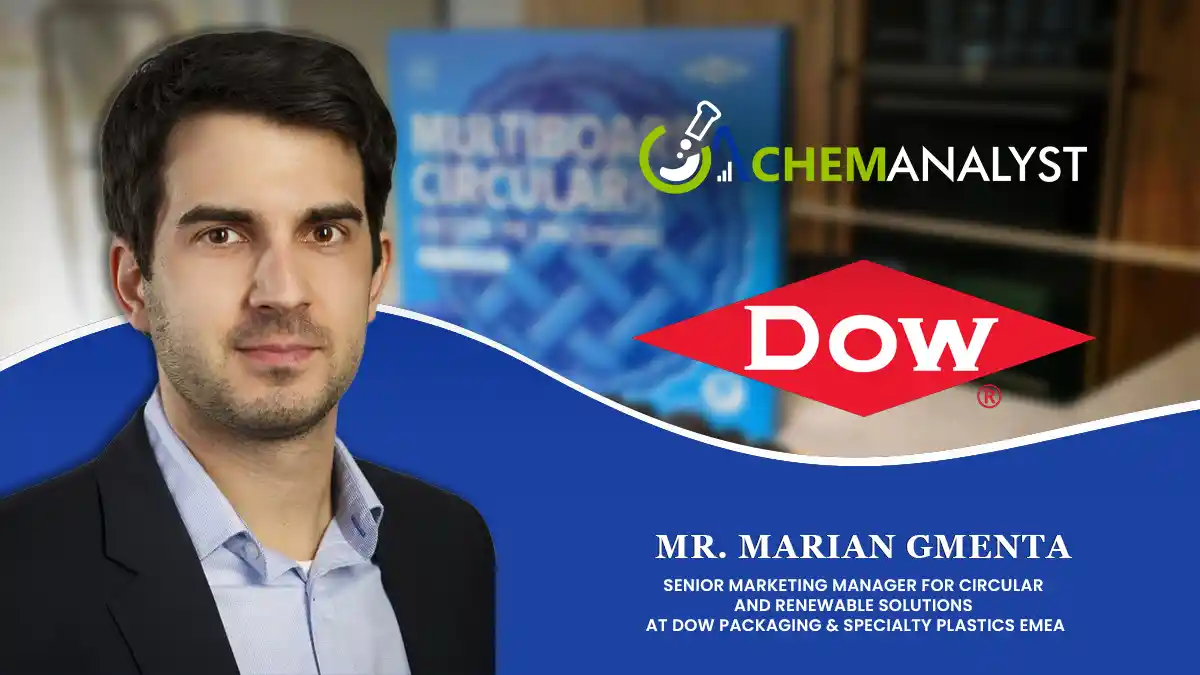
ChemAnalyst Talks with Mr. Marian Gmenta, Senior Marketing Manager for Circular and Renewable Solutions at Dow Packaging & Specialty Plastics EMEA
Dow is one of the world’s leading materials science companies, serving customers across high-growth sectors including packaging, infrastructure, mobility, and consumer applications. Leveraging its global scale, integrated asset base, and customer-centric innovation, Dow delivers advanced material solutions that support business growth while contributing to a more sustainable future. The company operates manufacturing sites in 29 countries, employs approximately 34,600 people worldwide, and generated sales of around $40 billion in 2025. ChemAnalyst spoke with Mr. Marian Gmenta, Senior Marketing Manager for Circular and Renewable Solutions at Dow Packaging & Specialty Plastics EMEA, about the evolving landscape of circular food packaging and the company’s approach to sustainable materials innovation. Drawing on his extensive experience across the packaging value chain, Gmenta highlighted the growing importance of system-level thinking that balances performance, food safety, and recyclability. He discussed Dow’s strategic collaboration with RDM Group to develop Multiboard CirculaRR, a packaging solution combining recycled fibre and advanced recycled plastics to meet demanding food-contact requirements. Looking ahead, he emphasized the critical role of advanced recycling technologies, cross-industry collaboration, and supportive regulatory frameworks such as the EU Packaging and Packaging Waste Regulation (PPWR) in accelerating the transition toward a circular packaging economy. He also underscored Dow’s continued investments in recycling technologies, circular polymers, and value-chain partnerships aimed at delivering scalable, high-performance packaging solutions that meet both sustainability goals and evolving consumer expectations.
Complete Interview with Mr. Marian Gmenta
Q: Mr. Marian Gmenta, please provide an overview of your professional journey within the sustainable packaging and circular materials industry, and share how your experience as Senior Marketing Manager for Circular and Renewable Solutions at Dow Packaging & Specialty Plastics EMEA has shaped your perspective on the future of circular and recyclable food packaging solutions.
Mr. Marian Gmenta: Over the course of my career, I’ve had the opportunity to work across the packaging value chain, which has given me a front-row view of how sustainability expectations have evolved – from early recyclability discussions to today’s focus on full system circularity.
In my current role at Dow, working on bringing to market circular and renewable solutions, that perspective has deepened. What stands out is that the future of food packaging isn’t about a single material or technology – it’s about designing systems that balance performance, safety, and circularity from the outset.
What excites me is how innovation – combined with collaboration across the value chain and industries – now allows us to rethink packaging solutions in a way that aligns both with regulatory expectations and real-world performance needs.
Q: The collaboration between Dow and RDM Group comes at a time when the packaging industry is facing mounting regulatory and sustainability pressures. From a strategic standpoint, how important is this collaboration in positioning both companies within the rapidly evolving circular packaging economy?
Mr. Marian Gmenta: This collaboration is highly strategic because it addresses one of the core challenges facing the packaging industry today: how to deliver circular solutions that are both technically viable and scalable.
By combining RDM Group’s expertise in recycled fibre with Dow’s capabilities in circular polymers and advanced recycling, we are demonstrating how complementary strengths across materials and the value chain can accelerate progress. Together, we’ve shown that it is possible to create a solution made exclusively from recycled materials while still meeting the high performance and food contact standards required for demanding food packaging applications.
Balancing performance, food safety and recyclability are some of the most complex challenges in packaging design. With Multiboard CirculaRR, this has been achieved through careful engineering of both the fibre structure and the polymer coating, using advanced recycled polyethylene to ensure food-contact compliance without compromising functionality and recyclability.
What this signals for the industry is that collaboration between materials – when designed with end-of-life in mind – can unlock new possibilities for circular packaging solutions. At a time of increasing regulatory pressure, collaborations like this are essential in moving from ambition to tangible, scalable solutions that help customers prepare for evolving requirements.
Q: The packaging industry has historically viewed paper and plastic as competing materials rather than complementary ones. How transformative is Dow and RDM Group’s collaborative approach in reshaping industry thinking around multi-material circular packaging systems?
Mr. Marian Gmenta: This collaboration is important in helping reframe the conversation.
Historically, fibre and plastic have often been positioned as competing solutions. What we are showing here is that, when designed with end of life in mind, fibre and plastics can work together to deliver both performance and circularity, helping move the industry beyond material trade-offs and towards system-level innovation.
Cross-material collaboration is essential. No single material or technology can solve the challenge of circular packaging alone.
The most meaningful progress happens when we bring together capabilities across materials, industries and the value chain – because that is what enables circular solutions to move from concept to scalable reality.
Q: Multiboard CirculaRR incorporates ISCC PLUS-certified recycled plastic sourced through advanced recycling. How critical will advanced recycling technologies become in helping the packaging sector meet future recycled-content mandates without compromising material quality or food safety standards? And how should governments, recyclers, packaging companies, and material producers collaborate to build an effective circular packaging ecosystem?
Mr. Marian Gmenta: Advanced recycling plays a critical role as a complementary pathway alongside mechanical recycling.
It enables us to process hard-to-recycle plastic waste that would otherwise be lost to landfill or incineration and convert it back into high-quality recycled materials. This is particularly important for applications such as food packaging, where material purity, safety and performance are non-negotiable, and where there is increasing pressure to meet ambitious recycled-content targets.
At the same time, no single technology can deliver circularity at the scale required. Advanced recycling must work alongside mechanical recycling as part of a broader, integrated system.
Building that system requires alignment across the entire value chain. This means policy frameworks that recognise and enable multiple recycling technologies; investment in collection, sorting and recycling infrastructure; and strong collaboration between material producers, converters, brands and recyclers.
Ultimately, delivering circular packaging at scale depends on connecting these elements – so that more waste is captured, more recycled material is brought back into use, and recycled content can be delivered without compromising quality or food safety.
Q: Consumers and major food brands are increasingly demanding packaging that delivers both sustainability and high functionality. How is this shift influencing investment priorities, innovation pipelines, and product development strategies within Dow Packaging & Specialty Plastics?
Mr. Marian Gmenta: We are seeing a clear shift toward solutions that combine sustainability with high performance – and that is fundamentally reshaping how and where we invest.
At Dow, this is accelerating our focus on scalable, application-ready innovations that help meet both regulatory requirements and real-world performance expectations.
Similarly to our collaboration with RDM Group, where we’ve combined recycled fibre and advanced recycled plastics to deliver a food-contact-compliant solution that is designed for recycling, we are applying the same approach across our broader innovation pipeline.
For example, we have recently worked with Zermatt and Nature’s Variety on recyclable pet food plastic packaging that incorporates food-contact-compliant recycled content from advanced recycling, and with Elopak and Orkla Home and Personal Care on a first-of-its-kind fiber-based carton integrating circular and bio-circular polymers.
We are also investing across a diverse portfolio of circular solutions – from advanced recycling partnerships like Xycle and Mura Technology, to investments in mechanical recyclers like Circulus, and material innovations like our innovative REVOLOOP™ Recycled Plastics Resins and broad range of recycling compatibilizers that help enable higher recycled content in technically demanding applications.
Sustainability is no longer a separate dimension of product development – it is fully embedded into how we innovate, partner and scale solutions with our customers and value chain partners.
Q: The solution was independently assessed under the 4evergreen recyclability protocol. How important are third-party validation systems and certifications such as ISCC PLUS becoming in helping companies establish credibility and avoid concerns around greenwashing?
Mr. Marian Gmenta: Third-party certifications are becoming increasingly critical. Standards such as ISCC PLUS and frameworks like 4evergreen provide transparency, traceability and credibility. This is essential in addressing concerns around greenwashing and enabling brands to make substantiated claims.
Q: As global regulators intensify their focus on packaging waste reduction, how do you see the EU Packaging and Packaging Waste Regulation (PPWR) influencing innovation priorities, investment decisions, and packaging design strategies across the value chain over the next five years?
Mr. Marian Gmenta: The EU PPWR is a major catalyst for innovation across the packaging industry. It is accelerating a shift toward designing packaging with the full system in mind – from recyclability and material efficiency through compatibility with existing collection and recycling infrastructure.
In practical terms, this means three things are moving up the agenda:
• Designing for recyclability from the outset
• Increasing the use of certified recycled content
• Ensuring packaging works within real-world recycling systems
Over the next five years, PPWR will continue to drive investment toward innovations that are not only compliant, but also scalable and economically viable – pushing the entire value chain toward more integrated, system-based approaches to circular packaging.
Q: The ongoing geopolitical conflicts in the Middle East and disruptions around critical trade routes have significantly impacted global petrochemical supply chains. From Dow’s perspective, how are these developments reshaping the economics and operational strategies of the global packaging and chemicals industry?
Mr. Marian Gmenta: Geopolitical disruptions are increasing volatility across energy markets, feedstock availability and global logistics – and that is reshaping how the packaging and chemicals industry thinks about resilience.
In this environment, there is a growing recognition that circularity is not only a sustainability priority, but also a strategic lever. By reducing reliance on virgin fossil-based feedstocks and enabling greater resource efficiency, circular solutions can help strengthen supply security and long-term competitiveness.
At Dow, we are adapting by diversifying sourcing and leveraging our global asset footprint; investing across a range of recycling technologies, including both mechanical and advanced recycling; as well as strengthening collaborations across the value chain to improve flexibility and responsiveness.
This multi-pathway approach helps us manage risk while continuing to scale circular solutions for our customers because circular packaging innovation is evolving beyond just an environmental ambition – it is becoming an integral part of building more resilient, future-ready supply chains.
Q: As Dow continues expanding its circular and renewable packaging portfolio, what major technological, regulatory, and consumer-driven shifts do you believe will most strongly shape the next generation of sustainable food packaging solutions over the coming decade?
Mr. Marian Gmenta: Looking ahead, I see three major shifts shaping the next generation of food packaging:
• Technology and material innovation: expanding access to high-quality recycled content, including for technically demanding applications
• Regulation: clearer, more harmonised frameworks that accelerate investment and create stronger market demand pull for circular and renewable solutions
• Consumer and brand expectations: increasing demand for packaging that combines credible sustainability benefits with uncompromised performance and functionality
These forces are converging, and the companies that will succeed are those able to connect technology, regulation and customer needs – developing solutions that are not only innovative, but also scalable, compliant and commercially viable.








 About ChemAnalyst
Leave a Comment
Comments (0)