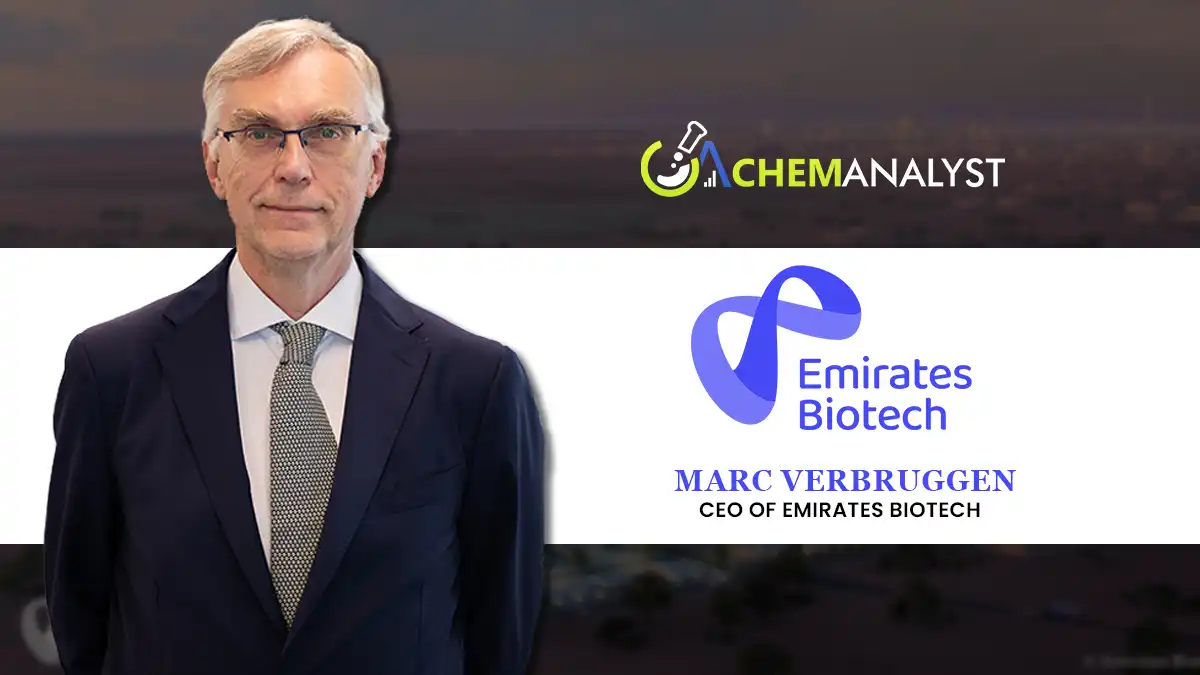
ChemAnalyst Talks with Marc Verbruggen, Chief Executive Officer of Emirates Biotech
Emirates Biotech, a UAE-based pioneer in sustainable materials, is advancing the commercialization of plant-based, biodegradable, and recyclable Embio PLA biopolymers in the Middle East. Headquartered in Dubai, the company is committed to supporting a circular economy through innovative alternatives to conventional plastics, with plans to establish a large-scale production facility in Abu Dhabi. ChemAnalyst spoke with Marc Verbruggen, Chief Executive Officer of Emirates Biotech, about the company’s strategic direction amid evolving global and regional dynamics. Drawing on his leadership perspective, Verbruggen emphasized long-term resilience, global collaboration, and the importance of feedstock innovation, particularly in lactic acid production. He highlighted the company’s participation in international initiatives such as the Circle Consortium to stay aligned with emerging technologies, while also underlining the significance of sustainability-driven value creation. Looking ahead, Emirates Biotech aims to scale its PLA production capabilities, expand research and development, and position itself as a key player in the global bioplastics ecosystem.
Complete Interview with Marc Verbruggen
Q: Emirates Biotech joining the Circle Consortium represents a significant strategic move. Beyond access to technology, what competitive advantage does this collaboration unlock? Additionally, how are you reassuring global partners about long-term investment stability amid heightened regional tensions?
Marc Verbruggen: If you are a PLA producer, your key raw material is lactic acid. When analyzing the cost structure of PLA production, lactic acid is the dominant factor. As a future PLA producer, it is critical for us to stay aligned with global developments in lactic acid production.
This is precisely why we joined the consortium—to explore whether lactic acid can be produced efficiently from food waste. Regarding regional tensions, we have no influence over them, but like everyone else, we hope they are resolved in the coming weeks or months.
Our strategy is firmly long-term. We are planning for the next 10–20 years, and we view the current situation as a short-term disruption. While we are actively monitoring developments, we remain confident that stability will return soon.
Q: As a Middle East-based company participating in a European initiative, how does this partnership strengthen your position?
Marc Verbruggen: PLA production is inherently a global business. Our competitors operate worldwide, and therefore it is essential for us to track technological advancements regardless of geography.
Whether innovations originate in Europe, the United States, or elsewhere, they are relevant to us. Participation in such initiatives ensures we remain competitive and informed.
Q: With the recent surge in Iranian ballistic and drone strikes targeting UAE infrastructure, how has Emirates Biotech adjusted its risk management strategy for the upcoming Abu Dhabi plant construction?
Marc Verbruggen: That is a very relevant question. While we have already procured long-lead equipment, construction has not yet begun and was scheduled to start in the coming months.
Given the current environment, construction is temporarily on hold due to logistical challenges and safety concerns. We are closely monitoring the situation and evaluating contingency plans, including alternative options in a worst-case scenario.
That said, our primary expectation remains that the situation will stabilize, allowing us to proceed with construction. Currently, ports are closed, equipment is dispersed globally, and no on-site activity is taking place. While this is disruptive, we hope the impact will be short-term.
Q: Samsung E&A contractors are handling site security for the Abu Dhabi plant. Considering their use of smart patrol robots and AI-based systems globally, are such technologies being deployed at KEZAD in response to current threats?
Marc Verbruggen: Not at this stage. Samsung has primarily completed the FEED (Front-End Engineering Design) work for us. The final decision regarding the EPC contractor for construction is still pending.
Q: Scaling from lab to production is challenging. What are the biggest hurdles in converting food waste into bioplastics? Has the current conflict accelerated your efforts to localize feedstock sourcing?
Marc Verbruggen: Our plant commissioning is scheduled for 2028, so we are not yet dependent on feedstock availability. However, if we were operational today, supply disruptions would likely force shutdowns due to import challenges.
The situation does highlight the importance of local feedstock development. However, even local lactic acid production requires inputs such as corn or sugar, which also depend on global logistics.
Food waste offers potential, as it is locally available. However, the technology is still under development.
It is not yet proven to be economically or operationally viable at scale.
Importantly, our 2028 plant commissioning will rely on conventional feedstocks. Food waste-based production is a longer-term opportunity beyond that timeline.
Q: Traditional plastics track oil prices. How does PLA remain competitive during volatility, especially with maritime insurance premiums in the Gulf rising sharply?
Marc Verbruggen: Our business model is based on general economic conditions, not short-term disruptions like wartime scenarios.
Currently, the UAE plastics market is experiencing significant disruption due to restricted imports and exports. While we are not yet producing PLA commercially, we are engaging with customers to navigate short-term supply challenges.
The situation is evolving, and it is too early to determine the long-term impact on pricing dynamics.
Q: Where is the strongest demand for PLA currently coming from?
Marc Verbruggen: PLA is highly versatile, with applications ranging from food service and packaging to 3D printing and automotive components.
This diversity is one of its key strengths. Producers must strategically decide which segments to prioritize. In the UAE, the plastics market is several million tons annually, while our planned capacity is around 80,000 tons—roughly 2%. Globally, larger markets like China, India, and Europe present even greater opportunities.
Q: Are you observing a shift toward supply chain security, where customers prioritize materials less dependent on volatile global logistics?
Marc Verbruggen: Such strategic shifts typically occur after a crisis, not during it. Currently, companies are focused on securing immediate supply rather than long-term strategy.
However, once stability returns, there will likely be broader discussions about reducing dependence on oil-based feedstocks and volatile supply chains.
Q: How are you incorporating current war risk premiums into your long-term pricing strategy for the Embio range?
Marc Verbruggen: Short-term oil price spikes do not significantly influence our long-term pricing strategy.
Our focus is on the value proposition of PLA—its sustainability, low carbon footprint, and in some cases, superior performance. The key question is what premium customers are willing to pay for these benefits.
Long-term pricing decisions are based on value creation, not temporary market disruptions.
Q: Is the Abu Dhabi plant being designed with localized or off-grid energy solutions to mitigate risks from potential infrastructure disruptions?
Marc Verbruggen: Our utilities will primarily depend on local infrastructure, similar to other regional plants. We will generate our own steam, but, for example, electricity, natural gas and wastewater systems rely on existing infrastructure.
The biggest vulnerability lies in logistics—specifically, the movement of raw materials and finished products.
Q: How important is the polymerization step, and does having this capability locally help mitigate logistical risks?
Marc Verbruggen: PLA is not yet a fully commoditized plastic. Unlike polyethylene or PET plants, turnkey PLA solutions are not readily available.
Building a PLA plant involves assembling various components and expertise—essentially solving a complex puzzle. Of course, having the last manufacturing step – polymerization – locally will help developing the PLA market but is far from being the only critical parameter.
Q: Is the waste-to-plastic model practical today given current supply chain disruptions?
Marc Verbruggen: Not yet. The primary challenge is technological readiness. The process has not been proven at scale in terms of economics, consistency, or sustainability.
This remains a development-stage initiative, not an immediate deployable solution. Commercial viability may emerge in the next five years.
Q: How are you investing in research and innovation to stay ahead?
Marc Verbruggen: Our immediate focus is building a plant using the most advanced available technology.
At the same time, we are investing in next-generation PLA development. We expect to announce a significant expansion of our R&D capabilities within the next 30–45 days.
Q: Are there any upcoming partnerships involving automation or digital technologies?
Marc Verbruggen: Nothing has been publicly announced yet. However, we are actively monitoring developments in process innovation, applications, and product advancements, and we are prepared to engage when the right opportunities arise.
Q: Are sustainable plastics close to becoming mainstream?
Marc Verbruggen: Global plastic production is around 200–300 million tons annually, while PLA accounts for only about 500,000–600,000 tons.
We expect significant growth into the millions of tons, but PLA will remain a fraction of total plastic consumption. It will, however, evolve from a niche product into a viable alternative across multiple applications.
Q: Does the current crisis delay or accelerate the transition to circular materials?
Marc Verbruggen: It depends on the duration of the crisis. A short disruption will have minimal long-term impact.
However, a prolonged crisis could accelerate interest in alternatives to oil-based plastics. That said, sustainability challenges such as recycling and microplastics remain global priorities regardless of geopolitical events.
Q: Do you believe the UAE will emerge from this conflict as a more self-reliant circular industrial hub, or is the 2030 green agenda at risk?
Marc Verbruggen: I of course cannot speak for the UAE government but, based on my experience in the region, I believe the UAE remains strongly committed to its sustainability goals.
The current slowdown is temporary. Once the conflict is resolved, I expect renewed investment and potentially even stronger momentum toward becoming a global sustainability hub.
Q: Where do you see Emirates Biotech five years from now?
Marc Verbruggen: We aim to have at least one, possibly two, PLA plants operational.
Beyond the GCC region, we will explore expansion opportunities globally, particularly in regions where PLA production is currently absent, such as Southeast Asia and parts of Africa.








 About ChemAnalyst
Leave a Comment
Comments (0)