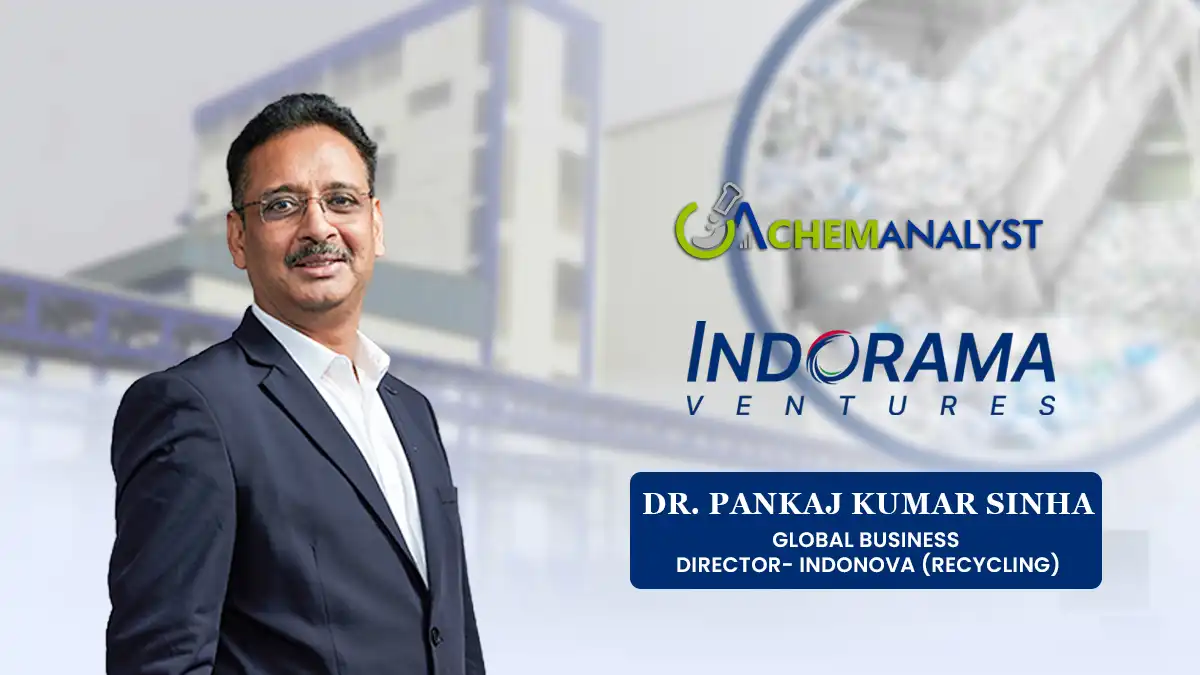
ChemAnalyst Talks with Dr. Pankaj Kumar Sinha, Global Business Director- IndoNova (Recycling), Indorama Ventures
Indorama Ventures Public Company Limited (IVL) is a leading global sustainable chemicals company and the world’s largest producer and recycler of polyethylene terephthalate (PET), serving customers across packaging, specialty chemicals, and fiber markets. Headquartered in Bangkok, Thailand, the company operates more than 100 manufacturing facilities in over 30 countries, with a strong focus on advancing circular economy solutions through recycling and sustainable packaging innovation. Through its Combined PET and Packaging, Indovinya, and Fibers business segments, Indorama Ventures delivers critical materials and technologies that support industries ranging from food and beverages to automotive, healthcare, and consumer goods.
ChemAnalyst spoke with Dr. Pankaj Kumar Sinha, Global Business Director – IndoNova (Recycling) at Indorama Ventures, about the company’s landmark investment in Africa’s recycling infrastructure and the future of circular packaging. Drawing on his extensive experience across the PET value chain—from packaging and bottle manufacturing to virgin PET production and recycling—Dr. Sinha highlighted the strategic significance of Indorama Ventures’ partnership with Nigerian Breweries and Genesis Energy to establish Nigeria’s largest food-grade PET recycling facility, adding to its global footprint of more than 20 recycling sites. He emphasized the importance of strengthening collection systems, expanding bottle-to-bottle recycling capacity, and fostering cross-sector collaboration to accelerate circular economy development across Africa. Looking ahead, Dr. Sinha underscored the growing global demand for food-grade recycled PET (rPET), driven by sustainability commitments, regulatory mandates, and technological advancements, positioning Africa as an emerging growth market in the global circular packaging ecosystem.
Complete Interview with Dr. Pankaj Kumar Sinha
Q1: Dr. Pankaj Kumar Sinha, please provide an overview of your professional journey within the global recycling, circular economy, and sustainable packaging sectors, and share how your experience as Global Business Director – Recycling at Indorama Ventures has shaped your strategic perspective on advancing PET recycling infrastructure and circular packaging solutions across global markets.
Dr. Pankaj Kumar Sinha: My professional journey has, in many ways, mirrored the circular economy we are trying to build today. I started on the shop floor in a plastic packaging company, then moved into bottle manufacturing equipment, followed by virgin PET production and sales, and now into recycling manufacturing. I joined Indorama Ventures as Head of PET Marketing – India in the Combined PET segment (CPET) before assuming the role of Global Recycling Business Director, CPET. This career journey gives me a practical understanding of the full PET value chain, from how packaging is designed and produced, to how it is collected, recycled and turned into new food-grade applications. So, my career has come full circle—very similar to the bottle-to-bottle circularity model we are driving.
This end-to-end exposure has been incredibly valuable in shaping my strategic perspective in the PET and recycling industry. It allows me to look at the business holistically from inbound logistics like bottle collection, plant operations, to outbound supply chains, customer demand and policy support. Therefore, my role is not only about expanding recycling capacity but also building the system that is scalable and meets market and regulatory demand.
I have always been deeply passionate about PET packaging and advancing circularity, particularly in enabling food and beverage applications to adopt recycled content at scale. Leading the recycling business ‘IndoNova’ at Indorama Ventures, whose commitments are anchored in scaling recycling infrastructure, strengthening collection systems, and building partnerships across the value chain, efforts that have positioned us as the world’s largest recycler of PET for beverage bottles, gives me a deep sense of pride and motivation. It is immensely fulfilling to be part of an organization that is placing circularity and sustainability at the core of its strategy, and to contribute alongside my team in building the infrastructure required to enable this transition at scale.
Recycling is a highly complex business, requiring alignment across multiple stakeholders, supply chain layers, and regulatory frameworks. But it is precisely this complexity that makes it both strategically exciting to build and scale.
1 As a publicly listed company, Nigerian Breweries' participation is subject to compliance with all applicable regulatory and disclosure requirements
Q 2: The recently announced partnership between Indorama Ventures, Nigerian Breweries, and Genesis Energy represents one of the largest recycling infrastructure investments in Africa to date. From a strategic perspective, how transformative could this project be for the development of Africa’s circular packaging economy?
Dr. Pankaj Kumar Sinha: From a strategic standpoint, this project represents a structural inflection point for Africa’s circular packaging ecosystem. Historically fragmented and downcycling-oriented, the project creates a pathway toward industrial-scale, food-grade, bottle-to-bottle circularity in the region.
Complete circularity in the region requires alignment across collection, recycling, and market demand—which this project directly addresses. The project also helps to drive EPR frameworks which support brand owners and converters to achieve their sustainability goals.
In the socio-economic aspect, this investment serves as a major employment catalyst, driving job creation across collection, sorting, aggregation, and logistics—formalizing circularity network, improving livelihoods, and creating safer, more traceable value chains.
Q3: Indorama Ventures has described the Nigeria project as both its first recycling investment in Africa and the largest recycling plant the company has ever built globally. What made Nigeria the right entry point for this landmark investment?
Dr. Pankaj Kumar Sinha: Indorama Ventures already has a strong presence in Nigeria as a virgin PET and PET packaging producer, supplying several global and regional brand owners. Our established footprint, combined with over 15 years of expertise in bottle-to-bottle recycling, gives us deep market insight and positions us as a strategic partner for brand owners and converters seeking to advance their circularity goals and EPR commitments. The partnership with Nigerian Breweries further reinforces this alignment, ensuring long-term demand visibility and offtake certainty, which is critical for scaling recycling infrastructure and supporting a sustainable circular economy. Genesis Energy also supports the initiative with sustainable infrastructure and energy expertise.
This initiative also aligns with Nigeria’s National Policy on Plastic Waste Management, introduced in 2020 to strengthen collection, recycling, and circular economy solutions, with the goal that all plastic packaging be recyclable, biodegradable, compostable, or reusable by 2030. Lagos, as Nigeria’s commercial hub, provides a strategic base to develop recycling infrastructure capable of serving both national and regional demand.
In summary, Nigeria brings together strong market presence, customer-backed sustainability demand, and the right technological timing, making it not just an entry point, but a strategic anchor market for circular plastics in Sub-Saharan Africa.
4. Africa’s recycling infrastructure remains underdeveloped compared with Europe or North America. What structural gaps in collection systems, waste management, and policy frameworks does this project aim to address?
Dr. Pankaj Kumar Sinha: The project is designed to address three fundamental systemic gaps:
1. Collection System Fragmentation
PET recovery remains heavily dependent on the informal networks, with inconsistent aggregation and sorting quality and limited traceability. By supporting more structured collection partnerships with NGOs and waste aggregators, the plant project can introduce formal demand discipline, drive supply reliability and strengthen the overall recycling ecosystem.
2. Processing & Food-Grade Capacity Gap
While recycling activities exist in Nigeria, food-grade closed-loop rPET capacity remains significantly limited. This facility establishes a global standard, bottle-to-bottle recycling capability, supported by Indorama Ventures’ expertise in operating procedures, quality compliance, and industry best practices, along with its experience partnering with brand owners and waste aggregators to build robust bottle-to-bottle value chains. Additionally, Indorama Ventures’ operating experience across Europe and North America, in which food-grade regulatory requirements are highly rigorous, enables us to effectively address challenges related to bottle decontamination, process consistency, and technical complexity, leveraging proven learnings from these mature recycling markets.
3. Policy-to-Execution Gap (EPR Implementation)
Nigeria has made progress in EPR frameworks and circular economy policy, but these require industrial-scale infrastructure to become actionable. This project is the key enabler, providing a credible endpoint for EPR systems, turning regulatory intent into environmental and economic impact.
Strategically, the project serves as a bridge between policy ambition and market execution that will truly drive the circular economy in the region.
Q5: The facility is expected to produce up to 45,000 tons of food-grade rPET annually. How significant is this scale in the context of Africa’s current rPET market, and what impact could it have on regional supply-demand dynamics?
Dr. Pankaj Kumar Sinha: With a capacity of ~45,000 tons annually, the project is considered to have market-defining capacity in the African context, especially against a projected PET market of ~350 KT by 2027, where Indorama Ventures currently holds ~35% share in virgin PET. Building on this, the investment is designed to support a key percentage of our existing Virgin PET customer base, enabling their transition toward sustainability and circularity commitments.
This investment supports multiple dimensions of the recycling landscape in Nigeria and across Africa. By establishing a reliable source of food-grade recycled PET (rPET), the project helps stabilize supply and meet growing demand from regional converters and brand owners. At the same time, increased demand for post-consumer PET bottles is expected to strengthen collection systems, improve collection efficiency, and promote greater pricing discipline across the value chain.
As one of the world's fastest-growing PET markets, Africa is well positioned to support rising domestic demand while also serving as a strategic hub for future export opportunities. Together, these developments will strengthen the region's recycling ecosystem, establish a new benchmark for recycling infrastructure, and accelerate the transition toward a more circular economy.
Q6: Food-grade rPET production requires high-quality feedstock and advanced processing capabilities. What are the biggest technical and operational challenges in scaling food-grade PET recycling capacity in emerging markets such as Nigeria?
Dr. Pankaj Kumar Sinha: The core challenge we face in Nigeria is not technology, but feedstock consistency and ecosystem maturity.
To operate efficiently, a consistent supply of post-consumer PET bottles with appropriate sorting and quality standards is essential. To achieve this, we are developing collection partnerships across the value chain and implementing a washline design tailored to local feedstock conditions in close collaboration with our OEM partners. In addition, we are investing in integrated AI and digital technologies to optimize operations, enhance process control, and ensure the consistent production of high-quality food-grade rPET. In addition to partnerships and technology, we leverage globally standardized operating processes and management systems supported by experienced operations and leadership teams. This helps ensure consistent product quality, while maintaining a safe, compliant, and reliable operating environment.
Q7: This initiative combines expertise from packaging, recycling, infrastructure, and energy sectors. How critical are cross-sector partnerships in building commercially viable and scalable circular economic ecosystems in developing regions?
Dr. Pankaj Kumar Sinha: The most critical enabler in emerging circular economies is cross-sector collaboration as no single stakeholder can build circularity alone. This project is a strong example of that philosophy, bringing together complementary expertise from leading partners.
In this project, Indorama Ventures leads implementation, technology selection, procurement, and plant operations; Nigerian Breweries, a Heineken operating company and the largest brewery in the country anchors demand and drives recycled-content adoption; and Genesis Energy provides energy infrastructure, ensuring stable and uninterrupted power supply to support reliable operation.
In parallel, the initiative also engages local government agencies to strengthen collection systems, while also promoting awareness around the benefits of recycling—helping build a more informed and structured ecosystem.
This alignment across supply, processing, demand, infrastructure, and policy engagement creates a strong foundation for both commercial viability and long-term ecosystem development.
Q8: Nigerian Breweries brings strong market access and local ecosystem engagement to the partnership. How important is collaboration with major beverage companies in accelerating closed-loop packaging systems and increasing recycled-content adoption?
Dr. Pankaj Kumar Sinha: Collaboration with major beverage companies is critical to building a scalable closed-loop bottle-to-bottle system.
Partnership with brand owners is critical, as it directly supports their EPR commitments and broader sustainability goals. It enables a more coordinated approach to plastic waste management, aligning demand, collection, and recycling efforts.
Importantly, brand owners have made strong commitments to global sustainability platforms, and their active participation helps create long-term demand for recycled materials, ultimately accelerating the adoption of higher recycled content in packaging solutions.
In Nigeria, this becomes even more important as EPR implementation and recycled-content mandates increasingly converge around the food and beverage sector. Their involvement ensures both:
Q9: Genesis Energy is supporting the project through sustainable infrastructure and clean energy solutions. How important is energy resilience and low-carbon infrastructure in improving the long-term economics of recycling operations?
Dr. Pankaj Kumar Sinha: Recycling economics in Africa are not just material-driven but also energy-driven. In manufacturing, power instability can directly affect plant uptime, production consistency, product quality and cost structures. For food-grade rPET production, where quality and reliability are critical, energy stability becomes a strategic requirement.
Therefore, energy resilience becomes a strategic lever, not just an operational consideration.
Equally, as global ESG frameworks evolve, low-carbon recycling infrastructure is becoming a competitive differentiator. Customers increasingly evaluate not only recycled content, but also the carbon intensity of recycled materials.
Q10: The project aligns with Nigeria’s National Policy on Plastic Waste Management and the country’s 2030 circular packaging ambitions. In your view, how influential are government regulations and policy incentives in attracting long-term recycling investments into Africa?
Dr. Pankaj Kumar Sinha: Government policy and regulation are critical to the long-term development of recycling infrastructure. Given the capital-intensive nature of recycling projects and their long investment horizons, stable and well-defined regulatory frameworks provide the certainty needed to support infrastructure development, strengthen collection systems, and drive the adoption of recycled content.
In Nigeria, the evolving policy environment is helping transform circularity from a voluntary effort into a structured market opportunity. A strong policy framework creates certainty for stakeholders across the value chain, encouraging investment in collection, supporting market development, and enabling the long-term growth of a circular economy.
Q11: Globally, packaging companies are under increasing pressure to meet recycled-content mandates and ESG targets. How do you see demand for food-grade rPET evolving across global beverage and packaging markets over the next decade?
Dr. Pankaj Kumar Sinha: Demand for food-grade rPET is expected to grow strongly over the next decade. This is driven by regulation, capacity development and advancement in technology.
Regulation is the primary catalyst, with governments globally introducing recycled-content mandates and EPR frameworks that are transforming sustainable packaging from a voluntary initiative into a regulatory requirement.
As global brands seek reliable, high-quality recycled materials to meet their sustainable packaging commitments, investment in capacity expansion and large-scale recycling infrastructure will continue to grow to meet increasing customer demand and support them in meeting the regulatory requirements.
Technology also plays a critical role as AI and digitalization in manufacturing continue to evolve. They help improve productivity, optimize cost structures, and unlock further benefits through economies of scale.
Together, the convergence of regulation, capacity expansion, and technology advancement provides strong structural support for a robust and growing demand outlook for food-grade rPET globally.
Q12: One of the biggest concerns in emerging recycling markets is the informal waste collection sector. How can companies, governments, and local communities collaborate to create inclusive recycling systems that also generate social and economic value?
Dr. Pankaj Kumar Sinha: Creating inclusive recycling systems requires strong alignment between policy, industry, and communities.
Governments can enable structured collection infrastructure, introduce incentives to formalize the sector and ensure a consistent regulatory framework across the value chain to support the long-term investment and scalability in recycling system development.
Industry can contribute by creating demand for high-quality feedstock, supporting collection partnerships, and investing in training programs that promote proper collection practices and safety standards throughout the collection value chain.
Equally important is the role of local communities as recycling behavior begins at the point of disposal. Building long-term recycling habits requires sustained education and awareness on plastic waste management and recycling, using multiple channels to drive behavioral change and improve collection rates.
When these elements come together, they help create a system that not only improves recycling outcomes but also generates meaningful social and economic value.
Q13: The global PET and rPET markets are becoming increasingly competitive as multinational brands accelerate sustainability commitments. Do you believe Africa could emerge as a major future growth market for recycled packaging materials?
Dr. Pankaj Kumar Sinha: Yes, Africa has strong potential to emerge as a major future growth market for recycled packaging materials, particularly as demand for sustainable packaging continues to accelerate.
This growth is not limited to Africa. We are seeing a structural increase in demand for rPET globally. This is driven by regulatory mandates, brand-owner commitments, and evolving consumer demands.
In this context, Africa represents a high-growth frontier, where rising consumption, improving policy frameworks, and increasing investment in recycling infrastructure can collectively position the region as an important contributor to the global circular packaging ecosystem.
However, growth will be likely phased and market specific. Countries such as Nigeria, which combine strong demand, supportive policy momentum, and industrial investment, are well positioned to lead the development of the circular economy in the region.
Q14: Advanced recycling technologies are receiving growing global attention alongside mechanical recycling. How do you see advanced recycling complementing traditional PET recycling infrastructure in supporting future circular economic goals?
Dr. Pankaj Kumar Sinha: Currently, advanced recycling technologies are still in the early stages of commercialization, with many solutions currently in pilot or pre-commercial phases. At Indorama Ventures, we are also investing in complementary innovations such as single pellet solutions and flakes-to-preform technologies, which represent evolving pathways within advanced recycling and expand the range of circular solutions for our customers.
Going forward, we see that mechanical and advanced recycling will be complementary, rather than competing solutions. While mechanical recycling will remain as the backbone of the large-scale rPET production, advanced solutions will help address more complex or lower-quality feedstock streams that are difficult to recycle mechanically.
Together, this combination will strengthen the overall recycling infrastructure and play a critical role in accelerating circular economic outcomes over the long term.
Q15: Global consumer brands are increasingly committing to higher recycled-content targets while also demanding food-grade quality and stable supply. How challenging is it for the global rPET industry to balance rapidly rising demand with limited availability of high-quality recycled feedstock?
Dr. Pankaj Kumar Sinha: Balancing rapidly rising demand with limited availability of high-quality feedstock is one of the most critical challenges for the global rPET industry. At its core, the issue is feedstock availability and quality consistency, which makes it essential to strengthen every stage of the supply chain, from collection, sorting to decontamination.
From IndoNova’s global operation across five continents, we see different dynamics across regions. In Europe, there is a strong focus on implementing Deposit Return Schemes (DRS) to improve collection rates and ensure higher-quality feedstock for recycling. In Asia, while collection is relatively strong due to informal collection network, it results in relatively strong recovery rates. Significant portion of the post-consumer PET bottles has traditionally been diverted to textile applications, a trend that is now gradually shifting toward food-grade recycling as demand for recycled content in packaging continues to grow. Ultimately, strengthening and formalizing the end-to-end supply chain—from collection to processing—will be the key enabler to meet the rapidly growing global demand for food-grade rPET.
Q16: Several regions are now competing aggressively to secure recycled plastic supply amid tightening regulations and ESG pressures. Do you foresee the emergence of a global “recycled materials supply race,” and how could this influence future investment decisions and pricing trends in the PET and rPET markets?
Dr. Pankaj Kumar Sinha: While competition for recycled materials is increasing globally, the ability to meet this growing demand will ultimately depend on the strength of local recycling ecosystems. Circular economy frameworks and plastic waste management regulations are designed to ensure that materials are collected, processed, and reused within the country of consumption, rather than being traded globally. As these local systems mature, they become the engine that supports the global transition toward circular packaging.
While competition for recycled materials may continue to grow globally, long-term success in rPET will increasingly depend on the ability to build strong, localized end-to-end value chains that ensure regulatory compliance, supply security, and sustainable growth.
Q 17: Beyond environmental benefits, large-scale recycling investments are increasingly being linked to industrial development, employment generation, and economic resilience. How important is it for projects like the Nigeria rPET facility to demonstrate both commercial profitability and measurable socio-economic impact in order to attract long-term global investment into Africa’s circular economy sector?
Dr. Pankaj Kumar Sinha: It is absolutely critical for projects like this to demonstrate both commercial viability and tangible socio-economic impact, particularly in emerging markets. Beyond environmental benefits, one of the most important outcomes is employment generation across the value chain, from bottle collection and sorting to aggregation, logistics, and plant operations. In developing economies like Nigeria, this has a significant multiplier effect, creating livelihoods and supporting the transition from informal to more structured economic activity. These investments can also reduce dependence on imported raw materials, strengthen domestic manufacturing capabilities, and support broader economic development objectives.
At the same time, these investments embody the concept of “waste to wealth”—where plastic waste is not just managed but transformed into a valuable circular resource. This not only helps reduce pollution but also creates a sustainable revenue-generating model, demonstrating that recycling can deliver both environmental benefits and long-term economic value. Together, the combination of profitability and measurable social impact is what builds long-term investor confidence and creates a strong foundation for future investment, which will accelerate the complete circular economy ecosystem in Africa.







Leave a Comment
Comments (0)