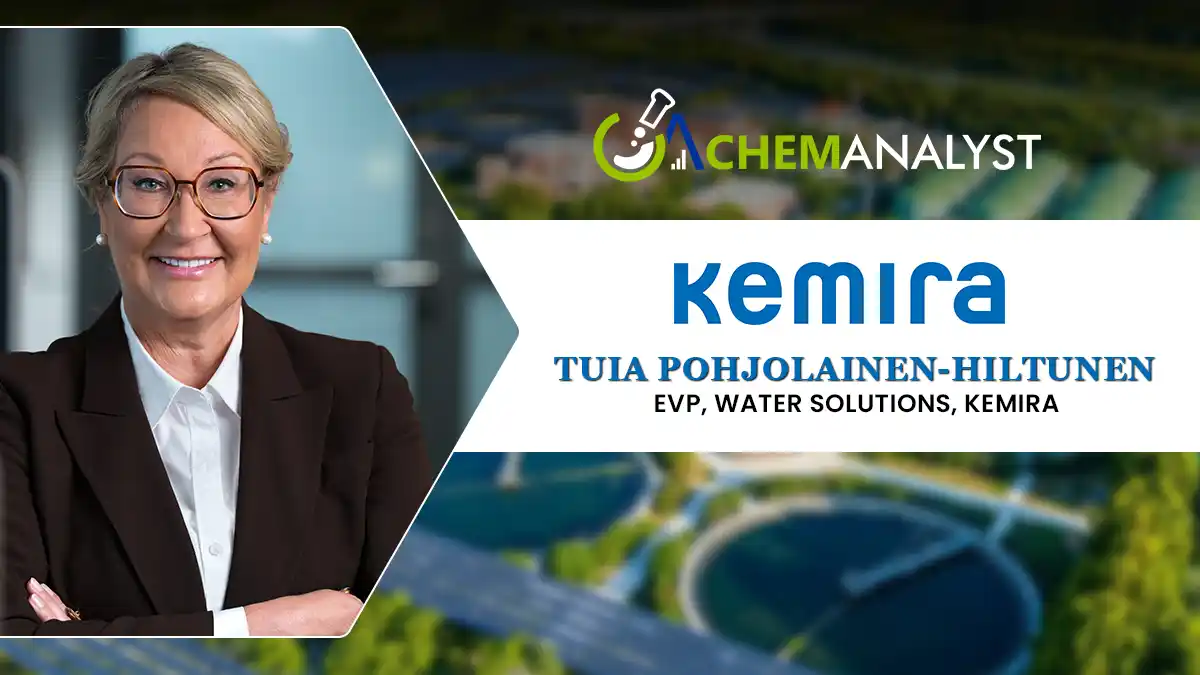
ChemAnalyst Talks with Tuia Pohjolainen-Hiltunen, EVP, Water Solutions, Kemira
Kemira, a global leader in sustainable chemistry for water-intensive industries, is advancing innovative solutions to support clean water access, resource efficiency, and circularity across municipal and industrial sectors. Operating worldwide, the company plays a critical role in helping customers optimize water treatment processes while addressing increasingly stringent environmental regulations and sustainability goals. ChemAnalyst spoke with Tuia Pohjolainen-Hiltunen, EVP, Water Solutions at Kemira, about the company’s strategic direction amid evolving regulatory, environmental, and geopolitical dynamics shaping the global water treatment landscape. Drawing on her extensive leadership experience, Pohjolainen-Hiltunen highlighted the growing importance of advanced purification technologies, particularly in addressing emerging contaminants such as PFAS, as well as the role of activated carbon and reactivation services in enabling more sustainable and cost-efficient water treatment. She emphasized Kemira’s focus on expanding its presence across the water treatment value chain through investments in regional infrastructure, including new reactivation facilities in Europe, while strengthening supply resilience and customer proximity. She also underlined the company’s commitment to combining chemistry expertise, digital capabilities, and collaborative partnerships to deliver scalable and future-ready solutions. Looking ahead, Kemira aims to accelerate growth in its Water Solutions segment, expand its circular service offerings, and reinforce its position as a trusted partner in advancing sustainable and resilient water management systems globally.
Complete Interview with Tuia Pohjolainen-Hiltunen
Q: Please provide an overview of your professional journey and leadership experience in the water treatment and specialty chemicals sector, and how these experiences have shaped your strategic vision for Kemira’s role in advancing sustainable and innovative water purification solutions globally.
Tuia Pohjolainen-Hiltunen: Throughout my career, I’ve worked across geographies, functions, and leadership roles within Kemira and earlier in infrastructure and environmental services. This has given me a broad perspective on how water treatment and specialty chemistry support both industrial performance and environmental responsibility.
Since joining Kemira in 2008, I’ve held roles in strategy, R&D, business development, and commercial leadership across municipal and industrial water as well as pulp and paper. Working across Europe and the Americas has given me the opportunity to view first-hand how water challenges differ regionally, yet are increasingly interconnected.
Most recently, leading the Water Solutions business unit has reinforced the importance of combining application expertise, innovation, and close customer collaboration to address complex water needs at scale.
These experiences have shaped my strategic vision in three ways: recognizing water as a critical global resource, leveraging sustainable chemistry to improve both performance and environmental outcomes, and advancing solutions through strong partnerships.
At Kemira, our role is to be a trusted partner—using our chemistry expertise, digital capabilities, and global reach to help customers improve water efficiency, treatment outcomes, and sustainability. By staying close to evolving needs and continuing to innovate, we aim to support a more resource-efficient and sustainable future globally.
Q: How does the planned activated carbon reactivation facility in Tarragona, Spain and Helsingborg, Sweden, strengthen Kemira’s long-term positioning in Europe’s water treatment value chain?
Tuia Pohjolainen-Hiltunen: European water regulations are becoming significantly stricter, especially around PFAS and emerging micropollutants, and activated carbon remains one of the most proven solutions for their removal. At Kemira, our Tarragona facility as well as our Helsingborg site in Sweden will directly support this regulatory shift by providing a reliable regional service to reactivate activated carbon, enabling utilities to meet tightening compliance requirements more efficiently.
These investments also reinforce our strategy to expand beyond chemicals into integrated water treatment services. By adding local reactivation capacity for granular and pelletized carbon, we are strengthening Kemira's presence across the full value chain from supply of activated carbon to reactivation and reuse supporting circularity, resource efficiency, and long term partnerships.
Ultimately, our investments in our Tarragona and Helsingborg sites position Kemira as a more comprehensive, sustainability driven partner in Europe’s evolving water treatment landscape.
Q: In what ways will the Tarragona plant improve Kemira’s regional supply security and operational efficiency for activated carbon services across the Iberian water treatment market?
Tuia Pohjolainen-Hiltunen: Locating reactivation capacity in Spain brings activated carbon processing much closer to the Iberian water treatment market, dramatically improving service responsiveness and reducing dependence on distant facilities. This proximity reduces transport times, stabilizes logistics, and increases reliability—critical for utilities that operate on tight replacement cycles. By strengthening our local footprint, Kemira can better support growing demand in Southern Europe while ensuring consistent, predictable service delivery.
Q: How could the Tarragona site investment, as well as the Helsingborg plant, support Kemira’s broader ambition of doubling its water-related revenue while reinforcing its footprint in circular water management solutions?
Tuia Pohjolainen-Hiltunen: The Tarragona and Helsingborg investments expand Kemira’s participation in one of the fastest growing segments of water treatment: reactivation of activated carbon used to advance removal of PFAS and micropollutants. As utilities face stricter regulatory limits, demand for high performance activated carbon and reliable reactivation services continues to rise. Investing in these areas is enabling Kemira to add scalable, recurring revenue streams that go beyond traditional chemicals.
Reactivation itself is a circular, resource efficient process that allows water utilities to reuse carbon multiple times, reducing waste and lowering lifecycle costs. Establishing local reactivation hubs further strengthens our circular value proposition at Kemira, and aligns closely with EU sustainability and resource efficiency priorities.
Q: What are the key demand drivers for activated carbon and reactivation services in the drinking water and wastewater sectors over the next decade?
Tuia Pohjolainen-Hiltunen: Demand for activated carbon and reactivation services is expected to grow steadily over the next decade, driven by three key factors. First, increasingly stringent regulations targeting contaminants such as PFAS, pesticides, and other trace organics are driving the need for high-performance treatment solutions like granular activated carbon (GAC).
Second, rising awareness of water quality challenges is accelerating investment in advanced treatment technologies across both municipal and industrial sectors. Third, reactivation is gaining traction as a cost-effective and sustainable alternative to virgin carbon, helping utilities reduce waste, lower lifecycle costs, and meet long-term environmental goals.
Together, these trends are reinforcing the role of activated carbon as a critical solution in modern water treatment.
Q: How are tightening regulations on micropollutants such as Per- and Polyfluoroalkyl Substances (PFAS) expected to reshape the global market for advanced water purification technologies?
Tuia Pohjolainen-Hiltunen: PFAS limits are becoming far more stringent worldwide, pushing utilities toward technologies such as granular activated carbon, ion exchange resins, and high pressure membranes. These regulatory shifts are driving unprecedented procurement cycles for advanced treatment systems and accelerating long term investment in PFAS removal infrastructure. Regulators are also extending PFAS compliance timelines to ensure utilities can implement new technologies at scale further expanding the market for advanced purification solutions over the next decade.
Q: How might the growing emphasis on sustainability and circular resource use accelerate adoption of activated carbon reactivation compared with traditional single-use carbon systems?
Tuia Pohjolainen-Hiltunen: Sustainability mandates are pushing utilities to reduce waste, energy use, and carbon footprints. Reactivation supports these goals by restoring spent activated carbon up to multiple cycles, reducing reliance on virgin feedstock and significantly lowering disposal volumes. Because circular solutions increasingly influence procurement decisions, reactivation is becoming the preferred approach over single use carbon systems in both municipal and industrial markets.
Q: What factors are currently influencing activated carbon prices, and how might fluctuations in raw material availability affect Kemira’s cost structure?
Tuia Pohjolainen-Hiltunen: Prices are rising due to higher raw material costs including energy price increases and freight volatility as well as stricter environmental rules in key producing countries. These pressures increase production costs for virgin carbon, reinforcing the strategic value of reactivation in stabilizing long term cost structures.
Q: Considering that activated carbon feedstocks often include coconut shells, coal, or wood, how could global supply chain disruptions influence the pricing and availability of these materials?
Tuia Pohjolainen-Hiltunen: Feedstock availability is concentrated in specific regions vulnerable to climate events, harvest fluctuations, and geopolitical disruptions. Climate driven coconut shortages in Southeast Asia, for example, have already created supply demand imbalances and price spikes. Trade barriers, tariffs, and logistical challenges can further strain supply, increasing raw material volatility.
Q: To what extent can reactivation of spent carbon reduce dependency on virgin feedstock and help stabilize long-term pricing for water utilities and industrial customers?
Tuia Pohjolainen-Hiltunen: Reactivation allows utilities to reuse spent carbon multiple times, reducing consumption of virgin materials which often represent up to half of total production costs. By lowering exposure to global feedstock volatility, reactivation provides a more predictable cost profile and improves long term price stability for customers.
Q: How could ongoing geopolitical tensions and shipping disruptions linked to the Strait of Hormuz and the broader Middle East region affect global chemical supply chains relevant to the water treatment sector?
Tuia Pohjolainen-Hiltunen: Kemira has an extensive supply network across many product line areas. While Kemira is not immune to geopolitical tensions and maritime disruptions, we do pride ourselves on our operational and supply chain capabilities to weather any change in the global chemical supply chain. Kemira’s customers can be confident in our proven track record of securing supply for our customers.
Q: What long-term impacts might Middle East geopolitical instability have on energy costs, shipping routes, and feedstock logistics for companies like Kemira?
Tuia Pohjolainen-Hiltunen: Sustained instability could drive prolonged increases in oil and gas prices, reshape global shipping routes, and disrupt access to key petrochemical feedstocks used in chemical and polymer production. These pressures ultimately affect manufacturing costs, logistics reliability, and the availability of materials critical for water treatment infrastructure.
Q: How is Kemira preparing to mitigate geopolitical risks, including supply chain diversification, localized production, or strategic sourcing?
Tuia Pohjolainen-Hiltunen: Kemira’s strategy emphasizes regional production footprints, diversified sourcing, and localized service capabilities. By investing in facilities like Tarragona and Helsingborg, Kemira is reducing reliance on long distance feedstock and chemical transport, strengthens supply resilience, and provides customers with more stable, regionally anchored solutions.
Q: Beyond the Tarragona investment, what new projects or technology advancements is Kemira pursuing to enhance performance in the Water Solutions segment?
Tuia Pohjolainen-Hiltunen: Kemira continues expanding its activated carbon platform, including the new reactivation facility in Helsingborg Sweden expected to be operational in 2027, following the acquisition of Norit’s UK reactivation business, Purton Carbons Limited. These investments broaden the company’s service network and enhance its ability to provide fully integrated treatment solutions. Kemira also invests in advanced water chemistries, digital monitoring tools, and technologies supporting more efficient contaminant removal.
Q: How could innovations in carbon regeneration processes, adsorption efficiency, or hybrid water treatment technologies strengthen Kemira’s competitive edge?
Tuia Pohjolainen-Hiltunen: Innovation in areas like carbon reactivation, adsorption performance, and hybrid treatment systems is shaping the future of water treatment. At Kemira, we closely follow these developments and collaborate with partners that help to ensure we bring the most effective solutions to our customers.
Our focus is on improving treatment solutions, optimizing processes, and integrating complementary technologies where value is added. This allows us to address emerging contaminants (like PFAS) with solutions that are more effective and efficient.
Q: How does Kemira envision the future of circular water management, and what role will carbon reactivation and advanced purification technologies play in achieving that vision??
Tuia Pohjolainen-Hiltunen: Kemira sees circularity as central to the future of water management. Reactivation plays a key role by enabling material reuse and reducing dependence on virgin feedstock. Advanced purification technologies including high performance activated carbon will continue to help customers meet stringent regulatory standards while reducing environmental impact. By combining circular services, sustainable chemistry, and integrated treatment expertise, Kemira aims to support utilities and industries in transitioning toward more resilient, resource efficient water systems.







 About ChemAnalyst
Leave a Comment
Comments (0)