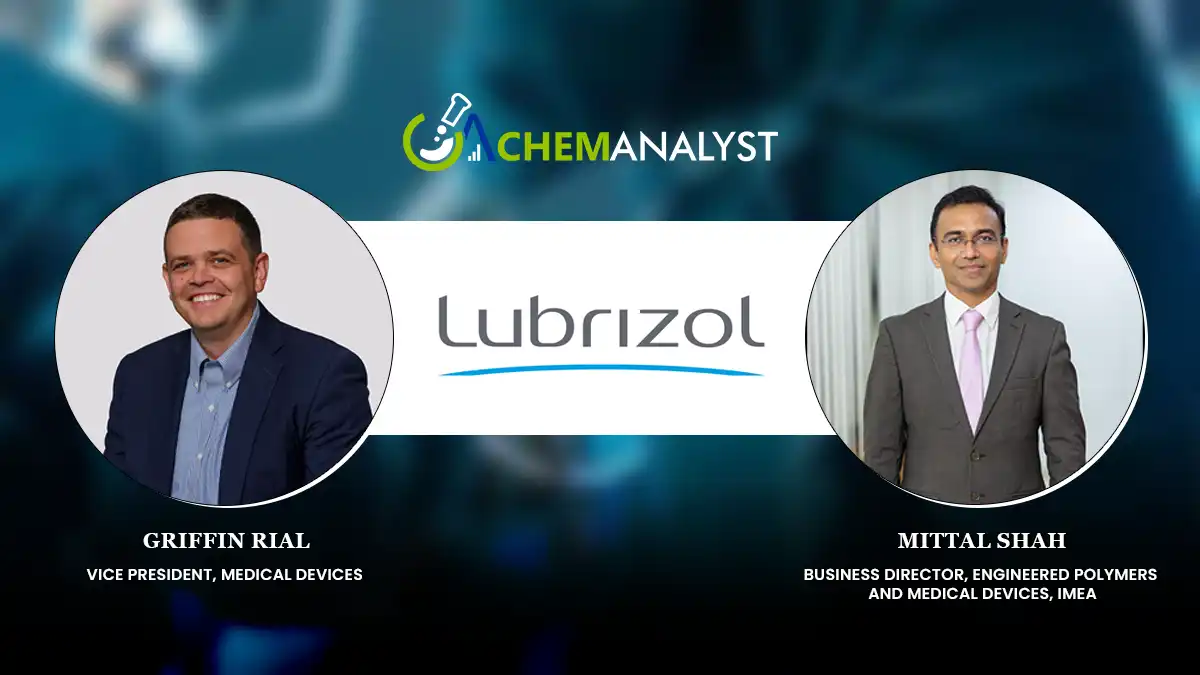
ChemAnalyst Talks with Griffin Rial, Vice President, Medical Devices / Mittal Shah, Business Director, Engineered Polymers and Medical Devices, IMEA
Lubrizol, a Berkshire Hathaway company, is a global science-based specialty chemicals company whose innovative material solutions advance mobility, improve well-being, and enhance modern life. Founded in 1928, the company operates more than 100 manufacturing facilities, sales, and technical offices worldwide, supported by over 7,000 employees. With a strong focus on specialty polymers, medical device materials, and sustainable innovation, Lubrizol continues to strengthen its global healthcare portfolio by expanding localized manufacturing capabilities and fostering strategic collaborations to support the rapidly evolving medical device industry.
ChemAnalyst spoke with Mr. Griffin Rial, Vice President, Medical Devices, and Mr. Mittal Shah, Business Director, Engineered Polymers and Medical Devices, IMEA, to gain insights into Lubrizol's collaboration with Polyhose and the establishment of its medical tubing manufacturing facility in Chennai, India. Drawing on their extensive leadership experience, they discussed the strategic significance of localizing precision medical tubing production, strengthening global supply chain resilience, and supporting the growing demand for minimally invasive medical devices. They also shared their perspectives on the evolving market for medical-grade polymers, India's emergence as a global medical manufacturing hub, the impact of government initiatives such as Make in India and PLI, sustainability in healthcare materials, and the long-term outlook for innovation, investment, and growth across the global and IMEA medical device sectors.
Complete Interview with Griffin Rial
Q1: Could you share an overview of your professional journey within Lubrizol and how your leadership has contributed to advancing innovation in specialty polymers and medical device materials globally?
Griffin Rial: I’ve spent close to a decade at Lubrizol, moving across roles in strategy, product management, and global business leadership – including leading our Medical Polymers business. What that journey has really allowed me to do is connect the dots between material science, customer needs, and long-term market trends. I’m constantly energized by the open and vibrant interactions with our global teams and the value-led execution excellence we pursue as an organization.
In medical devices especially, innovation is very outcome-driven. More than simply developing advanced polymers, it’s about enabling device manufacturers to deliver better clinical outcomes, whether that’s through flexibility in a catheter, durability in a component, or precision in minimally invasive procedures. That’s been a consistent thread in my work – how do we translate our chemistry into real-world impact for patients and providers.
Q2: What strategic objectives does Lubrizol aim to achieve through its collaboration with Polyhose, and how does the Chennai medical tubing facility align with the company's broader global medical strategy?
Griffin Rial: At a strategic level, this collaboration is about expanding access – both geographically and technologically. We’ve built a strong global medical device component business, and the next phase is about bringing that capability closer to high-growth markets.
The India extrusion facility in Chennai is a very tangible expression of that strategy. It allows us to combine Lubrizol’s expertise in medical-grade thermoplastic polyurethane, and extrusion with local knowledge. The goal is simple but powerful – deliver high-quality, precision tubing at scale, closer to where demand is growing fastest, while maintaining the same global standards our customers rely on.
Q3: Healthcare supply chains have undergone significant restructuring since the pandemic. How does this investment strengthen Lubrizol's global manufacturing footprint and improve supply chain resilience for medical device customers?
Griffin Rial: One clear lesson from the pandemic is that healthcare supply chains need both scale and regional balance.
This investment strengthens our footprint by adding capacity in a region that is both a large end market and an emerging manufacturing hub. It reduces dependency on single geographies, improves speed to market, and gives customers more optionality in sourcing. For critical medical components like precision tubing, that reliability and redundancy are incredibly important.
Q4: Global demand for minimally invasive medical devices is accelerating. Which product segments and geographic regions do you expect to be the primary growth drivers over the next five years?
Griffin Rial: We see continued strong momentum in minimally invasive devices, particularly in neurovascular and cardiovascular applications. These are areas where device complexity is increasing, and material performance becomes even more critical.
From a regional standpoint, Asia-Pacific – especially India – will play a significant role. You have a combination of rising healthcare access, increasing investments in medical manufacturing, and strong export potential. It’s a very compelling growth story over the next five years.
Q5: Specialty polymers such as TPU, Pebax®, polyamides, polypropylene, and polyethylene are becoming increasingly important in medical applications. How do you expect demand for these materials to evolve globally?
Griffin Rial: We’re seeing a structural shift toward higher-performance materials. As devices become smaller, more complex, and more precise, the demand for materials like medical-grade TPU and other engineered thermoplastics naturally increases.
What’s interesting is that it’s not just volume growth – it’s also a shift in specifications. Customers need these materials to be processed into very tight specification components for adding functionalities to their devices. That’s where Lubrizol adds value.
Q6: Medical-grade polymers are often exposed to volatility in feedstock and energy costs. How does Lubrizol manage pricing strategies while ensuring long-term supply reliability for medical device OEMs?
Griffin Rial: It is always a balance. Medical device OEMs expect long-term reliability – not just in supply, but also in performance and cost predictability.
Our approach has been to focus on building a resilient operating model – diversified manufacturing, strong supplier relationships, and local capabilities like Chennai. That allows us to better absorb volatility and provide more stability to customers over time, rather than reacting short-term to every fluctuation.
Q7: Considering ongoing geopolitical tensions, tariff uncertainties, and China-plus-one sourcing strategies, how are global manufacturing investment decisions changing within the medical device materials industry?
Griffin Rial: There’s definitely a broader shift toward regionalization and diversification. The traditional “one-region” manufacturing model is evolving into more distributed, multi-region networks.
Decisions today are increasingly influenced by factors beyond cost – things like regulatory environment, supply chain security, talent availability, and policy support. India, for example, stands out on several of these dimensions, which is why you’re seeing more investments flow into the region.
Q8: India is positioning itself as a global medical manufacturing hub. From a global perspective, how competitive do you believe India will become compared to established manufacturing centres in China, Europe, and North America?
Griffin Rial: Each of the regions we operate in has specific advantages and customer preferences. India is a high-growth geography for us and is moving quickly from being just a demand market to also becoming a manufacturing and export hub for medical components.
You have a strong engineering talent base, improving infrastructure, and supportive government initiatives. When you combine that with growing domestic demand, it creates a very balanced ecosystem. Over time, I expect India to be increasingly competitive with more established markets, especially in categories like medical tubing and components for minimally invasive devices.
Q9: Sustainability is increasingly becoming a purchasing criterion in healthcare. How is Lubrizol integrating circular economy principles and sustainable material innovation into its medical portfolio?
Griffin Rial: At Lubrizol, sustainability is already well integrated into the product and innovation life cycle. For medical devices, while performance and patient safety will always be the top priorities, there is growing focus on materials and processes that reduce environmental impact over the lifecycle. At Lubrizol, we are focused on advancing material innovation in a way that aligns with these goals – without compromising on the stringent standards medical device applications demand. Our products are durable and have high standards of quality, making them sustainable for long term use. Most of our manufacturing plants, including those in India, are green energy optimized and adhere to stringent EHS compliance standards.
Q10: Looking ahead, what is your outlook for pricing and demand of medical-grade polymers over the next 12–24 months, and what macroeconomic or geopolitical factors could have the greatest influence on market dynamics?
Griffin Rial: In the near term, we expect demand to remain steady and supported by ongoing innovation in medical devices.
From a macro perspective, factors like global economic conditions, energy costs, and geopolitical dynamics will continue to influence pricing. But fundamentally, the healthcare sector is quite resilient. The underlying demand drivers – aging populations, increasing access to care, and technological advances – remain very strong.
Complete Interview with Mittal Shah
Q1: As Business Leader for Medical Solutions & Engineered Polymers across IMEA, how do you assess the current growth trajectory of India's medical device industry, and what role will the Chennai facility play in supporting this expansion?
Mittal Shah: India’s medical device sector is at an inflection point. Demand is growing rapidly, but equally important is the shift toward building domestic manufacturing capability. Indian medical devices OEMs have reached a level of maturity, where they are now venturing in to more critical devices like minimally invasive surgeries.
The India extrusion facility based in Chennai, plays a key role in that transition. It strengthens the ecosystem by enabling high-quality, precision components to be produced locally, while also supporting exports. These capabilities will enable local OEMs to assemble complex devices locally. In many ways, it bridges the gap between demand growth and manufacturing readiness.
Q2: What were the primary market opportunities that encouraged Lubrizol to establish localized medical tubing manufacturing in India through its partnership with Polyhose?
Mittal Shah: What we saw very clearly was a gap between demand and local availability of high-precision medical tubing. Much of this was being imported, which added time, cost and complexity. We saw an opportunity to support our Indian customers with locally made tubing components and help them make complex devices locally.
Our association with Polyhose dates back to over a decade. By partnering with Polyhose, we are able to localize manufacturing at scale. This not only expands capacity significantly but also creates a more agile supply chain that can respond faster to customer needs in India and the broader region.
Q3: How will local manufacturing improve lead times, technical support, and product development capabilities for Indian and regional medical device manufacturers?
Mittal Shah: Local manufacturing fundamentally changes how we engage with customers.
It allows us to shorten lead times, offer faster prototyping, and collaborate much more closely on product development. Combined with Lubrizol’s global expertise in materials and extrusion, it creates a much more responsive and innovation-driven environment for medical device manufacturers.
Q4: Which medical device segments—such as catheters, drug delivery systems, cardiovascular devices, or diagnostic equipment—are expected to generate the strongest demand for precision extruded tubing in India?
Mittal Shah: We are seeing particularly strong demand in minimally invasive applications – especially neurovascular and cardiovascular devices. These segments require extremely high precision and consistency in tubing, which aligns well with the capabilities we are building in Chennai. Beyond that, we also expect growth in areas like advanced catheter systems and drug delivery platforms.
Q5: Demand for advanced polymers like medical-grade TPU, Pebax®, nylon, polypropylene, and polyethylene is rising. Which material categories are currently witnessing the fastest adoption in the Indian medical device market?
Mittal Shah: Medical-grade TPU continues to see strong traction because of its versatility and performance characteristics.
At the same time, materials like nylon, Pebax®, and other engineered polymers are gaining adoption, particularly in more complex device applications where performance requirements are becoming more demanding.
Q6: From your interaction with customers across IMEA, how are their expectations evolving regarding quality standards, regulatory compliance, customization, and technical collaboration?
Mittal Shah: Customers today expect a combination of global standards and local responsiveness. The customers in the IMEA region have attained maturity and recognition as global suppliers. They participate in several regulatory regimes across the world. Therefore, they need reliable suppliers, who understand and follow best manufacturing practices to meet regulatory requirements. Lubrizol’s global expertise comes as assurance to our customers for meeting regulatory requirements.
That includes rigorous quality systems, regulatory compliance, and the ability to co-develop solutions. Increasingly, they are looking for partners who can go beyond supply and act as collaborators in innovation – which is exactly the model we’re focused on building.
Q7: What are the major supply-side challenges currently affecting medical-grade polymer availability in the region, including raw material sourcing, logistics, regulatory approvals, and production capacity?
Mittal Shah: Some of the key challenges in the region include raw material availability, regulatory complexity, and supply chain related complexity.
The India extrusion facility directly addresses these by bringing world-class manufacturing standards into a local setting and integrating quality, production, and development capabilities more closely.
Q8: Do you anticipate increasing domestic demand for medical-grade polymers to influence pricing trends in India, particularly for TPU, polypropylene, polyethylene, and engineering polyamides?
Mittal Shah: As Indian OEMs participate in complex devices, their demand for medical grade polymers will increase. While this supply-demand dynamics will influence prices, this will also enable material level innovations. Lubrizol continues to expand its range of medical grade TPUs to add new features for enabling mode advance catheter designs.
Q9: Government initiatives such as Make in India and Production Linked Incentive (PLI) schemes are encouraging domestic medical manufacturing. How significant have these policies been in supporting investments like this facility?
Mittal Shah: Government initiatives have played a meaningful role in enabling investments in manufacturing in India, including the recent ones by Lubrizol. Government’s effort to develop medical devices industry in India by supporting ecosystem development is helping all participants.
Apart from our medical tubing plant, we recently inaugurated state-of-the-art CPVC resin plant in Vilayat with Grasim and added significant new capacity to our existing CPVC compounding plant at Dahej. In our polymer manufacturing journey in India, we have been engaged with state and central government as well as various regulatory bodies to facilitate these investments and will continue the dialogue about specific incentives, duty concessions and more.
Policies focused on building domestic manufacturing capabilities and strengthening the industrial ecosystem specifically in medical devices have created a favorable environment for long-term investments.
Q10: Looking ahead, what are Lubrizol's priorities for expanding its medical materials and component business across India and the broader IMEA region, and which emerging trends do you believe will create the biggest opportunities over the next decade?
Mittal Shah: Looking ahead, our priorities are quite clear – continue expanding local manufacturing, build stronger R&D and application development capabilities, and deepen customer collaboration.
India will play a dual role for us – as a high-growth domestic market and as an export hub for advanced medical components. Over the long term, trends like minimally invasive healthcare, increased access to medical care, and higher expectations for product performance will continue to create opportunities across the region.








 About ChemAnalyst
Leave a Comment
Comments (0)