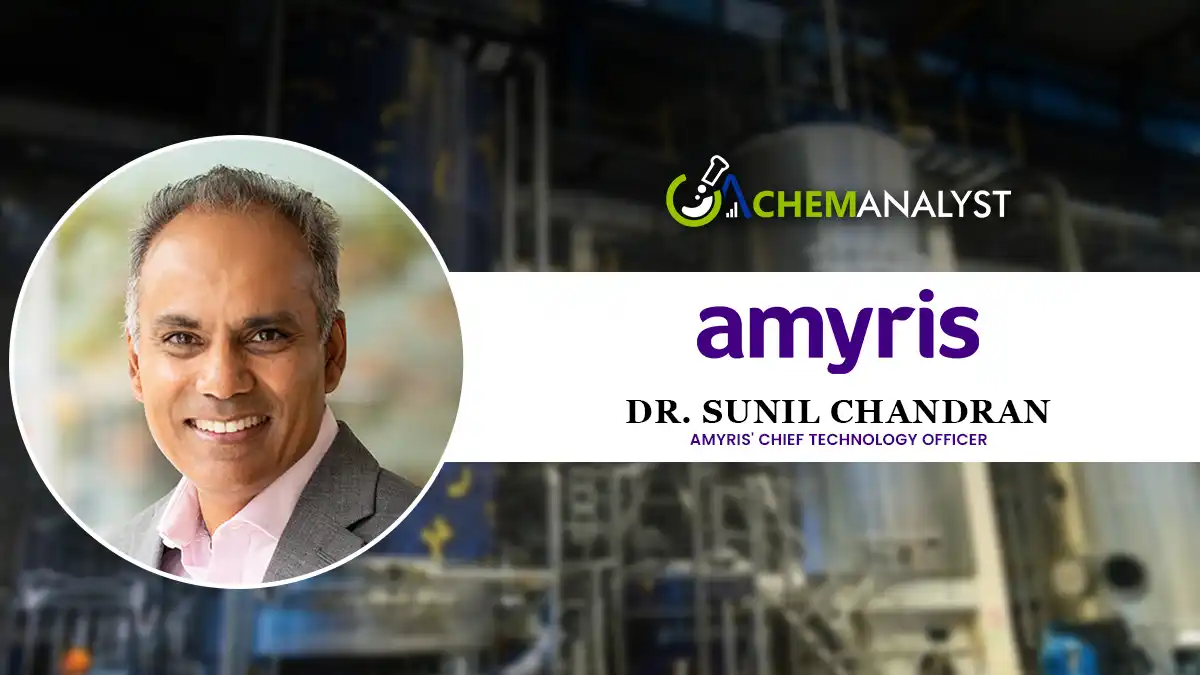
ChemAnalyst Talks with Dr. Sunil Chandran, Amyris' Chief Technology Officer
Amyris, a vertically integrated biomanufacturing company and a global innovator in precision fermentation, is transforming the future of sustainable specialty chemicals through advanced biotechnology and renewable biological chemistry. With applications spanning flavors and fragrances, beauty and personal care, food, advanced materials, and beyond, the company is redefining how industries access high-performance, bio-based ingredients with greater precision, consistency, and sustainability. Founded in 2003 with a humanitarian vision to improve drug access through biotechnology, Amyris has evolved into a leader in industrial biotechnology, leveraging its proprietary fermentation platform to create molecules that enhance lives, protect ecosystems, and improve supply chain resilience worldwide. ChemAnalyst spoke with Dr. Sunil Chandran, Chief Technology Officer at Amyris, about his professional journey in industrial biotechnology, the growing role of precision fermentation in replacing conventional petrochemical systems, and Amyris’ strategic vision for scaling sustainable biomanufacturing through innovation, advanced data-driven platforms, and expanded production capacity at its Barra Bonita facility in Brazil.
Complete Interview with Dr. Sunil Chandran
Q: Please provide an overview of your professional journey in industrial biotechnology and precision fermentation, and how your experience has shaped your strategic vision for Amyris, Inc.’s role in advancing sustainable bio-based chemicals globally.
Dr. Sunil Chandran: My initial foray into industrial biotechnology and precision fermentation was in graduate school, when I worked on the development of a strain and fermentation process to produce shikimic acid, a key starting material for Tamiflu. I was an organic chemist, but this project highlighted how biology could be applied to access numerous chemicals for a variety of industries. In other words, nature is an amazing organic chemist, and the key is to understand how to harness this ability in a reproducible fashion. I followed this up in the pharmaceutical industry where I explored novel drug candidates that could be derived using fermentation.
In 2006, I came to Amyris with the goal of using biotechnology and fermentation to solve some of the most pressing global issues, from cost-effective malaria treatments for low-income economies, to the production of biofuels to address issues with climate change. To allow our sector to truly make an impact, I noticed that the underlying technology platform needed to evolve and undergo a radical transformation. We needed to reduce time to market, improve our success rate, and access chemicals that remained inaccessible due to gaps in our biological data set. Now, we have a technology platform that integrates next-generation genetic tools, high-throughput analytics, proprietary robotic systems, curated data collection, and predictive analysis tools. We have combined this platform with scalable manufacturing operations that enable reliable production and purification of biological chemicals for a variety of industries.
During our 20-year history, we have systematically collected billions of data points across various projects, resulting in a rich, unparalleled repository of curated biological information that also happens to be AI-ready. We are at the stage in our evolution where our ability to unlock the chemistry of life to globally deliver sustainable, high-performing bio-based chemicals, is unparalleled in the industry.
Q: How does the new production line at Amyris, Inc.’s Barra Bonita facility strengthen its competitive positioning in the global precision fermentation market?
Dr. Sunil Chandran: Our new line at Barra Bonita is specifically designed to close a much needed gap in our industry. A majority of the precision fermentation facilities in the industry are either too big or too small to efficiently produce the specialty chemicals that are a priority for our partners. The line offers a unique volume option for our partners and fills a gap in the current manufacturing ecosystem.
Q: What strategic advantages does the smaller 2x80 m³ configuration offer compared to the existing large-scale lines in terms of flexibility and commercialization speed?
Dr. Sunil Chandran: The new 2×80 m³ configuration adds an intermediate commercial scale alongside our existing 2×200 m³ lines so we can match production to wherever a molecule or customer is in the commercialization journey, and move faster as demand evolves. The new line is explicitly designed to accelerate scale-up and support customers at different stages of their commercialization life cycle. The 2×80 m³ line also enables us to shift products between lines and batch sizes, reducing changeover time and improving overall efficiency of plant operations.
Q: How is precision fermentation reshaping the economics of sustainable ingredient production compared to traditional petrochemical-based manufacturing?
Dr. Sunil Chandran: Historically, petrochemical-based manufacturing has controlled the market for large-volume commodity chemicals including hydrocarbons, volatiles, and aromatic compounds. By contrast, precision fermentation has held its own in commodity segments like amino acids, ethanol, and organic acids. However, the diversity of chemicals accessed via petrochemical-based manufacturing is unlikely to change in the future, while we are just beginning to access the wide array of chemicals that biology has to offer. Abundant and cheap feedstocks, expanding infrastructure, and better understanding of biological systems are allowing the sector to produce chemicals that cannot be cost-effectively accessed via petroleum. It’s also important to note that the chemicals coming out of fermentation can be further derivatized via chemistry to other value-added/performance-advantaged chemicals, that cannot be accessed via petrochemicals.
Q: To what extent can fermentation-based processes reduce carbon intensity and improve lifecycle sustainability across industries?
Dr. Sunil Chandran: Fermentation-based processes are already significantly reducing carbon intensity and improving sustainability for many molecules. Many of the ingredients in the Amyris portfolio have traditionally been sourced from botanical feedstocks, for example. Using our fermentation technology, we can dramatically decrease land-use requirements – sometimes by several hundred-fold - and in many cases, decouple production from ecological regions that are under tremendous pressure.
Q: With rising global demand for bio-based ingredients, how do you see supply-demand dynamics evolving over the next five years?
Dr. Sunil Chandran: We see demand steadily increasing, and we see our industry entering an inflection point. To date, the most impactful application of our technology has been in the flavor and fragrance and beauty industries. But as the technology matures, we’re experiencing more and more interest and demand from additional sectors.
Q: Are current production capacities across the industry sufficient, or is there a risk of supply bottlenecks as commercialization accelerates?
Dr. Sunil Chandran: As demand is increasing, we’re seeing production capacity increase across the sector in general. We’re also seeing increased interest from governments across the world, including the United States Government, to support capacity expansion. There are many facilities that can be retrofitted or modified to meet demand as and when it arises. Currently, the risk of not being able to meet production capacity for future demand is quite low.
Q: What are the key challenges in scaling fermentation-derived molecules from pilot to full commercial production?
Dr. Sunil Chandran: The main challenge is ensuring that a process that was developed at lab-scale will repeat with the same efficiency at a 100,000x higher commercial scale, while also meeting the target economics. At Amyris, we are well versed in transferring technology from the lab, to pilot, to manufacturing, and we have established a proprietary framework for scale-up that delivers very high fidelity across scales.
Q: Which end-use sectors—such as personal care, flavors & fragrances, or specialty chemicals—are expected to drive the highest growth for fermentation-derived ingredients?
Dr. Sunil Chandran: At Amyris, all three of those sectors are growth drivers in addition to health and agriculture. However, the adoption time varies significantly between industries. Personal care is the fastest to commercialize. In order to have a balanced portfolio, we play in all of these sectors.
Q: How are brand owners and manufacturers adapting their formulations to incorporate bio-based alternatives at scale?
Dr. Sunil Chandran: Brand owners are hungry for new ingredients derived from biology because they offer a clean, sustainable, and higher performing alternative to the current incumbents. With precision fermentation, brand owners can see all the benefits of renewable, natural-origin ingredients, without having to deal with the challenges of inconsistent product quality and availability from legacy sourcing. This value proposition has resulted in fast and enthusiastic adoption of our technology.
Q: How do feedstock costs (such as sugar or biomass inputs) impact the overall economics of precision fermentation, and are these costs becoming more volatile?
Dr. Sunil Chandran: The overall impact of feedstock costs varies across different bio-based chemicals and is only one of many factors that impact overall economics. Other factors include the purity levels needed for commercial launch and the unit operations that are needed to meet those purity specifications. Overall, feedstock costs have remained quite stable in the last decade.
Q: Can fermentation-derived products achieve price parity with conventional petrochemical alternatives, or will premium pricing persist?
Dr. Sunil Chandran: Achieving price parity with conventional petrochemical alternatives will depend on the specific chemical and the price point. There are multiple instances of fermentation-derived products matching and sometimes even beating their petroleum alternatives. However, at Amyris, we find that cost is not always the most relevant measure of success. In many of Amyris’s core markets, we compete with botanical or animal-derived ingredients rather than petrochemicals, and those supply chains are inherently volatile. Fermentation creates value in different ways: through supply chain resilience, consistent quality, and reliable performance at scale. Customers adopt our ingredients because they reduce sourcing risk, enable competitive advantage, and enable product differentiation. When we can deliver these types of benefits, the market adopts quickly.
Q: How does expanding production capacity in Brazil improve supply chain resilience and reduce dependency on other global manufacturing hubs?
Dr. Sunil Chandran: Expanding production capacity in Brazil strengthens supply chain resilience by anchoring manufacturing close to key feedstocks and diversifying geographic risk. This reduces reliance on long, complex global logistics routes and concentrated manufacturing hubs, which are increasingly vulnerable to climate, geopolitical, and trade disruptions.
Q: Do geopolitical uncertainties accelerate the shift toward localized, bio-based production models, and how might this influence long-term investment in industrial biotechnology?
Dr. Sunil Chandran: Across the globe, the public sector is recognizing the strategic importance of industrial biotechnology in de-risking supply chains. When added to private sector demand, we are seeing an inflection point toward increased adoption of the technology.








 About ChemAnalyst
Leave a Comment
Comments (0)