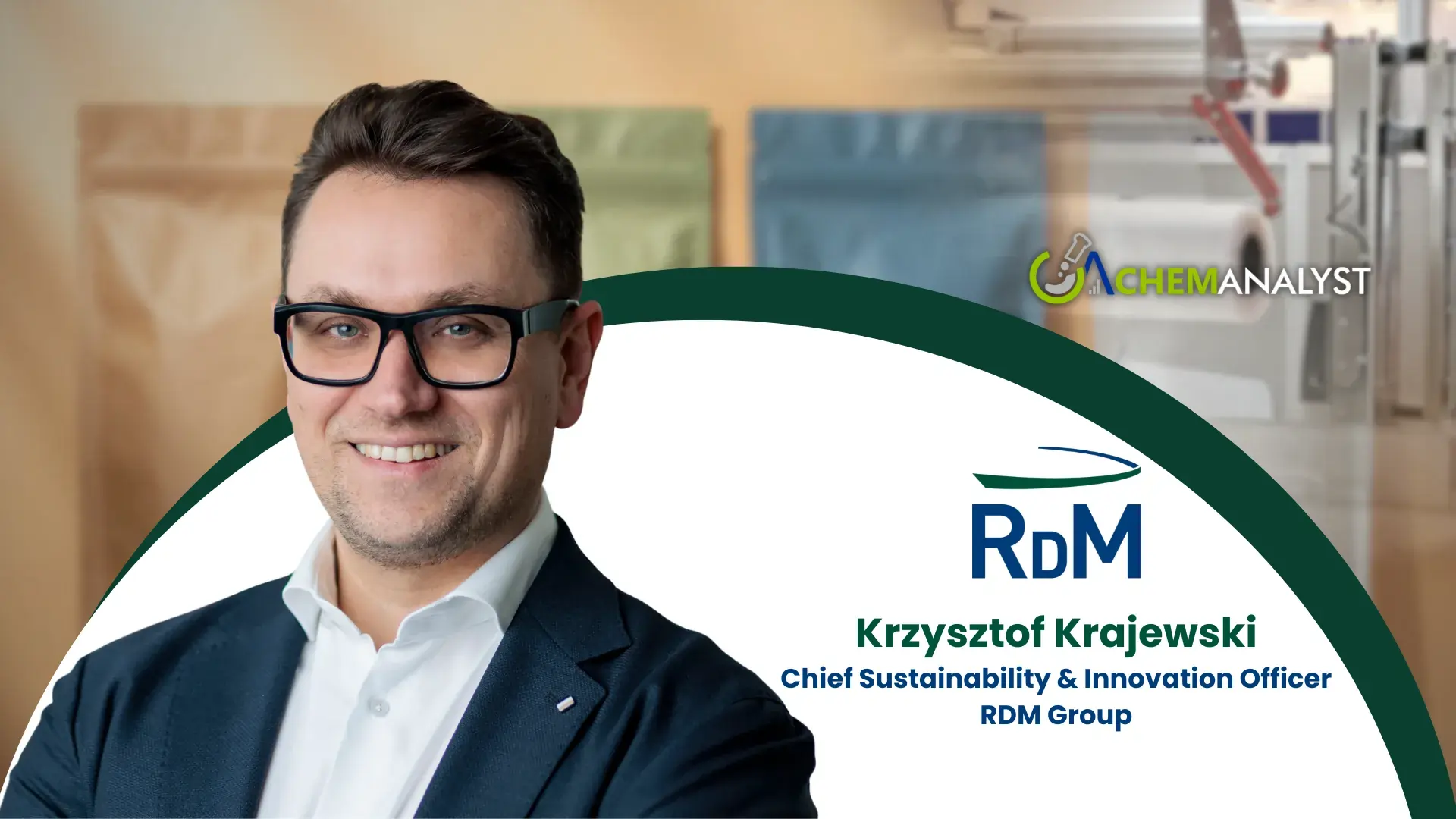
ChemAnalyst Talks with Mr. Krzysztof Krajewski, Chief Sustainability and Innovation Officer at RDM Group
RDM Group is one of Europe's leading producers of recycled cartonboard, committed to developing sustainable packaging solutions using recycled fibres and renewable materials. With circularity at the core of its business model, the company focuses on delivering fully recyclable packaging products that support a more sustainable packaging ecosystem.
ChemAnalyst spoke with Mr. Krzysztof Krajewski, Chief Sustainability and Innovation Officer at RDM Group, about the future of circular packaging, the growing role of fibre-based solutions, and the importance of balancing performance, food safety, and recyclability. He discussed RDM Group's collaboration with Dow to develop Multiboard CirculaRR, an innovative packaging solution combining recycled fibre-based cartonboard with advanced recycled polyethylene. He also shared insights on advanced recycling technologies, evolving regulatory requirements such as the EU Packaging and Packaging Waste Regulation (PPWR), and the partnerships needed to accelerate the transition toward a circular packaging economy.
Complete Interview with Mr. Krzysztof Krajewski
Q1. Can you share a bit about your professional journey and what led you to focus on sustainability and innovation in the packaging sector?
Mr. Krzysztof Krajewski: My professional background is rooted in materials science and packaging technology. Throughout my career, I have witnessed firsthand how critical packaging design and innovation are in delivering product performance and enhancing consumer experience. Over time, it became increasingly evident that sustainability would fundamentally redefine the packaging industry.
This realization led me to focus on combining material science, packaging technology, and circular economy principles to help organizations develop more sustainable packaging solutions. My objective has always been to support the transition toward packaging systems with higher recycled content, improved circularity, lower carbon footprints, and enhanced resource efficiency while maintaining performance and scalability.
Q2. How has your engineering and manufacturing background influenced your approach to sustainability strategy?
Mr. Krzysztof Krajewski: My background in manufacturing engineering provides a practical understanding of what is achievable and how innovations can be implemented at scale. Sustainability requires urgent action, but solutions must also be technically feasible, manufacturable, and commercially viable.
Every innovation presents challenges during its early stages. However, true sustainability impact can only be achieved when innovations move beyond concepts and become scalable industrial solutions. Therefore, I place significant emphasis on manufacturability, scalability, and speed of implementation when evaluating new technologies and sustainability initiatives.
Q3. How would you describe RDM Group's sustainability mission to someone outside the packaging industry?
Mr. Krzysztof Krajewski: RDM Group's sustainability mission is fundamentally centered on circularity. Circularity is not simply one aspect of our strategy—it is the foundation upon which our business is built.
For us, circularity means designing packaging solutions that are recyclable, effectively recycled at scale, and capable of remaining within the value chain through multiple life cycles. In simple terms, we transform recovered materials into valuable packaging solutions while continuously promoting closed-loop systems. Our goal is to maximize resource efficiency and help create packaging systems that remain circular throughout their lifecycle.
Q4. What are some common misconceptions about fibre-based packaging?
Mr. Krzysztof Krajewski: One of the most common misconceptions is that fibre-based packaging has significant limitations compared to alternative materials. Consumer research consistently shows that fibre-based packaging remains one of the most trusted and preferred packaging materials from a sustainability perspective.
At the same time, it is important to acknowledge that fibre-based packaging also faces technical challenges. Properties such as moisture resistance and barrier performance often require additional solutions to achieve the required functionality. Rather than viewing this as a limitation, we see it as an opportunity for innovation through advanced barrier technologies and complementary material solutions.
Q5. What makes Multiboard CirculaRR a breakthrough innovation in fibre-based food packaging?
Mr. Krzysztof Krajewski: Multiboard CirculaRR represents an important milestone because both key components of the packaging solution originate from recycled feedstocks. RDM Group produces 100% recycled fibre-based cartonboard, and for the first time, this board is coated with recycled polyethylene derived from advanced recycling technologies.
The double "RR" in the product name reflects this dual circularity. It symbolizes a collaboration between the paper and plastics industries, demonstrating how both sectors can work together to advance circularity and improve recycling outcomes.
The solution combines high recycled content, food-contact compliance, recyclability, and performance within a single packaging format. Furthermore, it has been designed to support the requirements of the forthcoming Packaging and Packaging Waste Regulation (PPWR), making it a future-ready solution for the food packaging market.
Q6. What motivated RDM Group to collaborate with Dow on this initiative?
Mr. Krzysztof Krajewski: Dow brings world-class expertise in polymer science and advanced recycling technologies. Their experience in chemically recycled plastics was instrumental in enabling us to develop a solution that meets both food-contact requirements and circularity objectives.
Achieving food-contact compliance with recycled materials remains one of the industry's most significant challenges. Dow's advanced recycling capabilities enabled us to incorporate recycled polyethylene while maintaining the high safety standards required for food packaging applications.
Q7. How does this collaboration help bridge the gap between fibre-based and plastic packaging systems?
Mr. Krzysztof Krajewski: Plastic continues to deliver exceptional barrier performance and remains difficult to replace in many food packaging applications. Rather than eliminating plastic entirely, our objective was to integrate it more responsibly into a circular packaging system.
By combining recycled fibre-based cartonboard with recycled polyethylene, we are able to maintain excellent barrier performance while simultaneously increasing recycled content and supporting plastic circularity. This approach delivers the performance required by the food industry without compromising sustainability goals.
Q8. What role does advanced recycled polyethylene play in the solution?
Mr. Krzysztof Krajewski: Advanced recycled polyethylene enables us to achieve the barrier performance and food-contact safety standards required for demanding food packaging applications.
Traditional mechanical recycling has limitations, particularly for food-contact uses. Advanced recycling technologies help overcome these limitations by converting difficult-to-recycle plastic waste streams into high-quality recycled materials suitable for food packaging. This creates new opportunities for increasing recycled content while maintaining safety, performance, and regulatory compliance.
Q9. How do advanced recycling technologies complement mechanical recycling?
Mr. Krzysztof Krajewski: Mechanical recycling remains essential to a circular economy. However, certain plastic streams—particularly flexible plastics—remain challenging to recycle through conventional methods due to contamination, collection, and sorting limitations.
Advanced recycling technologies provide a complementary solution by enabling the recovery of these hard-to-recycle materials and transforming them into valuable feedstocks. This is especially important for the food packaging sector, where recycled materials must meet exceptionally high quality and safety standards.
Together, mechanical and advanced recycling technologies can help increase overall recycling rates while supporting the recycled-content requirements established under future regulations.
Q10. How is the concept of design for recyclability incorporated into product development?
Mr. Krzysztof Krajewski: Design for recyclability must be considered from the earliest stages of packaging development. Every design decision influences a product's ability to be effectively collected, sorted, and recycled.
While no packaging solution can achieve absolute perfection, our objective is to minimize barriers to recycling and maximize recyclability wherever possible. This requires balancing technical performance, functionality, and circularity considerations throughout the development process. Various assessment methodologies and industry-recognized tools support this evaluation and help guide design decisions.
Q11. How can businesses differentiate genuine sustainability innovation from greenwashing?
Mr. Krzysztof Krajewski: The foundation of genuine sustainability innovation is expertise and scientific credibility. Organizations must fully understand the materials, technologies, and processes behind their sustainability claims.
Every claim should be supported by robust scientific evidence, testing, validation, and, wherever possible, independent third-party verification. Innovation should not rely on marketing language alone. Transparency, data, and substantiation are essential to building trust and ensuring that sustainability claims accurately reflect environmental benefits.
Q12. How is the EU Packaging and Packaging Waste Regulation (PPWR) influencing innovation and investment decisions at RDM Group?
Mr. Krzysztof Krajewski: PPWR is encouraging the industry to align technical performance, regulatory compliance, and economic competitiveness more closely than ever before.
RDM Group is well positioned for this transition. Our products are based entirely on recycled fibres, support food-contact applications, and are designed with circularity at their core. In addition, we continue to develop PFAS-free solutions and maximize recycled content across our portfolio.
We believe our expertise can help brand owners and converters prepare for upcoming regulatory requirements while accelerating their sustainability objectives.
Q13. How are geopolitical disruptions and rising energy costs affecting the packaging industry?
Mr. Krzysztof Krajewski: The packaging industry continues to face significant challenges related to geopolitical instability, supply chain disruptions, raw material volatility, and rising energy costs. These factors have altered trade flows, impacted sourcing strategies, and created new market pressures.
In such circumstances, maintaining a strong commitment to circularity becomes even more important. Localized recycling systems, regional supply chains, and stronger community-based circular economies can improve resilience while reducing transportation-related emissions and environmental impacts.
Q14. What does a successful circular economy look like for RDM Group over the next five years?
Mr. Krzysztof Krajewski: Our ambition is to strengthen RDM Group's position as a leader in recycled cartonboard and become the partner of choice for circular packaging solutions.
We aim to support circularity not only within the paper industry but across multiple industries and stakeholders. This includes collaboration with converters, brand owners, recyclers, waste management companies, and consumers. By fostering stronger partnerships throughout the value chain, we can accelerate the transition toward truly closed-loop packaging systems.
Q15. Which emerging technologies or innovations are most exciting for the future of packaging?
Mr. Krzysztof Krajewski: Food safety technologies remain one of the most exciting areas of innovation. New barrier materials and advanced protection technologies can help prevent unwanted substance migration while enabling broader use of recycled materials.
Equally important is the development of stronger recycled cartonboard grades capable of delivering performance characteristics comparable to virgin-fibre alternatives. Continued innovation in material performance, safety, and circularity will play a crucial role in expanding the adoption of recycled packaging solutions.
Ultimately, the most impactful innovations will be those that successfully combine sustainability, safety, functionality, and consumer acceptance.
Q16. What advice would you give to the next generation of engineers working to solve global waste challenges?
Mr. Krzysztof Krajewski: First, develop a strong foundation in engineering and technology. Technical expertise remains essential for solving complex sustainability challenges.
Second, remain agile and adaptable. The packaging industry is evolving rapidly due to technological advancements, regulatory developments, and changing market expectations. Continuous learning and flexibility are therefore critical.
Finally, act with urgency. Sustainability challenges such as climate change, waste reduction, and biodiversity protection require immediate action. The industry has a responsibility to accelerate innovation and deploy scalable solutions capable of delivering meaningful environmental impact.







Leave a Comment
Comments (0)