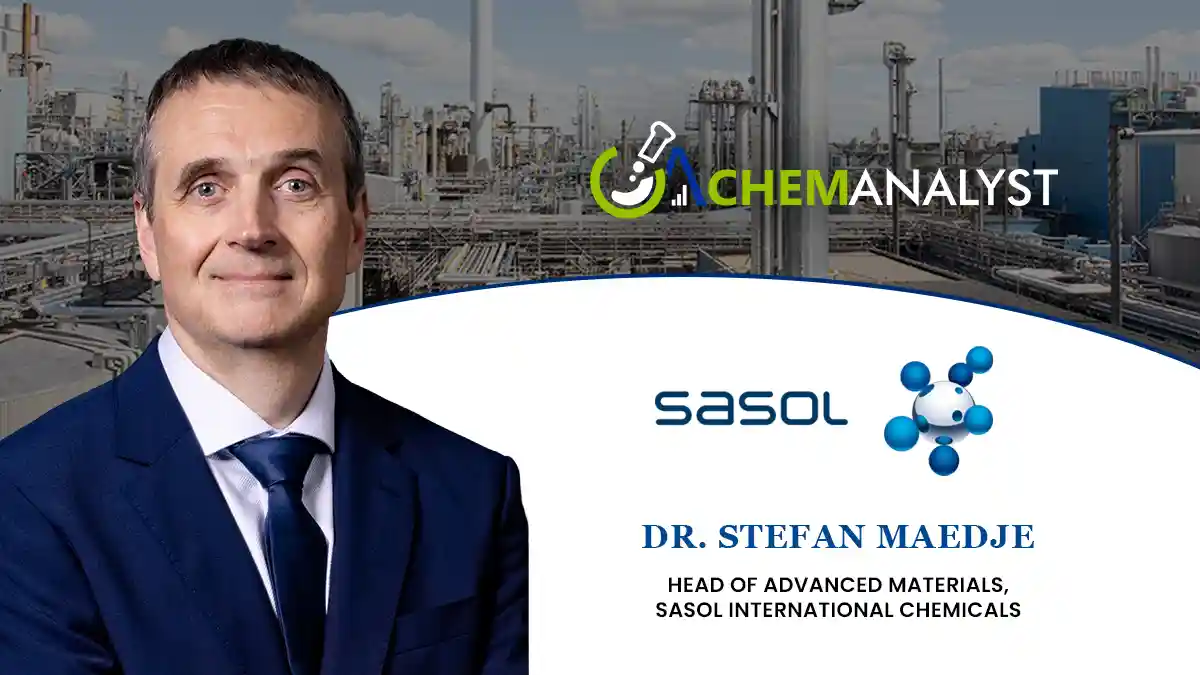
ChemAnalyst Talks with Dr. Stefan Maedje, Head of Advanced Materials, Sasol International Chemicals
Sasol International Chemicals manufactures and markets a broad portfolio of specialty and commodity chemicals for diverse industrial applications, serving more than 4,000 customers across 80 countries. A business of Sasol Limited, it manages the company’s Northern Hemisphere chemicals operations, driving innovation, safe operations, and sustainable chemical solutions. ChemAnalyst spoke with Dr. Stefan Maedje, Head of Advanced Materials, Sasol International Chemicals, about the company’s strategy to strengthen its leadership in high-performance aluminas and specialty materials. Dr. Maedje highlighted Sasol’s customer-centric approach, proprietary alumina technology, and €60 million investment in its Brunsbüttel, Germany, facility, which will expand high-purity alumina production, improve process efficiency, and reduce the product carbon footprint by up to 15% per ton. Looking ahead, Sasol aims to drive sustainable growth through innovation, reliable global supply, and advanced material solutions for next-generation industrial applications.
Complete Interview with Dr. Stefan Maedje
Q: Please provide an overview of your professional journey in the advanced materials and specialty chemicals sector, and share how your experience has shaped your strategic vision for strengthening Sasol’s position as a global supplier of high-performance aluminas and next-generation specialty materials.
Dr. Stefan Maedje: I joined Sasol nearly 30 years ago and have held a variety of commercial roles within our alumina business before assuming leadership of the Advanced Materials business division in 2024. Throughout that time, I have developed an understanding of our customers’ evolving needs and the market dynamics shaping demand for high-performance aluminas and specialty materials.
My experience has reinforced a core principle that continues to guide our business: long-term success is driven by strong customer partnerships, consistent reliability, innovation across the organization, expertise in core technologies and the ability to develop tailored products for customer needs. This approach has helped shape the direction of our Advanced Materials portfolio, which today is significantly more differentiated than when I joined, with an expanding range of high-purity and ultra-high-purity aluminas and specialty materials across many applications that are not limited to the catalyst market.
Investments such as our €60 million project in Brunsbüttel reflect this strategy in action. By expanding and optimizing our Advanced Materials alumina asset base, we are strengthening Sasol’s position as a leading supplier of spherical alumina supports for advanced catalyst systems and other high-value applications. At the same time, we are improving efficiency and reducing the product carbon footprint through energy optimization and enhanced process design. This combination of innovation and sustainability underpins our ambition to further strengthen Sasol’s position as a global supplier of high-performance aluminas and next-generation specialty materials.
Q: What is the strategic rationale behind Sasol’s €60 million investment in the Brunsbüttel facility, and how does this expansion align with the company’s broader growth roadmap in advanced materials and high-value specialty chemicals?
Dr. Stefan Maedje: Sasol's €60 million investment in its Advanced Materials alumina asset base at Brunsbüttel will expand our capabilities in advanced materials and specialty chemicals, enabling us to better support customers in applications where performance, supply reliability and technical expertise are key.
The investment reflects our commitment to disciplined, customer-focused growth. By expanding and optimizing our existing asset base, we are strengthening our portfolio of specialty products, deepening long-term customer partnerships and enhancing the resilience of our global chemicals business. It also supports our focus on continuous innovation, positioning us to meet evolving customer needs and capture growth opportunities in advanced materials and high-value specialty chemicals.
Q: The European chemical industry continues to face challenges related to competitiveness, energy costs, and market uncertainty. What factors give Sasol confidence to move forward with this investment, and what strategic advantages does the Brunsbüttel site offer for long-term growth?
Dr. Stefan Maedje: This investment is a selective, site-specific commitment within an existing asset base. It reflects disciplined capital allocation in a challenging European chemicals environment and reinforces Sasol’s position that investment decisions remain closely linked to market conditions and enabling policy frameworks.
The Brunsbüttel site combines experienced, innovative teams with proven capability in producing high-purity and ultra-high-purity aluminas. Together with Sasol’s U.S. Advanced Materials operations, this allows us to leverage existing assets and capabilities efficiently, while reinforcing our ability to serve customers who require reliable, technologically advanced supply from both Europe and North America manufacturing hubs.
Q: From a technology and product perspective, how will the Brunsbüttel expansion enhance Sasol’s capabilities in high-purity and ultra-high-purity aluminas, and what differentiating advantages will these materials provide for advanced catalyst systems and other high-performance applications?
Dr. Stefan Maedje: The Brunsbüttel expansion will increase capacity and enhance process performance for our advanced alumina portfolio, strengthening Sasol's position as a leading merchant supplier of spherical alumina supports for advanced catalyst applications.
What differentiates Sasol is our proprietary alkoxide-based alumina technology and decades of expertise in shaping high-quality alumina spheres. The expansion incorporates the quality and process improvements we have developed over the past decade while supporting continued growth in high-purity and ultra-high-purity aluminas.
For customers, this means reliable access to high-performance materials with the consistency and tailored properties required for next-generation catalyst systems and other demanding industrial applications.
Q: How do you see the global advanced materials and specialty chemicals market evolving over the next three to five years, and which end-use sectors—such as automotive, electronics, catalysts, packaging, and consumer applications—are expected to generate the strongest growth opportunities?
Dr. Stefan Maedje: In coming years, we expect advanced materials and specialty chemicals to be driven by the transition to cleaner technologies, electrification and more sophisticated manufacturing. This is reshaping catalyst demand, with fossil-fuel-based applications under pressure and increased focus on lower-carbon, circular and energy-efficient processes.
Within this context, we see opportunities in applications that require advanced catalyst systems and high-performance materials to improve efficiency, performance and sustainability. As customer requirements continue to evolve, demand for high-purity, reliable and tailored materials is expected to remain an important driver across a range of industrial markets, aligning well with our Advanced Materials strategy.
Q: As industries increasingly demand higher performance, reliability, and customized material solutions, how are changing customer requirements influencing Sasol’s research, innovation, and product development priorities?
Dr. Stefan Maedje: Evolving customer requirements play an important role in shaping where we focus our resources and investments. As performance expectations increase and applications become more technically demanding, we continually assess how our products, technologies and manufacturing capabilities can best support current and future market needs.
Our investment in Brunsbüttel reflects that long-term approach. By expanding and enhancing our capabilities, we are strengthening the foundation for future innovation, improving our ability to introduce new products and ensuring we remain well positioned to support customers as their requirements continue to evolve.
Q: What role will innovation, process optimization, and technical collaboration with customers play in helping Sasol maintain a competitive advantage in the rapidly evolving advanced materials landscape?
Dr. Stefan Maedje: Technical collaboration with established and new customers is at the core of our Advanced Materials business. Through trustful, long-standing partnerships, we gain valuable insight into application requirements.
Those insights, combined with our proprietary technology and deep manufacturing expertise, drive continuous innovation across our alumina value chain. We are constantly refining processes and enhancing product performance to meet increasingly demanding customer requirements, supporting the long-term growth of both our business and our customers.
Q: The transition toward cleaner technologies, electrification, and more sophisticated manufacturing processes is increasing demand for specialized materials. How do you expect these industrial megatrends to influence future demand for high-purity aluminas and advanced specialty chemical solutions?
Dr. Stefan Maedje: Future growth will increasingly be driven by applications that require engineered materials with consistent performance characteristics. As technologies become more sophisticated, customers are looking for solutions that can meet specific technical requirements.
Our ability to tailor material properties and leverage proprietary alumina technologies position us well to address these needs. We expect this to create new opportunities across a range of advanced industrial applications.
Q: From a supply-side perspective, what are the key challenges currently impacting the advanced alumina and specialty chemicals value chain, including raw material availability, energy costs, logistics, and regional capacity additions, and how are these factors affecting market dynamics?
Dr. Stefan Maedje: On the feedstock side, recent years have reinforced the importance of diversified supply chains and robust risk mitigation to manage potential disruptions. Our approach has long been to ensure products are available where our customers need them, supported by a global production and logistics footprint.
These market dynamics have increased the importance of supply reliability, operational flexibility and regional presence. Our investments in Germany and the U.S. strengthen established production hubs, enhance our ability to serve customers across key markets and support continuity of supply in an increasingly complex operating environment.
Q: How are global supply-demand balances for high-performance aluminas evolving, and do you anticipate any supply constraints or capacity shortages as demand increases from advanced manufacturing, catalyst, and electronics-related applications?
Dr. Stefan Maedje: Over the past decade, we have made substantial investments to expand our Advanced Materials production capabilities in the U.S. and Germany. As a result, we are well positioned to support growing demand while maintaining the flexibility to adapt to market requirements.
The shaped carrier expansion at Brunsbüttel further strengthens that position. By expanding and optimizing an established Advanced Materials asset base, we are increasing our ability to serve high-performance applications and reinforcing Sasol's role as a reliable, long-term supplier of specialty alumina products to customers worldwide.
Q: Considering fluctuations in energy costs, feedstock prices, and global supply chain disruptions, how are pricing mechanisms for advanced alumina and specialty chemical products changing, and what approaches are customers adopting to manage cost volatility?
Dr. Stefan Maedje: We take a data-based approach to managing cost volatility, working closely with customers to navigate changes in energy, feedstock and logistics costs while maintaining reliable supply.
Our role is to provide the reliability, technical expertise and commercial partnership needed to help customers achieve their objectives in a changing environment.
Q: What is your pricing outlook for high-purity aluminas and advanced specialty materials over the next 12–24 months, and which market factors—including demand growth, production costs, and regional supply expansion—are likely to influence price movements?
Dr. Stefan Maedje: While market conditions will continue to be shaped by factors such as demand trends, production costs and various other factors, customers value suppliers that can deliver more than product alone.
At Sasol, our differentiated value proposition is built on proprietary alumina technologies, manufacturing expertise, reliable global supply and close customer engagement. Combined with strategic investments such as the Brunsbüttel expansion, these strengths enable us to support demanding applications and help customers achieve their long-term objectives in a dynamic market environment.
Q: The Brunsbüttel expansion aims to lower the product carbon footprint by up to 15% per ton. Could you elaborate on the technological improvements and energy optimization measures that will help achieve these sustainability objectives?
Dr. Stefan Maedje: The Brunsbüttel project design integrates advanced technologies, energy optimization and enhanced process design through proprietary technology to deliver the targeted reduction in product carbon footprint of up to 15% per ton versus the existing baseline. Rather than a single measure, it is the integrated design of the project that supports Sasol’s and our customers’ sustainability and competitiveness objectives.
Q: As sustainability becomes an increasingly important purchasing criterion for industrial customers, how is Sasol adapting its advanced materials portfolio to meet growing expectations around lower emissions, resource efficiency, and environmental compliance?
Dr. Stefan Maedje: More than five years ago, we developed a product carbon footprint (PCF) model for our Advanced Materials grades, which underpins our decarbonization roadmap to 2030 and beyond and guides where we focus our efforts.
Building on these insights, we are implementing selective measures to reduce the product carbon footprint. The Brunsbüttel investment, for example, is expected to reduce the product carbon footprint by up to 15% per ton compared to the existing baseline, supporting both Sasol’s and our customers’ sustainability and competitiveness objectives.
For our major customers, we provide product-specific PCF information reflecting improvements achieved. This helps customers manage their own sustainability commitments.
Q: How do evolving European environmental policies, decarbonization targets, and industrial regulations influence Sasol’s investment decisions and long-term manufacturing strategy in the region?
Dr. Stefan Maedje: Policy and regulatory frameworks play an important role in shaping investment decisions.
Our decision to invest in Brunsbüttel demonstrates that targeted investment remains possible in Europe when the right conditions are in place. At the same time, it reinforces the importance of predictable, competitive and enabling policy frameworks that support long-term industrial activity. Maintaining this balance will be essential to ensuring Europe remains an attractive location for specialty chemicals production.
Q: Beyond increasing production capacity, what operational and commercial benefits do you expect from the Brunsbüttel expansion in terms of supply reliability, customer partnerships, and market competitiveness?
Dr. Stefan Maedje: Beyond added capacity, the Brunsbüttel expansion will enhance our ability to respond quickly and reliably to customer needs. It is designed to be executed with no disruption to customer supply, reinforcing our track record of reliability and continuity.
Operationally, we expect shorter lead times and greater flexibility to introduce and scale new products. Commercially, the project strengthens customer confidence in our long-term commitment to the Advanced Materials alumina platform and supports deeper, technology-based partnerships in critical applications.
Q: How important is Germany and the wider European manufacturing ecosystem in Sasol’s global advanced materials strategy, particularly as companies seek secure, regional, and technologically advanced supply chains?
Dr. Stefan Maedje: Germany—and the wider European manufacturing ecosystem—is an important part of Sasol’s global Advanced Materials footprint, alongside other key regions.
Our European operations form one pillar of our platform, combining local presence with international reach and enabling reliable global supply.
Q: Looking ahead to the project’s targeted operational timeline around 2029, what milestones should customers and industry stakeholders watch as Sasol progresses with this expansion?
Dr. Stefan Maedje: The project has already reached a key milestone, enabling us to move into execution. Procurement activities are underway, with the selection of the general contractor expected very soon.
Looking ahead, stakeholders can expect phased construction and commissioning aligned with safety, regulatory and operational requirements, with beneficial operation targeted around 2029.
Q: With global competition intensifying in specialty chemicals, what technological, commercial, and collaborative capabilities will be most critical for companies to succeed in the advanced materials market over the next decade?
Dr. Stefan Maedje: Success in the advanced materials market will increasingly depend on the ability to combine differentiated technology, manufacturing excellence and close customer engagement. Customers will continue to seek partners that can deliver specialized materials, technical expertise and reliable supply on a global scale.
At Sasol, our strengths are built on proprietary alumina technologies, deep application knowledge and established manufacturing assets in both Germany and the U.S. Investments such as the Brunsbüttel expansion strengthen our ability to support customer requirements through innovation, operational excellence and a growing portfolio of high-performance materials. Companies that can translate application insight into differentiated solutions while maintaining quality, reliability and long-term partnerships will be best positioned for success in the years ahead.
Q: Looking beyond the Brunsbüttel investment, does Sasol see additional opportunities to expand its advanced materials portfolio through new technologies, strategic partnerships, or further capacity investments?
Dr. Stefan Maedje: The Brunsbüttel investment is an important milestone in our long-term strategy for advanced materials, building on a long history of investments in capacity, technology and technical expertise. These investments have strengthened our ability to serve specialized applications and support customers with high-performance solutions across a range of industries.
Looking ahead, our focus remains on executing against that strategy and continuously enhancing the value we deliver to customers. With established manufacturing assets in the U.S. and Germany, a differentiated portfolio of high-performance aluminas and application expertise, Sasol is well positioned to meet market requirements. We will continue to take a disciplined approach to investment and innovation, reinforcing our position as a trusted supplier of advanced materials while maintaining the flexibility to adapt to changing customer and industry needs.







 About ChemAnalyst
Leave a Comment
Comments (0)