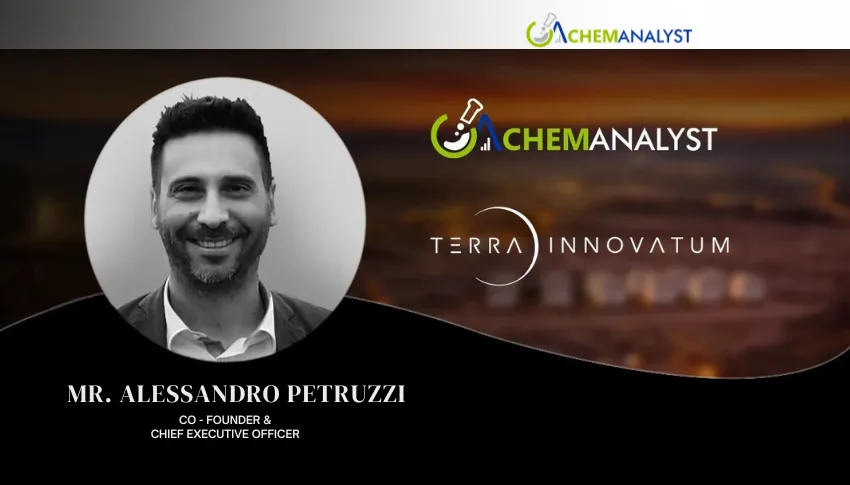
ChemAnalyst Talks with Mr. Alessandro Petruzzi, Co-Founder & Chief Executive Officer
Terra Innovatum is a pioneering nuclear energy company dedicated to making clean, safe, and reliable nuclear power accessible through its innovative SOLO™ Micro-Modular Reactor (MMR™) technology. With a mission to address growing global energy demand, Terra Innovatum focuses on delivering scalable, affordable, and deployable micro-reactor solutions capable of providing CO2-free behind-the-meter and off-grid power for industrial facilities, remote communities, data centers, and other energy-intensive applications. Designed using commercially available components and a proven licensing pathway, SOLO™ enables rapid deployment, enhanced supply chain resilience, and long-term cost predictability.
ChemAnalyst spoke with Mr. Alessandro Petruzzi, Co-Founder & Chief Executive Officer of Terra Innovatum, about the vision behind SOLO™, the role of advanced microreactors in transforming the global energy landscape, and the company’s progress toward commercialization. He shared insights on helium-cooled reactor technology, safety and licensing strategies, industrial decarbonization, energy security, supply chain resilience, and how decentralized nuclear solutions can support a more sustainable and reliable energy future.
Complete Interview with Mr. Alessandro Petruzzi
Q1. Can you share your professional journey and what inspired you to focus on advanced nuclear and clean energy technologies through Terra Innovatum Global N.V.?
Alessandro Petruzzi: My journey has always been driven by a strong passion for nuclear technology and its potential to support sustainable development and improve the quality of life for people worldwide. As a nuclear engineer, I believe that nuclear energy represents one of the most reliable pathways for technological advancement while ensuring long-term environmental sustainability.
For more than six decades, the global nuclear industry has demonstrated a strong safety record, with over 400 nuclear power plants operating worldwide. The industry has developed effective approaches for managing the entire nuclear lifecycle, including the handling and management of nuclear waste, despite the misconceptions that still exist around the technology.
In 2018, we founded Terra Innovatum with the ambition of making nuclear energy accessible to a much broader market. The initial vision was to enter the small-scale energy segment—industries and facilities with power demands of up to around 10 MW that cannot benefit directly from large conventional nuclear plants.
This led to the development of a micro-nuclear reactor capable of delivering the right amount of reliable energy exactly where it is needed. Our goal is to democratize access to nuclear energy by enabling small industries and remote applications to benefit from a safe, physics-based technology that is inherently resistant to core melting or explosions and can be deployed rapidly wherever infrastructure access is available. The real opportunity isn't simply building another reactor. It's fundamentally changing how energy is delivered by bringing reliable nuclear power directly to where it's consumed.
Q2. What was the key gap in the global energy landscape that led to the development of the SOLO™ micro-modular reactor program?
Alessandro Petruzzi: The world is witnessing an unprecedented increase in electricity demand, particularly due to the growth of artificial intelligence, digital infrastructure, and broader industrial development. While generating additional power through nuclear, renewable, and other energy sources is achievable, the greater challenge lies in transmitting that electricity efficiently to end users.
Today’s electricity grid infrastructure represents a major bottleneck. Expanding and modernizing power transmission networks requires enormous investment and significant time. Therefore, decentralized energy solutions are becoming increasingly important.
SOLO™ addresses this challenge through a behind-the-meter approach. The reactor can operate independently from the grid, allowing clean and reliable power generation directly at the point of consumption. It can provide approximately 1 MW of continuous electrical output for up to 15 years without refueling.
This offers industrial operators long-term cost stability and energy security, enabling them to plan their operations with greater certainty because their energy costs become predictable over an extended period.
Q3. Reflecting on your leadership journey, what has been the most significant milestone in advancing SOLO™ from concept to experimental validation?
Alessandro Petruzzi: One of the most meaningful milestones has been witnessing the transition of SOLO™ from a concept and engineering design into a tangible technology with real components being manufactured and validated.
Recently, we achieved a major milestone by successfully machining graphite components with the precision and tolerances required for our reactor design. Seeing these physical components manufactured according to our specifications was an important moment for the entire team because it demonstrated that the project had moved beyond theoretical development.
Another major milestone is the licensing pathway. The regulatory process is fundamental because no advanced reactor can move toward deployment without regulatory approval. Our construction permit application process with the U.S. Nuclear Regulatory Commission represents a critical step toward bringing SOLO™ into real-world operation.
Q4. How would you explain Terra Innovatum’s vision and mission to stakeholders outside the nuclear and energy sectors?
Alessandro Petruzzi: Terra Innovatum’s mission is to make advanced nuclear energy accessible, safe, and practical for a wider range of applications. We believe energy production should become more decentralized, reliable, and available even in locations where conventional grid expansion is challenging.
Our vision is to create compact micro-reactors that function almost like long-duration energy assets, delivering electricity, heat, and potentially radioisotopes close to the point of use. Through this approach, we aim to support industrial development, strengthen energy resilience, and contribute to global decarbonization efforts.
Q5. What is the strategic significance of integrating the helium circulator into the SOLO™ testing infrastructure?
Alessandro Petruzzi: I do not consider the helium circulator a standalone breakthrough but rather an essential milestone within the broader development journey of SOLO™.
From the beginning, our strategy has been to design the reactor using components and materials that are already commercially developed and have established industrial maturity. This approach helps accelerate both licensing and supply chain readiness.
The helium circulator is one of many critical components, alongside systems such as turbines, steam generators, and graphite structures, that demonstrate the transition of SOLO™ from engineering drawings to real industrial execution.
Every supplier agreement represents confirmation that a component design has reached maturity and is ready for manufacturing. Our objective is to continue this process until every component of the reactor is fully validated and integrated into the complete system.
Q6. What key factors influenced Terra Innovatum’s decision to partner with Boldrocchi for this critical component?
Alessandro Petruzzi: Boldrocchi has extensive expertise and a long-standing track record in the design and manufacturing of this type of component, which gave us strong confidence in their capabilities.
However, our supply chain strategy involves evaluating multiple highly qualified suppliers for each major component. For some systems, we assess two to four potential suppliers to ensure flexibility and long-term scalability.
While Boldrocchi is an excellent partner for our current development phase, large-scale commercialization will require a broader supplier ecosystem. Unlike traditional nuclear projects that may require components only once every decade, micro-reactor deployment will involve manufacturing numerous units annually. Therefore, establishing a robust and diversified supply chain is essential to the long-term success of the technology.
Q7. How does this collaboration strengthen Terra Innovatum’s ability to de-risk and validate its reactor technology?
Alessandro Petruzzi: Collaborations with experienced industrial partners are fundamental to reducing technical and supply-chain risks. Every partnership confirms that a component is not only technically feasible on paper but can also be manufactured according to the required specifications.
As Terra Innovatum moves toward its first-of-a-kind deployment and future commercial production, developing relationships with multiple qualified suppliers will be critical to ensuring reliability, reducing manufacturing risks, and enabling large-scale production of SOLO™ reactors.
Q8. Why is helium circulation fundamental to the design and performance of next-generation microreactors like SOLO™?
Alessandro Petruzzi: Helium is an excellent coolant due to its favorable thermal properties, particularly its heat transfer capabilities compared with other gases. While alternative gases can also be utilized, reactor design always involves finding the right balance between performance, efficiency, cost, and supply chain practicality.
Since 2018, we have evaluated multiple coolant options throughout the evolution of the SOLO™ reactor design. After assessing various alternatives, helium emerged as the most suitable choice because of its technical advantages and compatibility with our overall design philosophy.
Another important consideration is that helium is a very small atom, which historically created challenges related to leakage. However, our reactor design minimizes potential leakage points by incorporating advanced sealing techniques and reducing the number of mechanical connections wherever possible.
Additionally, the quantity of helium required for SOLO™ is significantly lower than that of larger gas-cooled reactors. We also designed the system to operate without requiring ultra-high-purity helium, making our supply chain more flexible and resilient. Ultimately, our approach reflects a practical engineering compromise between maximizing performance and maintaining economic viability.
Q9. What are the primary engineering challenges in achieving helium leak-tight systems, and how are these challenges addressed?
Alessandro Petruzzi: The primary challenge with helium is its extremely small atomic size, which makes it more prone to escaping through microscopic gaps and imperfect connections. Historically, maintaining helium containment has been one of the key engineering challenges for gas-cooled reactor systems.
To overcome this challenge, our design philosophy focuses on minimizing the number of potential leakage paths. We rely heavily on high-integrity sealing solutions, optimized component interfaces, and advanced manufacturing techniques to ensure long-term system integrity.
Furthermore, because SOLO™ uses a relatively small quantity of helium and does not require exceptionally high purity levels, the overall impact of helium supply and containment challenges is significantly reduced.
Q10. How do advanced thermal management systems impact efficiency, safety, and long-term reliability in microreactors like SOLO™?
Alessandro Petruzzi: For the first version of SOLO™, we have intentionally selected a proven and well-established power conversion approach based on a Rankine cycle with a steam turbine. This decision aligns with our broader strategy of using mature technologies that already have an established industrial track record, helping to reduce technical risk and accelerate deployment.
The first-generation reactor is expected to achieve an electrical efficiency of slightly above 20%, primarily due to the small size of the turbine system. However, we have identified pathways for significant efficiency improvements.
One approach involves connecting multiple reactor units to a shared, larger power conversion system. By increasing turbine size, overall efficiency can rise toward approximately 30–33%. Another future development pathway involves replacing steam with advanced working fluids such as supercritical CO2, which could further enhance performance.
At this stage, our primary focus remains the successful execution and commercialization of the first SOLO™ units using reliable, proven technology before transitioning to more advanced power conversion systems.
Q11. In what ways does the helium circulator enable the simulation of real-world operating conditions during testing?
Alessandro Petruzzi: The helium circulator is a critical part of developing a realistic test environment because it represents an essential element of the reactor’s primary cooling system. Integrating such industrial-grade components into our testing infrastructure allows us to validate not only theoretical designs but also the practical manufacturability and operational readiness of the system.
The broader objective of our testing program is to confirm that all components can work together as an integrated reactor system under conditions representative of real-world operation. Every validated component brings SOLO™ one step closer to commercial deployment.
Q12. How will this infrastructure enhancement accelerate your research and system validation timelines?
Alessandro Petruzzi: The greatest advantage of the microreactor approach is the ability to manufacture reactors in a controlled factory environment rather than constructing each unit individually on-site.
Transitioning from design and laboratory development to industrial manufacturing requires continuous optimization. A design that works on paper must be adapted to real-world manufacturing processes, assembly techniques, and quality requirements.
Our objective is to develop standardized procedures for every stage of production—from manufacturing graphite components and integrating reactor systems to final assembly. These procedures will continuously improve as we move from building the first-of-a-kind reactor toward producing dozens, hundreds, and eventually thousands of units annually.
This factory-based model allows us to reduce construction time, lower costs, improve consistency, and ultimately create a manufacturing approach similar to the modern automotive industry, where standardized components are assembled efficiently at scale.
Q13. What specific performance benchmarks or validation goals does the helium circulator help achieve?
Alessandro Petruzzi: The helium circulator plays a vital role in validating the operational performance of the primary cooling system. It enables us to verify that the selected component design meets the engineering requirements necessary for the reactor’s long-term operation.
More importantly, it demonstrates that our design is progressing beyond theoretical calculations into real industrial implementation. Each successfully integrated component confirms the maturity of the technology and strengthens the overall confidence in SOLO™’s readiness for future deployment.
Q14. How does strengthening experimental infrastructure influence investor confidence and commercialization prospects?
Alessandro Petruzzi: Strong experimental infrastructure demonstrates that the project is moving from a conceptual stage into tangible execution. For investors and industrial partners, seeing physical components being designed, manufactured, and validated provides greater confidence in the technological maturity and commercial potential of the reactor.
Our strategy is based not only on completing the first-of-a-kind reactor but also preparing the supply chain and manufacturing ecosystem required for large-scale commercialization. Establishing reliable partnerships with qualified suppliers is therefore a key factor in reducing risks and enabling future market expansion.
Q15. What are the next major milestones in transitioning SOLO™ from testing to deployment readiness?
Alessandro Petruzzi: The most important milestone is obtaining regulatory approval, as no reactor technology can move toward deployment without successful licensing.
A major step in this journey is the submission of our construction permit application to the U.S. Nuclear Regulatory Commission (NRC), which represents a critical phase in bringing SOLO™ toward real-world implementation.
At the same time, progress in manufacturing and supply chain development remains equally important. The successful production of graphite components with the required precision was a major achievement because it demonstrated that our design can be translated into physical hardware.
Moving forward, our priorities include advancing the licensing process, continuing component validation, completing manufacturing mock-ups, and preparing for the first stages of reactor construction.
Q16. How does the development of SOLO™ contribute to advancing global clean energy and decarbonization goals?
Alessandro Petruzzi: Nuclear energy is inherently one of the lowest-carbon sources of reliable electricity available today. When evaluating the complete energy lifecycle, including fuel extraction, infrastructure development, electricity generation, and transmission, every technology carries some level of carbon impact. The objective is not to achieve absolute zero emissions—which is practically impossible—but to minimize the overall environmental footprint.
Microreactors such as SOLO™ provide additional advantages because they are designed as behind-the-meter solutions. This reduces the need for extensive grid expansion, transmission infrastructure, and additional materials such as copper and large-scale electrical networks.
Furthermore, SOLO™ can operate continuously for approximately 15 years without refueling, reducing the frequency of fuel transportation and associated emissions. This long operational cycle, combined with its compact footprint, makes it a highly attractive solution for industries seeking reliable and low-carbon energy.
While carbon pricing and tax incentives are still developing in some markets, particularly the United States, European industries are increasingly required to account for their carbon footprint. In such environments, microreactor technologies can play a significant role in helping industries reduce emissions while maintaining energy reliability.
Q17. What role do high-integrity components, such as helium circulators, play in shaping future standards for advanced reactors?
Alessandro Petruzzi: High-quality and reliable components are essential for the success of any advanced reactor technology. Our philosophy from the beginning has been to utilize proven materials and industrially mature components wherever possible. This approach reduces technical uncertainty, simplifies licensing, and strengthens supply chain readiness.
Components such as helium circulators demonstrate the transition from theoretical reactor designs to real-world industrial systems. As advanced reactors move toward commercial deployment, the availability of reliable suppliers and standardized components will be essential for establishing new industry benchmarks and enabling large-scale production.
Q18. How do you see micro-modular reactors influencing industrial decarbonization and the future of distributed energy systems?
Alessandro Petruzzi: Microreactors have the potential to fundamentally transform how industries access clean and reliable energy. Instead of depending entirely on centralized power generation and long-distance transmission networks, industries can generate electricity directly at their facilities.
Beyond electricity, microreactors can also provide process heat, which is one of the most difficult aspects of industrial decarbonization. The first generation of SOLO™ is designed to deliver heat at approximately 900°F (around 480–500°C), enabling it to support several industrial heating applications.
In the future, higher-temperature designs could expand the range of industrial processes that can be supported. The long-term vision is to position microreactors as compact, reliable energy systems capable of delivering electricity, heat, and other valuable outputs directly where they are needed.
Another important aspect is safety. SOLO™ was intentionally designed with a low thermal power level to eliminate the possibility of core melting or hydrogen generation, making it fundamentally different from conventional large-scale reactor designs. This allows the technology to be deployed closer to industries, communities, and other end users while maintaining a strong safety profile.
Q19. How is the ongoing conflict involving Iran and the broader Middle East reshaping global energy security and investment priorities?
Alessandro Petruzzi: Energy has always been closely connected to geopolitical dynamics. The current instability in the Middle East highlights the vulnerability of global energy systems that rely heavily on concentrated fuel resources and complex international supply chains.
Microreactors represent a new approach toward energy resilience by enabling localized and decentralized energy generation. By providing reliable electricity closer to where it is consumed, this technology can reduce dependence on traditional energy transportation routes and contribute to greater energy security.
However, oil and natural gas will continue to play a fundamental role in the global economy for the foreseeable future. The transition toward advanced nuclear solutions should therefore be viewed as a complementary strategy that reduces dependency, increases resilience, and expands access to reliable energy in regions where electricity remains limited.
Q20. With disruptions in the Strait of Hormuz affecting critical materials, how do you assess supply chain risks for helium and other reactor-relevant inputs?
Alessandro Petruzzi: Helium supply is an important consideration because major producers, including countries in the Middle East such as Qatar, contribute significantly to global availability. However, for the SOLO™ reactor, the overall risk is limited because our technology requires a relatively small quantity of helium and does not depend on extremely high-purity helium.
It is also important to recognize that helium demand is increasing not only because of nuclear technologies but also due to growing applications in semiconductors, advanced electronics, and artificial intelligence-related industries.
As demand increases, the market will likely respond by expanding supply capacity. In addition, advanced reactor technologies can continue exploring alternative cooling solutions, as coolant selection ultimately depends on balancing performance, availability, and cost.
Q21. Given potential disruptions in global helium supply, what contingency strategies should advanced reactor developers adopt?
Alessandro Petruzzi: The most important strategy is maintaining flexibility in technology development and supply chain planning. Reactor developers should minimize dependence on highly specialized materials whenever possible and design systems that can operate efficiently with commercially available resources.
At Terra Innovatum, we deliberately selected a helium system that requires limited quantities and lower purity levels compared with some conventional designs. This decision improves supply chain resilience.
At the same time, future reactor concepts may continue exploring alternative coolants. In fact, earlier stages of SOLO™ development evaluated other gases such as CO2 before helium was selected as the optimal balance between technical performance and practicality.
Q22. How do rising energy and petrochemical prices driven by geopolitical instability influence the economic case for microreactors like SOLO™?
Alessandro Petruzzi: Geopolitical instability and energy price volatility reinforce the value of decentralized energy systems. The traditional model of generating electricity in one location and transmitting it over long distances is increasingly challenged by infrastructure limitations, rising costs, and energy security concerns.
Microreactors offer a behind-the-meter solution that provides predictable, long-term energy costs. This stability allows industries and businesses to plan investments with greater confidence.
Additionally, decentralized energy systems can improve resilience against cyber threats. Instead of relying on a small number of large generation facilities and extensive transmission networks, a future energy system with thousands of smaller distributed generation points can offer greater flexibility and security.
Q23. Do geopolitical shocks accelerate the transition toward decentralized and resilient energy systems such as microreactors?
Alessandro Petruzzi: Yes, geopolitical disruptions can accelerate the transition toward decentralized energy solutions because they highlight the importance of energy independence and supply security.
Microreactors provide a practical way to produce reliable electricity and heat directly at the point of demand, reducing reliance on vulnerable transmission networks and international energy supply chains.
The increasing importance of energy security, combined with the growing challenges associated with expanding electricity grids, makes decentralized technologies an increasingly attractive option for governments and industries worldwide.
Q24. How should companies balance long-term clean energy objectives with short-term market volatility caused by geopolitical crises?
Alessandro Petruzzi: Companies must adopt a long-term strategic perspective while building flexibility into their energy planning. Short-term geopolitical disruptions may affect fuel prices, supply chains, and investment decisions, but the global demand for reliable, low-carbon energy will continue to grow.
The most successful energy strategies will combine resilience, sustainability, and cost predictability. Technologies such as microreactors can support this balance by providing stable energy supply independent of many external market fluctuations.
Q25. What lessons can Terra Innovatum draw from current disruptions affecting helium, semiconductors, and industrial gas supply chains?
Alessandro Petruzzi: The key lesson is the importance of designing technologies with practical supply chains in mind. Advanced energy systems must not only achieve excellent technical performance but also ensure that critical materials and components are available at commercial scale.
For SOLO™, this philosophy has guided many engineering decisions, including selecting mature components, minimizing specialized material requirements, and maintaining flexibility for future technological improvements.
Q26. What regulatory considerations are most critical when validating and deploying advanced reactor systems like SOLO™?
Alessandro Petruzzi: Regulatory approval remains one of the most important steps in bringing any advanced nuclear technology to market. Nuclear safety culture is deeply connected to a robust licensing framework, and maintaining this standard is essential for public confidence and successful deployment.
In the United States, the Nuclear Regulatory Commission has made significant progress in adapting regulations for advanced and low-consequence reactors. These regulatory developments create a more suitable pathway for small, inherently safe reactor technologies such as SOLO™.
Globally, many countries are still developing frameworks tailored to microreactors. However, the strong safety characteristics, compact size, and lower capital requirements of technologies like SOLO™ are expected to support broader regulatory acceptance in the coming years.
Countries that previously moved away from nuclear energy are also reconsidering their position due to increasing energy demand and decarbonization goals. This shift may create new opportunities for advanced microreactor deployment worldwide.
Q27. How does this partnership and infrastructure expansion align with Terra Innovatum’s long-term growth and global deployment strategy?
Alessandro Petruzzi: Our long-term strategy is not only to successfully develop the first SOLO™ reactor but also to establish the industrial ecosystem required for large-scale global deployment.
Partnerships with experienced component manufacturers strengthen our supply chain, validate the manufacturability of our designs, and reduce the risks associated with commercialization.
The ultimate objective is to transition from a first-of-a-kind reactor toward mass production, where multiple units can be manufactured every year through standardized factory processes.
We envision a future where SOLO™ reactors serve industries, hospitals, municipalities, remote communities, mining operations, and other off-grid applications by providing reliable electricity, process heat, and potentially radioisotopes.
By combining safety, scalability, and decentralized energy generation, Terra Innovatum aims to contribute to a more resilient, sustainable, and accessible global energy future.








 About ChemAnalyst
Leave a Comment
Comments (0)