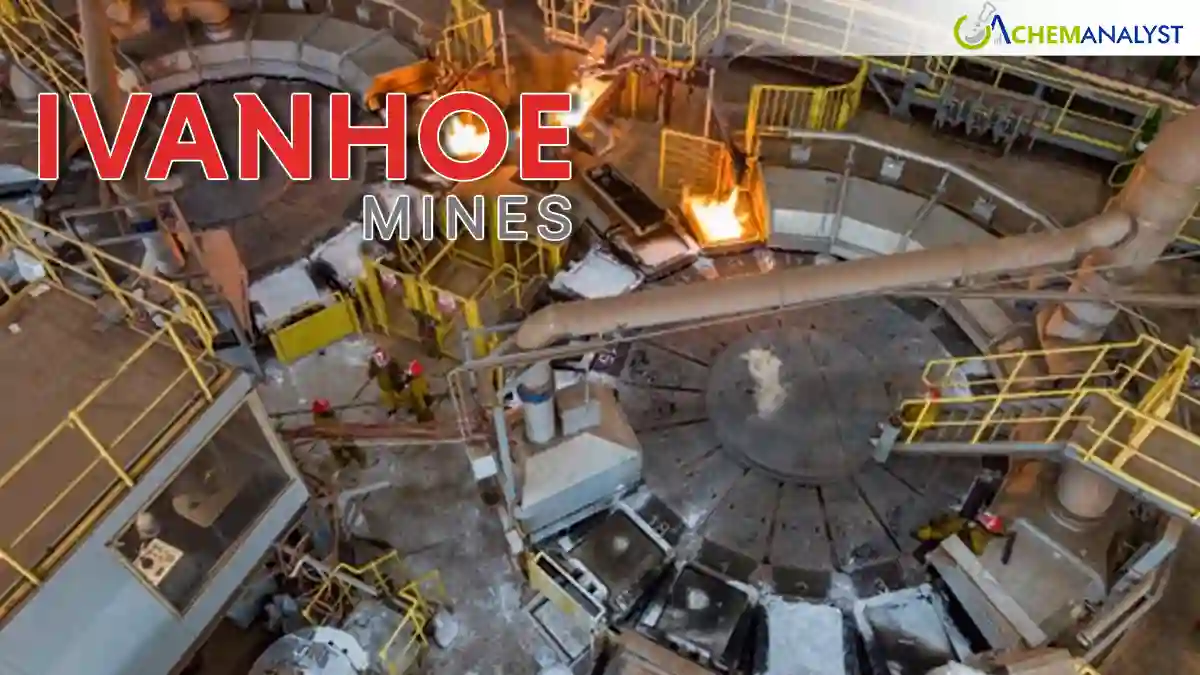
Ivanhoe Mines has announced a major operational milestone with the successful production of its first copper anodes at the Kamoa-Kakula Copper Complex. The achievement was confirmed by Executive Co-Chairman Robert Friedland and President and Chief Executive Officer Marna Cloete, who revealed that the first anodes were produced on December 29, 2025. This landmark event occurred roughly five weeks after the start of the smelter heat-up process and just one week after the first copper concentrate was fed into the system.
The copper anodes were produced at Kamoa-Kakula’s newly constructed, on-site direct-to-blister copper smelter, which has a nameplate capacity of 500,000 tonnes per annum. This state-of-the-art facility represents one of the most significant industrial investments in the African mining sector, with total capital expenditure of approximately $1.1 billion. According to Friedland, the first anode production marks a defining moment for the Kamoa-Kakula operation, reflecting years of planning, engineering excellence, and disciplined execution. He emphasized that the project was completed through more than 18 million man-hours of work while maintaining an exceptional health and safety record, underscoring the professionalism of the workforce and contractors involved.
Once fully ramped up, the smelter is expected to produce 500,000 tonnes per year of copper anodes with a purity of 99.7%, making it the largest copper smelter on the African continent. Ramp-up activities will continue throughout 2026, with steady-state operations anticipated by the end of the year. As previously guided, Kamoa-Kakula’s total copper production in 2026 is projected to range between 380,000 and 420,000 tonnes, with the midpoint of 400,000 tonnes representing around 80% utilization of the smelter’s capacity.
The management team plans to prioritize the processing of concentrates generated by the Phase 1, Phase 2, and Phase 3 concentrators through the on-site smelter. Any surplus concentrate will be toll-treated at the nearby Lualaba Copper Smelter, located near Kolwezi in the Democratic Republic of the Congo. The smelter’s hot commissioning proceeded in line with expectations, with the furnace successfully operating at 1,250 degrees Celsius for five days before the first concentrate feed. Key auxiliary systems, including boilers, steam infrastructure, the acid circuit, and the concentrate dryer, were also completed as planned.
Prior to commissioning, approximately 37,000 tonnes of copper were held in on-site concentrate inventory. As the smelter ramps up, unsold copper in concentrate is expected to decline to around 17,000 tonnes during 2026. This planned destocking is expected to result in copper sales exceeding production by roughly 20,000 tonnes next year, particularly during the first half of 2026, enabling the operation to benefit from near-record global copper prices.
Energy security has been a major focus of the project. A 60-megawatt uninterruptible power supply (UPS) facility was fully installed ahead of first concentrate feed on December 21, 2025. The UPS system can provide up to two hours of instantaneous backup power, protecting the smelter from grid instability. In parallel, construction of a 60 MW on-site solar photovoltaic facility with battery storage is progressing well. Once operational in the second quarter of 2026, it is expected to be the largest installation of its kind in Sub-Saharan Africa, complementing approximately 180 MW of existing diesel backup generation.
As on-site smelting replaces the export of unprocessed concentrate, Kamoa-Kakula’s operating margins are expected to expand significantly. Logistics costs are projected to fall by around 50%, as the copper content per exported truckload increases from about 45% in concentrate to nearly pure anodes. Additional revenue benefits will come from the sale of sulphuric acid, a valuable by-product of smelting.
The smelter has already produced its first batch of sulphuric acid and is expected to generate up to 700,000 tonnes annually at steady state. Demand for acid is strong across the Central African Copperbelt, particularly after Zambia imposed an export ban in September 2025. Spot prices in Kolwezi have reportedly reached as high as $700 per tonne, and Kamoa-Kakula has already completed its first acid sale.
Beyond processing milestones, the project team maintained an industry-leading safety record during construction, recording just one lost-time injury across 18 million hours worked. Meanwhile, underground operations at the Kakula Mine continue to advance, with Stage Two dewatering completed and selective mining on the eastern side commencing ahead of schedule. These developments are expected to support higher head grades and operational stability as the mine progresses into 2026.







Leave a Comment
Comments (0)