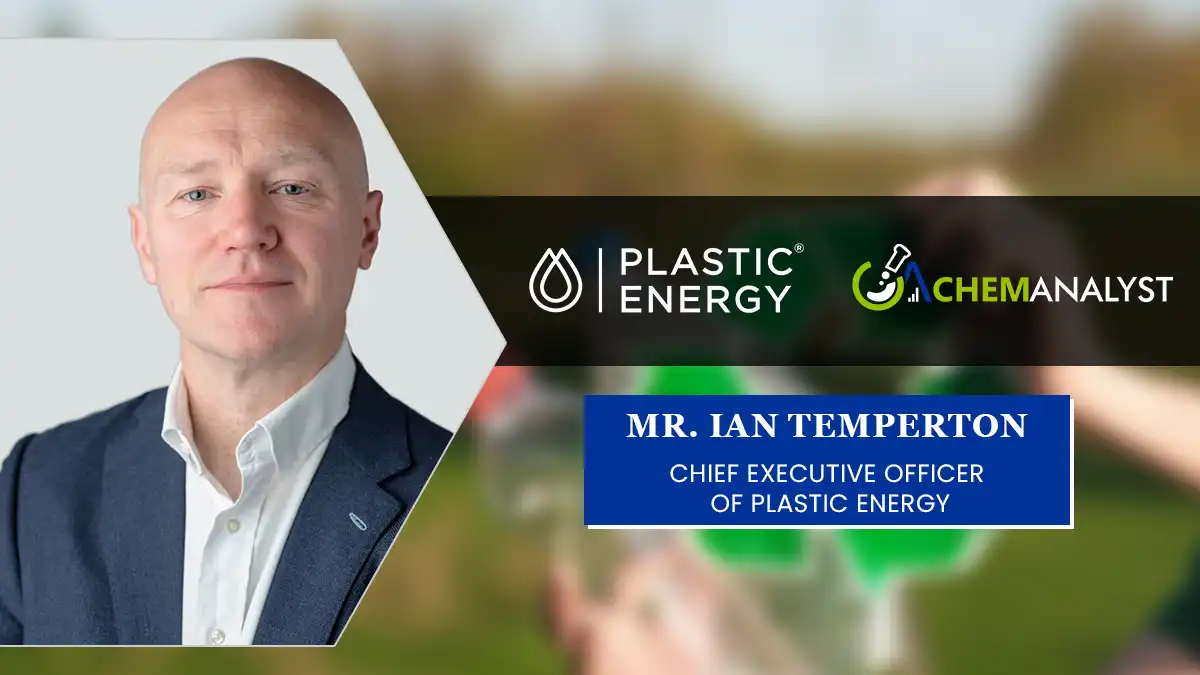
ChemAnalyst Talks with Mr. Ian Temperton, CEO of Plastic Energy
Plastic Energy, a leading industrial technology company focused on building a circular economy for plastics, was founded in 2012 and is headquartered in London. With around 200 employees across the UK, Singapore, Malaysia, Spain, France, and remote locations, the company converts end-of-life plastics into feedstock that replaces fossil oils in new plastic production, helping divert waste from landfill and incineration. ChemAnalyst spoke with Ian Temperton about Europe’s evolving recycling regulations and the role of chemical recycling in achieving circular economy targets. Temperton emphasized the importance of clear and predictable regulations to support large-scale investments and highlighted how chemical recycling technologies can transform hard-to-recycle plastics into valuable feedstocks for producing high-quality recycled plastics.
Complete Interview with Ian Temperton, CEO of Plastic Energy
Q1. The recycling industry is closely watching the draft End-of-Waste rules in Europe. Why is this regulation considered such a critical moment for chemical recycling?
Ian Temperton: There is a significant amount of regulatory activity taking place in Europe at the moment, and much of it is positive for the recycling industry. The sector is transitioning from voluntary recycling targets to legally mandated requirements, particularly through the Packaging and Packaging Waste Regulation. These regulations set clear recycling targets that will come into force toward the end of this decade.
However, along with these targets comes a great deal of detailed regulatory work that may appear technical but is extremely important. Companies need clarity on these rules well before the 2030 targets take effect in order to make investment decisions.
One key issue is the concept of “End-of-Waste.” This determines when a material stops being classified as waste and becomes a product again, which is essentially the foundation of recycling and the circular economy. While the current draft regulation primarily addresses mechanical or physical recycling processes, it was not specifically written for chemical recycling technologies like ours.
The concern is not necessarily the regulation itself, but the precedent it could set. Policymakers often rely on existing regulatory frameworks as models for future rules. If this regulation becomes the template for chemical recycling without appropriate adjustments, it may not accurately reflect how our technology works.
Q2. Some stakeholders argue that regulations are focusing too much on processes rather than environmental outcomes. Why is this distinction important in the real world?
Ian Temperton: Chemical recycling companies like ours produce an intermediate product rather than finished plastic. We take end-of-life plastic waste from post-consumer streams—materials that would otherwise go to landfill or incineration—and convert it through pyrolysis into an oil.
This oil acts as a substitute for virgin fossil feedstocks that are normally used to produce new plastics. In our case, the product is called TACOIL, a specific form of pyrolysis oil. Petrochemical companies then use this material in their production systems to manufacture new polymers, which are later turned into plastic products.
The issue with the current consultation is that it does not fully recognize these intermediate stages as legitimate product steps within the circular value chain. In addition, it raises the possibility that products currently granted End-of-Waste status might lose that classification in the future. For companies that already operate facilities under existing regulations, sudden changes like this create significant uncertainty.
Q3. Investors generally dislike uncertainty. How does regulatory ambiguity affect investment decisions for new chemical recycling plants?
Ian Temperton: It’s important to clarify that businesses like ours do not oppose regulation. In fact, environmental technology companies rely heavily on well-designed regulation because it recognizes the real economic cost of unsustainable practices.
The targets being introduced for the 2030s are extremely positive for our industry. They provide long-term demand signals and encourage the development of recycling infrastructure.
However, detailed regulatory mechanisms—such as product classification or accounting systems like mass balance accounting—play a crucial role in investment decisions. These rules may seem technical, but they become critical when companies are evaluating projects worth tens or even hundreds of millions of euros.
If the regulatory framework is unclear or subject to sudden changes, investors may delay decisions until there is more certainty.
Q4. Could overly restrictive regulations risk giving international competitors an advantage and potentially leave Europe behind in the global recycling market?
Ian Temperton: Both industries that chemical recycling intersects with—recycling and petrochemicals—are currently facing challenges in Europe. The recycling sector has had a difficult market environment, and the European petrochemical industry is also under pressure in terms of global competitiveness.
That said, European regulation has historically played a positive role in driving innovation and investment in recycling technologies. In fact, many of the leading chemical recycling companies are headquartered in Europe and have established their first operations there.
So while there are competitiveness challenges, Europe still represents one of the most promising markets for developing circular plastic solutions—provided policymakers maintain a supportive and predictable regulatory framework.
Q5. Major consumer brands such as Nike or Unilever have strong recycled-content commitments. Could regulatory complexity make it harder for them to meet their targets?
Ian Temperton: I don’t believe so. The market is simply transitioning. At the beginning of this decade, demand for recycled materials was largely driven by voluntary commitments from brands. Now, those commitments are increasingly being translated into binding regulations.
This shift actually benefits the entire value chain because it provides certainty that recycled content will be valued and required in the market.
There may be a temporary adjustment period as the industry moves from voluntary targets to regulated ones, but as we approach the 2030 deadlines, demand will likely accelerate significantly.
In particular, chemical recycling will play an essential role in producing plastics suitable for contact-sensitive applications, such as food or cosmetic packaging. Many in the industry believe this type of recycling is the only viable way to meet those high-quality material requirements.
Q6. As the industry races to scale recycling infrastructure, do these regulatory proposals accelerate progress or slow it down?
Ian Temperton: The most important thing is to ensure that regulations are correct and comprehensive. Individual recycling plants require investments measured in tens or hundreds of millions of euros, and meeting Europe’s overall recycling targets will require billions in capital.
Given the scale of these investments, it’s understandable that developing detailed regulatory frameworks takes time. While the process can sometimes feel slow, once the rules are clearly defined and recognize all forms of recycling within the circular economy, they will ultimately support long-term investment.
Q7. Is there a risk that companies might technically comply with regulations while failing to deliver genuine environmental improvements?
Ian Temperton: That risk always exists with any regulatory system, which is why environmental integrity must remain central to policy design. Our industry depends on public confidence in the environmental benefits of the technologies we operate.
For example, we have published multiple life-cycle analyses (LCAs) to evaluate the environmental performance of our technology. These studies assess factors such as emissions reductions and material recovery rates.
At the same time, continuous improvement is built into our business model. We are constantly working to increase the proportion of material that can be recycled and to reduce emissions from our processes, ultimately aiming for net-zero emissions.
Q8. If you could gather EU regulators in one room and ask them to fix one issue immediately, what would it be?
Ian Temperton: My main message would be to stay the course. The recycling targets that have been set are ambitious, and in the early stages they may appear difficult to achieve.
However, ambitious targets exist precisely because they drive innovation and investment. Companies like ours are already working intensively to develop the technologies and infrastructure required to meet those targets.
Even though the market is currently challenging and there are calls from some stakeholders to reduce regulatory requirements, I believe this transition represents a major industrial opportunity for Europe.
Q9. What principles should guide recycling regulations to ensure they remain investable, technologically neutral, and environmentally credible?
Ian Temperton: First, environmental integrity must remain at the heart of regulation. Since we operate in the environmental technology sector, credibility and transparency are essential.
At the same time, policymakers must recognize that chemical recycling is still a young industry. Imposing the same regulatory burdens that apply to mature industries may not always be appropriate at this stage.
The industry is currently measured in thousands or tens of thousands of tonnes of output, while future targets are measured in millions of tonnes. As the sector scales, regulations can gradually become more rigorous, reflecting the maturity of the industry.
Q10. Looking ahead ten years, what do you expect Europe’s plastics landscape to look like?
Ian Temperton: In ten years, Europe should be well on its way toward a functioning circular economy for plastics. Achieving this will require a combination of technologies.
Chemical recycling, mechanical recycling, and other waste-management approaches all play complementary roles in creating a circular system. Each technology addresses different types of plastic waste and serves different applications.
The key will be recognizing these differences in regulatory frameworks while ensuring that all technologies ultimately contribute to the same objective: a fully circular plastics economy.








 About ChemAnalyst
Leave a Comment
Comments (0)