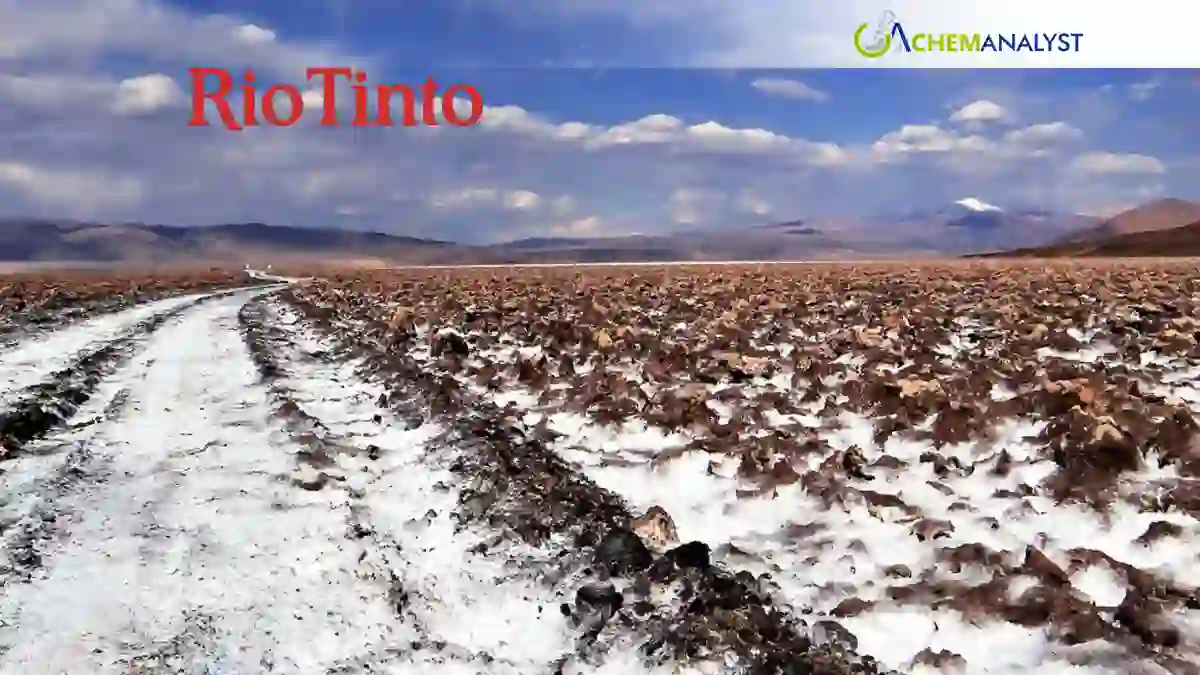
Rio Tinto is aggressively positioning its lithium business to become its fastest-growing division, aiming to triple production by 2028 to meet the surging global demand for electric vehicles and battery storage. This strategic shift underscores the company's commitment to energy transition materials and its ambition to establish a leading presence in the lithium market.
A pivotal move in this strategy was the acquisition of US-based Arcadium Lithium in 2025 for $6.7 billion. This acquisition significantly bolstered Rio Tinto's lithium portfolio, granting it access to mines, processing facilities, and deposits across four continents, along with a customer base that includes major players like Tesla. The company's goal is to achieve a lithium production capacity of 200,000 metric tons per year of lithium carbonate equivalent by 2028, up from a baseline of 75,000 mt/y post-acquisition, with an impressive 50% EBITDA margin target.
Key to this expansion are "in-flight projects" primarily located in Argentina. These include the 15,000 mt/y Sal de Vida lithium carbonate project and the expansion of the Rincon project. Rincon is a centerpiece of Rio Tinto's direct lithium extraction (DLE) efforts, a technology expected to revolutionize the industry by offering faster processing times and a smaller environmental footprint compared to traditional evaporation ponds. A starter plant at Rincon was completed in late 2024, and Rio Tinto plans a substantial $2.5 billion investment to expand its production capacity to 60,000 tonnes per year. The company is also exploring a joint venture for a 50,000-tonne lithium carbonate equivalent project in Chile.
Despite these advancements, Rio Tinto has faced significant challenges with its Jadar lithium-borate project in Serbia, one of the largest lithium deposits globally. The project, vital for Europe's critical raw materials supply, was suspended in November 2025 due to strong opposition from local communities and environmental activists, coupled with permitting issues. Although the Serbian Supreme Court ruled in July 2024 that the government's earlier revocation of licenses was unconstitutional, leading to renewed discussions with the EU, Rio Tinto has transitioned Jadar into a "care and maintenance" phase, prioritizing other near-term opportunities and maintaining capital discipline.
Economically, Rio Tinto aims to establish a low-cost lithium production platform, leveraging DLE technology to optimize operational costs and accelerate the conversion timeline, thereby freeing up substantial working capital. Geopolitically, the Jadar project highlights the complexities of resource development amidst local opposition and the European Union's strategic imperative to secure critical raw materials and reduce reliance on external suppliers like China. Industry-wide, the lithium market is experiencing a transformative growth phase, moving from a niche commodity to a crucial economic building block, although it remains susceptible to cyclical downturns and oversupply. Rio Tinto's strategic focus on low-cost, efficient production methods reflects its adaptation to these dynamic market conditions.
Market Impact: The announcement is expected to have a significant long-term impact on the lithium market and the broader battery materials value chain. By targeting lithium production of 200,000 metric tons per year by 2028, Rio Tinto is positioning itself as a major global supplier at a time when demand from electric vehicles, energy storage systems, and renewable energy infrastructure continues to expand rapidly. The company's investments in Argentina, Chile, and advanced Direct Lithium Extraction (DLE) technology are likely to improve supply availability, reduce production costs, and enhance operational efficiency. This could strengthen the competitiveness of battery manufacturers by ensuring a more reliable supply of lithium feedstock.
From a pricing perspective, ChemAnalyst-tracked lithium commodities, including lithium carbonate and lithium hydroxide, may face downward pressure in the medium to long term as additional production capacity enters the market. Increased supply from Rio Tinto and other mining companies could help alleviate concerns over raw material shortages and contribute to market balance. However, short-term price movements may remain volatile due to project execution risks, geopolitical uncertainties, and fluctuating EV demand.
Other battery-related commodities such as nickel, cobalt, graphite, and electrolyte materials could experience stable-to-firm demand trends as expanded lithium availability supports growth in battery production. Overall, the development is bearish for lithium prices over the long run but supportive of sustained growth across the broader battery chemicals sector.







Leave a Comment
Comments (0)