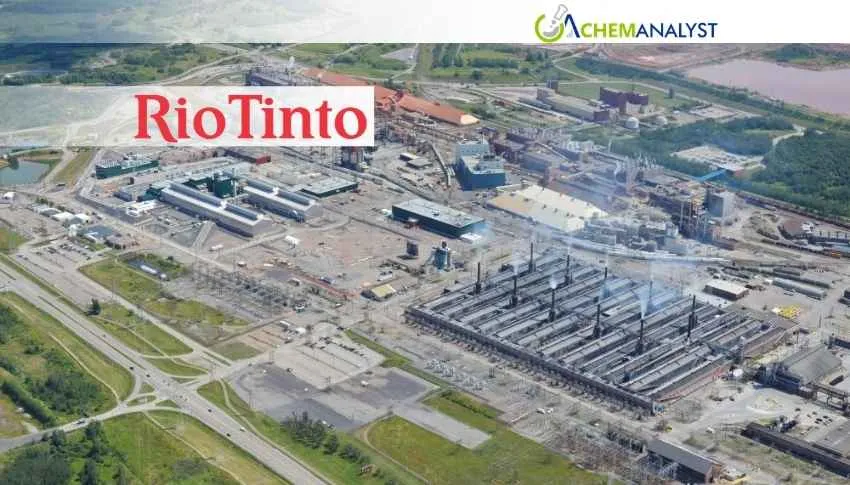
Rio Tinto has officially commenced a major $1.5 billion expansion project at its AP60 aluminum smelter in Quebec, reinforcing its commitment to increasing the supply of low-carbon aluminum for key industries such as automotive manufacturing, construction, and packaging. The investment represents a significant step in the company’s strategy to strengthen its position in the growing market for sustainable metals while enhancing production efficiency and reducing emissions.
The expansion of the AP60 facility, located within the Arvida industrial complex in Quebec’s Saguenay region, will involve the installation of 96 additional AP60 electrolytic pots. Once completed, the project will more than triple the smelter’s current production capacity. Rio Tinto expects the expanded operation to achieve annual primary aluminum output of approximately 220,000 tonnes by the end of the ramp-up period, scheduled for completion by December 31. This represents an increase of around 160,000 tonnes per year compared with current production levels.
According to Jérôme Pécresse, Chief Executive Officer of Rio Tinto Aluminium and Lithium, the expansion will deliver multiple benefits for both the company and its customers. He noted that the enhanced AP60 facility will improve Rio Tinto’s competitiveness in the North American aluminum market, increase operational efficiency across its Quebec assets, and significantly lower carbon emissions. Compared with the aging Arvida smelter infrastructure, the upgraded facility is expected to reduce greenhouse gas emissions by roughly 290,000 tonnes annually.
Rio Tinto highlighted that AP60 technology ranks among the world’s most environmentally efficient aluminum smelting processes currently operating at a commercial scale. Powered almost entirely by renewable hydroelectric energy, the technology generates approximately one-seventh of the greenhouse gas emissions associated with the global aluminum industry average. This low-carbon profile has become increasingly attractive to manufacturers seeking more sustainable supply chains and lower-emission raw materials.
The project received approval in 2023 and has benefited from strong provincial support. The Government of Quebec contributed up to $113 million in financial assistance to help advance the development. Beyond increasing production capacity, the investment has also generated substantial economic benefits. During the peak construction phase, the project supported more than 1,500 jobs, while the completed expansion is expected to create around 100 permanent positions at the facility.
The new AP60 capacity will gradually replace production from older potlines at the historic Arvida smelter, which is scheduled to complete its phased shutdown next month. This transition forms part of Rio Tinto’s broader modernization strategy aimed at improving productivity while reducing the environmental footprint of its aluminum operations. In addition, the company is developing a nearby recycling facility designed to incorporate post-consumer aluminum into its production stream, further supporting circular economy objectives.
Arvida has played a pivotal role in the development of Quebec’s aluminum sector for nearly a century. Originally established in the 1920s by Alcan, long before the company became part of Rio Tinto, the smelter helped transform the Saguenay region into one of the world’s leading aluminum-producing centers. The area’s abundant hydroelectric resources have long provided a competitive advantage for aluminum production.
The AP60 pilot plant, launched in 2013, served as a testing ground for Rio Tinto’s next-generation smelting technology and has since demonstrated the commercial viability of producing aluminum with significantly lower emissions.
Quebec remains one of the most important global sources of low-carbon aluminum due to its extensive use of renewable hydroelectric power. The province supplies aluminum to a wide range of industries, including automotive manufacturers, beverage can producers, and aerospace companies that are increasingly prioritizing sustainable materials.
Rio Tinto is also continuing to invest in future technologies through the development of Elysis, an innovative carbon-free aluminum smelting process that emits oxygen instead of greenhouse gases. Supported by both the federal and Quebec governments, the technology is currently advancing toward commercialization, with a demonstration facility under construction in the province.








 About ChemAnalyst
Leave a Comment
Comments (0)