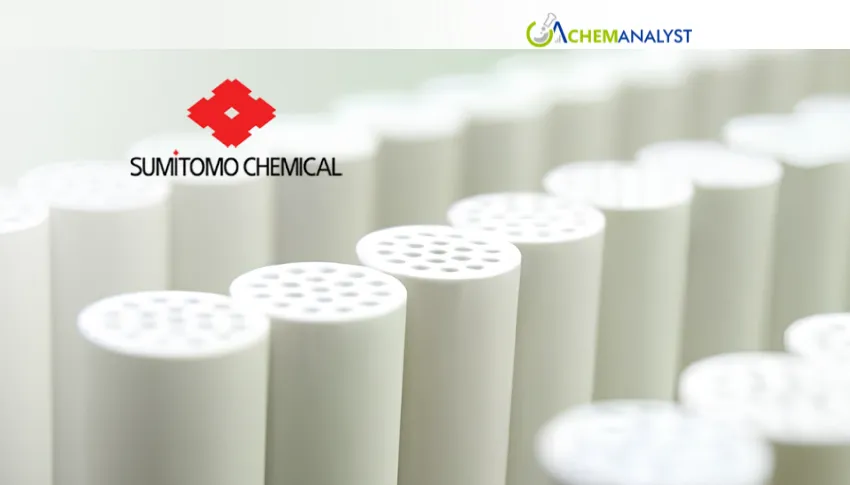
Sumitomo Chemical Co., Ltd. has developed a new high-permeance alumina technology designed to improve the performance of ceramic separation membranes without compromising their separation capabilities. The technology uses the company’s high-performance alumina to increase the density of through-pores within the membrane structure, addressing a key trade-off in membrane design where higher permeance can often reduce separation efficiency.
The technology was developed and validated through joint research with Kobe University in Japan. The research findings were published online in the Journal of Membrane Science Letters on August 12, 2026. The study provides new insights into how the internal structure of ceramic membranes influences filtration performance, particularly in applications where contaminants can accumulate and block membrane pores.
Ceramic separation membranes are widely used in food processing, fermentation, biotechnology, chemical processing, and wastewater treatment. Their strong mechanical properties, chemical resistance, and heat resistance make them suitable for demanding filtration environments. However, when treating suspensions, emulsions, and other fluids containing contaminants, substances can adhere to membrane pores, causing permeance to decline over time.
Traditionally, membrane performance has been assessed largely according to average pore size. Sumitomo Chemical’s research demonstrates that pore connectivity and the distribution of internal flow paths can also have a significant impact on filtration efficiency and contaminant accumulation.
In collaboration with Kobe University, the company compared the three-dimensional internal structures and filtration performance of multilayer α-alumina tubular membranes using yeast suspensions. Although the membranes had almost identical average pore sizes, those manufactured with the newly developed alumina featured a higher density of through-pores.
The greater number of flow paths enabled permeate to move through a wider portion of the membrane structure. This reduced contaminant intrusion into pores, lowered the risk of internal blockage, and decreased resistance caused by contaminant adhesion. Consequently, the high-through-pore-density membranes achieved more than three times the steady-state permeance while maintaining comparable separation performance.
The findings highlight that membrane performance depends not only on average pore size but also on how flow is distributed throughout the membrane. The technology therefore provides a new approach to designing differentiated, high-performance ceramic membranes.
Going forward, Sumitomo Chemical plans to advance alumina-based structural-control technologies and strengthen collaboration with membrane and filtration-system manufacturers. The company also aims to expand applications across food processing, biotechnology, fermentation, chemicals, and wastewater treatment, potentially enabling higher throughput, less frequent cleaning, and more stable filtration operations.
Impact on the Product and Chemical Commodity Prices
Sumitomo Chemical’s technology could increase the value proposition of high-performance alumina and ceramic membrane materials, particularly in filtration systems requiring high throughput and resistance to fouling. Improved permeance may support greater adoption of alumina-based membranes in wastewater treatment, biotechnology, food processing, and chemical processing. For Sumitomo Chemical, this could strengthen demand for specialty alumina grades and higher-value membrane solutions. For chemical commodities tracked by ChemAnalyst, the direct price impact is likely limited because the technology does not immediately alter large-scale commodity supply or demand. However, stronger demand for alumina and specialty ceramic materials could provide modest upward price support over the longer term, depending on commercialization and adoption rates.








 About ChemAnalyst
Leave a Comment
Comments (0)