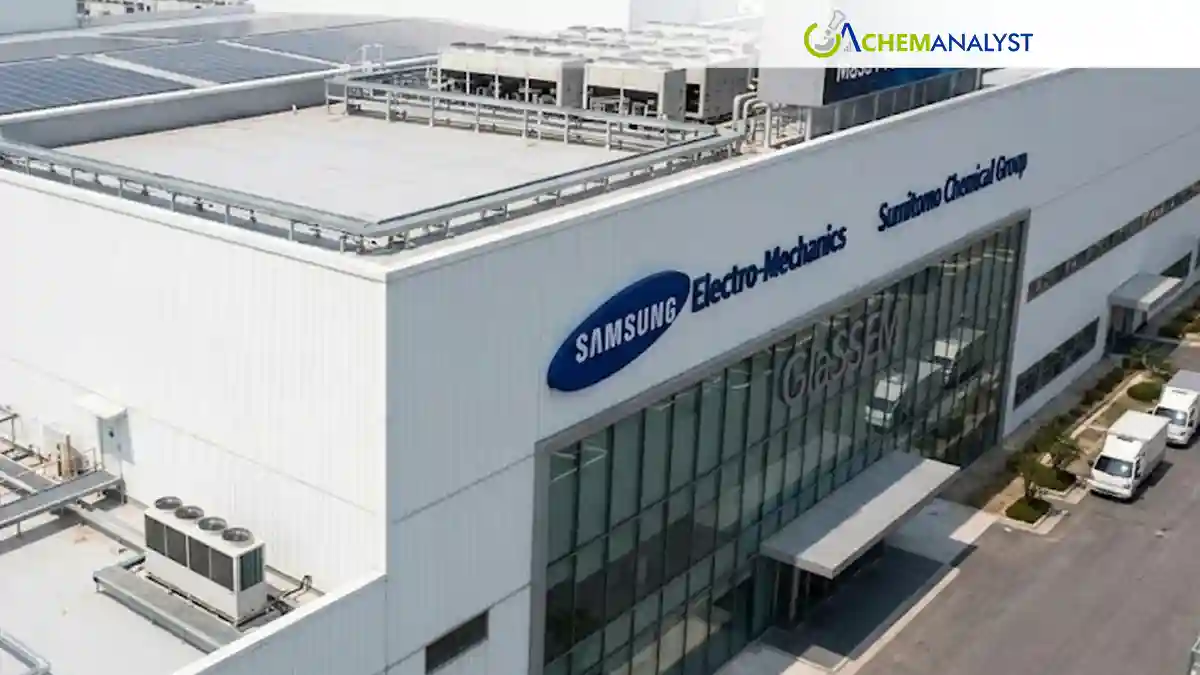
Sumitomo Chemical Co., Ltd., headquartered in Tokyo, has announced that its wholly owned South Korean subsidiary, Dongwoo Fine-Chem Co., Ltd., has entered into a joint venture agreement with Samsung Electro-Mechanics Co., Ltd. to establish a new company dedicated to the development and production of glass core substrates for advanced semiconductor packaging. The new joint venture is expected to be officially established in 2026, pending completion of the required regulatory approvals and other procedural formalities.
The collaboration comes at a time when the global semiconductor industry is undergoing rapid transformation, fueled by the increasing adoption of generative artificial intelligence (AI), expanding investments in hyperscale data centers, and the growing need for high-performance computing (HPC). These technological advancements are driving demand for semiconductor devices that deliver greater processing power while consuming less energy. Consequently, semiconductor packaging technologies are also evolving to accommodate larger chip sizes, increased circuit density, and enhanced thermal and mechanical performance.
Glass core substrates have emerged as one of the most promising next-generation packaging solutions capable of meeting these demanding requirements. Compared to conventional organic substrates, glass core substrates offer superior rigidity, exceptional dimensional stability, reduced warpage, and lower thermal expansion. These characteristics enable the production of larger semiconductor packages with finer wiring density and improved reliability, making them particularly suitable for AI processors and advanced computing applications. As AI chips continue to become more complex, industry demand for glass core substrate technology is expected to accelerate, paving the way for widespread commercial adoption.
Dongwoo Fine-Chem brings significant manufacturing expertise to the partnership. Over the years, the company has developed advanced capabilities in handling ultra-thin glass materials and has accumulated extensive experience in manufacturing products that require high precision and stringent quality standards. It also possesses automated production technologies designed for large-area glass substrates, alongside sophisticated cleanliness control systems and process management expertise. These strengths, combined with its comprehensive analytical and evaluation infrastructure, existing manufacturing facilities, and skilled workforce, position Dongwoo Fine-Chem to support every stage of glass core substrate development—from research and pilot production to full-scale commercial manufacturing.
Samsung Electro-Mechanics complements these capabilities with its long-standing expertise in advanced semiconductor package substrates and electronic component manufacturing. The company has established itself as a global leader in designing and producing high-density, multi-layer semiconductor substrates capable of supporting increasingly complex chip architectures. Its extensive experience serving leading semiconductor manufacturers has enabled it to build strong competencies in product reliability, quality assurance, customer support, and large-scale commercialization. Furthermore, Samsung Electro-Mechanics has been actively investing in the research and practical implementation of glass core substrate technology, recognizing its importance in the future of semiconductor packaging.
The newly formed joint venture will combine the technical expertise, manufacturing capabilities, and commercialization experience of both companies to accelerate the industrialization of glass core substrates. The partners aim to establish a stable supply system by the second half of fiscal year 2027, after which production capacity will be expanded gradually in line with market demand. The venture is expected to play an important role in supporting semiconductor manufacturers seeking next-generation packaging solutions for AI, high-performance computing, and data-intensive applications.
For Sumitomo Chemical, the investment aligns with its long-term strategy of strengthening its information and communications technology (ICT)-related businesses, which have been identified as one of the company's primary growth engines. The company has already expanded its portfolio of front-end semiconductor materials, including photoresists and specialty semiconductor chemicals, to address increasing demand for advanced chip manufacturing. Simultaneously, it has been investing in back-end semiconductor materials such as package materials, substrate technologies, and next-generation process materials. The establishment of this joint venture further reinforces Sumitomo Chemical's presence across the semiconductor value chain while enhancing its competitiveness in advanced packaging technologies.
By combining their complementary strengths, Sumitomo Chemical and Samsung Electro-Mechanics aim to accelerate innovation in semiconductor packaging, establish a reliable supply chain for glass core substrates, and contribute to the advancement of AI-driven computing technologies. The partnership is expected to support the broader semiconductor industry's transition toward higher-performance, more reliable, and energy-efficient electronic devices while contributing to the realization of a smarter, increasingly connected digital society.
Impact on Product and Chemical Commodity Prices
The joint venture between Sumitomo Chemical and Samsung Electro-Mechanics is expected to strengthen the supply chain for advanced glass core substrates, a key material for next-generation semiconductor packaging used in AI processors, high-performance computing, and data center applications. While the collaboration will accelerate commercialization and improve long-term availability of glass core substrates, its immediate impact on commodity markets is expected to be limited, as commercial production is targeted for the second half of 2027. Over the medium to long term, rising production of advanced semiconductor packages could increase demand for high-purity specialty chemicals, semiconductor process chemicals, photoresists, electronic-grade solvents, and ultra-high-purity glass materials tracked by ChemAnalyst. Prices of these specialty semiconductor chemicals may witness gradual upward pressure due to stronger consumption and expanding manufacturing capacity. However, bulk petrochemicals and conventional industrial chemicals are unlikely to experience significant price changes in the near term, as the project's scale and commercialization timeline will delay any substantial impact on overall chemical demand.







 About ChemAnalyst
Leave a Comment
Comments (0)