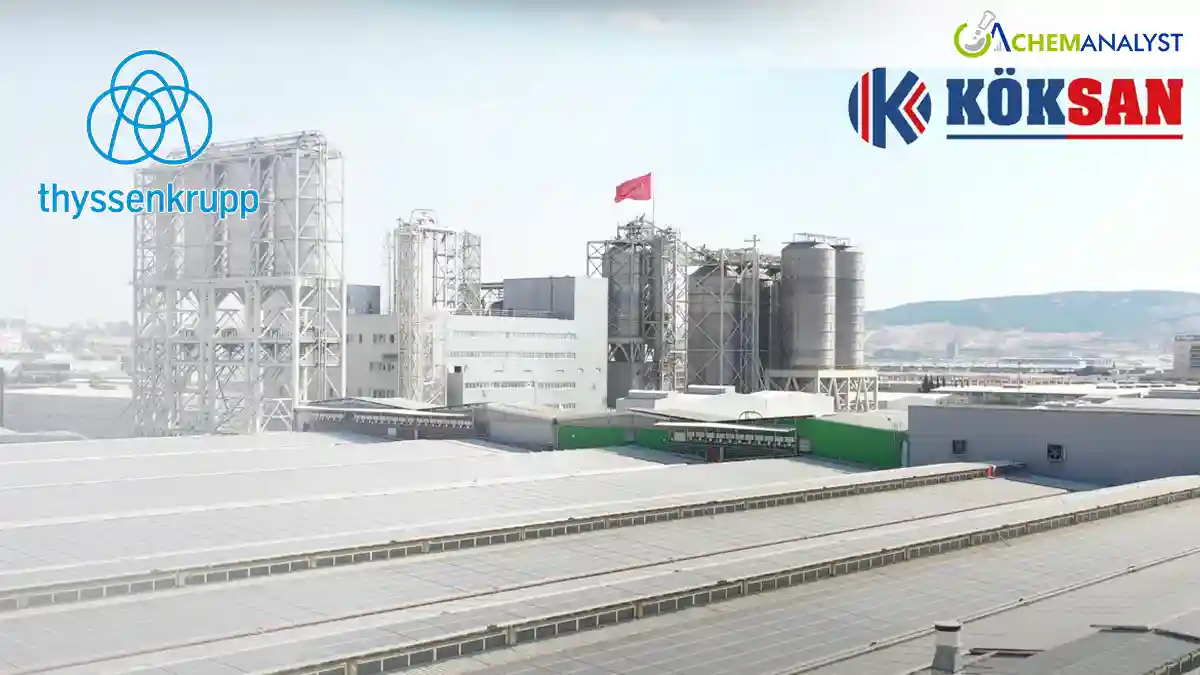
thyssenkrupp Uhde, through its subsidiary Uhde Inventa-Fischer, has entered into an agreement with Turkish packaging manufacturer KÖKSAN to design and construct a new polyethylene terephthalate (PET) production facility in Yumurtalik, Turkey. This upcoming plant represents a significant industrial investment and is expected to play a crucial role in enhancing KÖKSAN’s production capabilities and global competitiveness. Once completed, the facility will have an annual production capacity of 324,000 tons of PET resin, catering to a wide range of packaging applications as well as bulk continuous filament (BCF) production. The project is scheduled to be finalized and commissioned by the year 2028.
A key feature of this plant is the integration of the advanced Melt-To-Resin (MTR®) technology developed by thyssenkrupp Uhde. This proprietary process significantly reduces energy consumption compared to traditional PET manufacturing methods, making it both economically and environmentally advantageous. As part of the agreement, thyssenkrupp Uhde will be responsible for providing the process license, conducting both basic and detailed engineering, and supplying all critical equipment required for the plant’s operation. Additionally, the company will offer specialized training programs for KÖKSAN’s operational staff to ensure efficient and optimized use of the new technology.
This strategic investment aligns with KÖKSAN’s long-term vision of strengthening its market presence and expanding its global reach. The PET resin produced at the facility will not only serve domestic demand in Turkey but will also be exported to various international markets, including the Middle East, Europe, Africa, and the Americas. By increasing its production capacity and adopting advanced manufacturing technology, KÖKSAN aims to reinforce its position as a key player in the global packaging industry.
Leadership from both organizations has expressed strong confidence in the collaboration. Nadja Håkansson, COO of thyssenkrupp Decarbon Technologies and CEO of thyssenkrupp Uhde, emphasized that the MTR® process delivers both economic and environmental benefits. She highlighted that the technology reduces energy usage while simultaneously improving production yield and lowering both capital expenditure (CAPEX) and operational expenditure (OPEX). On the other hand, M. Murat Kökoglu, CEO of KÖKSAN, expressed satisfaction with continuing the partnership, noting that previous production lines implemented in Gaziantep have consistently demonstrated high performance and product quality.
From a technological standpoint, the MTR® process represents a major innovation in PET production. Unlike conventional methods, it eliminates the need for solid-state post-condensation steps, thereby streamlining the manufacturing process. This leads to considerable savings in energy, reduced investment costs, and lower maintenance requirements. Furthermore, the process enhances raw material efficiency, resulting in higher output yields.
Environmentally, the MTR® technology contributes to sustainability goals by reducing the plant’s carbon footprint. It achieves up to a 30 percent reduction in fuel and electricity consumption, addressing the growing global demand for greener industrial processes. The system operates using a two-reactor configuration that incorporates patented ESPREE and DISCAGE reactors, enabling the production of high-viscosity PET melt efficiently.
Overall, this project reflects a forward-looking approach by both companies, combining technological innovation with sustainability and economic efficiency to meet evolving industry demands.







 About ChemAnalyst
Leave a Comment
Comments (0)