Toray Industries, Inc. has recently introduced an advanced photo-definable polyimide sealing material specifically designed for use in micro-electromechanical systems (MEMS). These systems combine electronic circuitry with mechanical components through semiconductor microfabrication techniques, enabling the development of highly compact and precise devices. The newly developed material builds upon Toray’s established polyimide technologies, including its SEMICOFINE® non-photo-definable polyimide and PHOTONEECE® photo-definable polyimide, which are widely used for insulating semiconductors and display components.
This innovative sealing material allows for the simultaneous formation of fine patterns and bonding through photolithography, simplifying the manufacturing process. It is particularly useful for sealing hollow structures in MEMS devices. Such hollow structures are essential because they allow mechanical parts to move freely or act as cavities that shield sensitive components from external environmental interference.
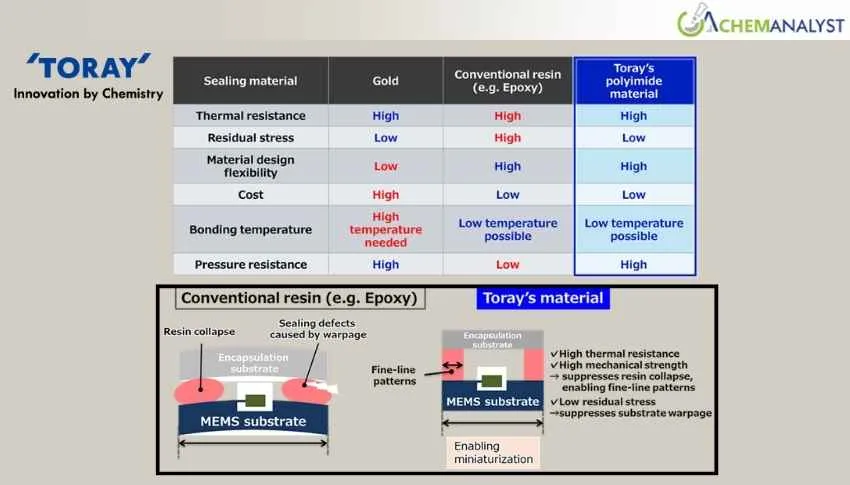
Traditionally, gold has been used as a sealing material for these hollow structures due to its superior sealing capabilities and excellent resistance to high temperatures. However, gold is expensive and limits flexibility in device design. As a result, there has been growing interest in developing alternative sealing solutions based on resin materials. Epoxy resin, a commonly used encapsulant, has been considered for this purpose. Despite its widespread use, epoxy lacks sufficient thermal resistance and mechanical strength. It is also susceptible to deformation and stress when exposed to temperature fluctuations, which can compromise the performance and reliability of MEMS devices.
To address these limitations, Toray engineered its new polyimide-based sealing material with enhanced properties. By carefully optimizing both the molecular structure and the photo-definable characteristics of polyimide, the company achieved a balance between high thermal resistance and low residual stress. The inherent properties of polyimide already include excellent heat resistance and electrical insulation. The newly designed low-stress structure further reduces the risk of warping caused by repeated thermal cycles, ensuring improved long-term reliability compared to conventional resin materials.
Another significant advantage of this material is its high mechanical strength. This feature enables the formation of narrower bonding lines at the interface, which in turn allows for greater device density and supports the ongoing trend toward miniaturization in MEMS technology. By enabling more compact designs without compromising structural integrity, the material contributes to the advancement of smaller, more efficient devices.
In addition to its technical benefits, the new sealing material also aligns with increasing environmental and safety standards. It does not contain polyfluoroalkyl substances (PFAS) or N-methyl-2-pyrrolidone (NMP), both of which are subject to growing regulatory scrutiny. This makes the material suitable for applications where environmentally responsible and safer chemical compositions are required.
Toray plans to showcase this development at the 2026 International Conference on Electronics Packaging and Hybrid Bonding Symposium (ICEP-HBS 2026), scheduled to take place from April 14 to April 18. The presentation is expected to highlight the material’s capabilities and its potential to enhance MEMS device reliability while supporting cost reduction and design flexibility.








 About ChemAnalyst
Leave a Comment
Comments (0)