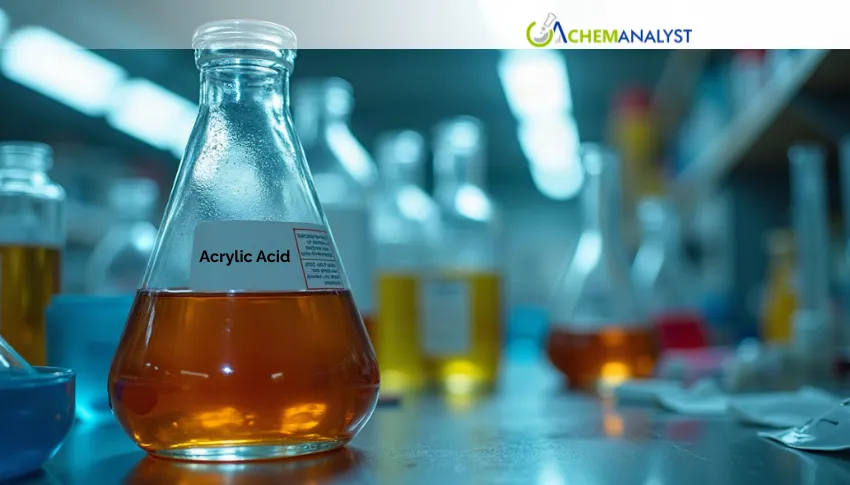
U.S. Acrylic Acid prices remained unchanged in late August 2026, as comfortable feedstock availability and stable operating conditions balanced against muted downstream purchasing. The flat movement reflected a market lacking a strong catalyst in either direction. Producers faced limited cost pressure, while buyers remained cautious amid weak construction activity and a seasonal summer slowdown. Consequently, the Acrylic Acid market ended August in a wait-and-see phase, with participants increasingly focused on whether post-summer procurement and Gulf Coast weather risks could alter the supply-demand balance.
On the supply side, Acrylic Acid availability remained comfortable across the U.S. Gulf Coast, with abundant C3 feedstock availability keeping production economics relatively favourable for producers. Combined U.S. propane and propylene inventories reached 107.013 million barrels by August 14, indicating sufficient upstream availability and limiting the urgency for producers to seek higher selling prices. Stable plant operations and the absence of major outages further supported regional availability, while steady logistics enabled distributors to maintain regular deliveries. As a result, Acrylic Acid sellers had limited scope to pass through higher prices, particularly while feedstock economics were not generating meaningful cost-push pressure.
Demand remained the main constraint on the Acrylic Acid market, although consumption was uneven across downstream sectors. Construction-linked applications, including architectural coatings, sealants, adhesives, and other acrylate derivatives, faced pressure as U.S. construction spending fell 0.5% in July to $2.158 trillion, its lowest level since October 2023. Residential construction spending declined 1.3%, while federal construction expenditure dropped 3.5%, limiting near-term demand visibility. August homebuilder sentiment improved modestly but remained below the threshold for a 16th consecutive month, indicating that high financing costs continued to restrain building activity. Conversely, stronger factory orders and continued data-centre investment offered some industrial support. This mixed demand environment kept Acrylic Acid purchasing largely requirement-based rather than inventory-driven.
Looking ahead, Acrylic Acid prices are expected to strengthen in September as downstream manufacturers emerge from the summer slowdown and begin rebuilding inventories for fourth-quarter production. The recovery could gain additional momentum from renewed coatings, adhesives, superabsorbent polymer, and acrylate-derivative procurement, while Acrylic Acid buyers may increase safety stocks ahead of potential Gulf Coast disruptions.
Hurricane risk will remain particularly important for Acrylic Acid market through September and October because storms can interrupt chemical production, power supply, port operations, and inland transportation even when direct plant damage is avoided. Tropical Storm Edouard’s September 1 landfall near the Texas-Louisiana border highlights the continuing operational sensitivity of the Gulf Coast, although initial reports indicated limited disruption to major energy operations. With September marking the climatological peak of Atlantic activity, precautionary buying could provide additional support. Acrylic Acid prices are therefore anticipated to rise through October and November as Q4 production schedules strengthen and inventories are rebuilt, before declining in December as year-end manufacturing slowdowns, destocking, and reduced procurement pressure the market.








 About ChemAnalyst
Leave a Comment
Comments (0)