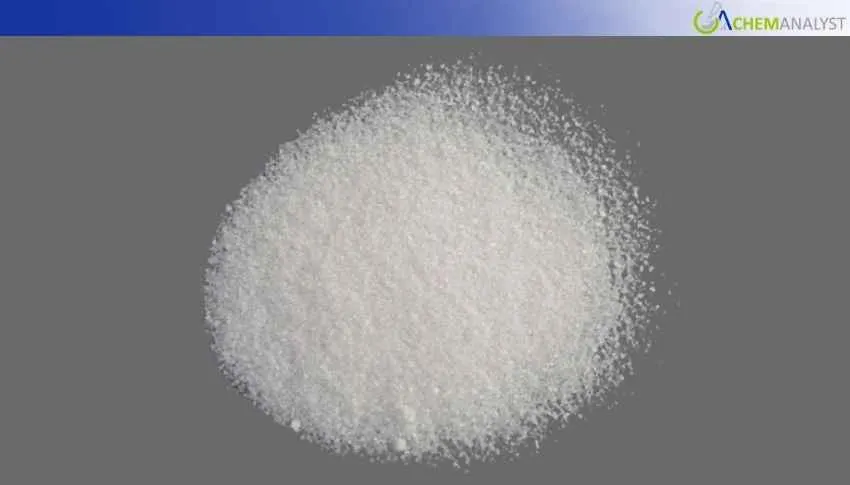
USA Tartaric Acid prices increased in late March 2026, with a modest weekly rise and a pronounced month-on-month gain, according to ChemAnalyst. Early March saw only tepid movement, but demand momentum built through mid-month and into late March as tightening import economics and elevated logistics costs supported firmer quotations. Rising bunker and freight pressures alongside higher processing costs from stronger energy benchmarks provided the backdrop for the month’s advance, tightening spot availability as distributors and processors competed for limited cargoes.
Tartaric acid demand in the United States remained stable across key end-use sectors through March, with food and beverage applications continuing to drive consistent offtake for Tartaric acid. Effervescent beverage formulations and baking powder production maintained steady consumption, while specialty grades of Tartaric acid such as clean-label, natural, organic, and non-GMO variants, recorded incremental growth aligned with evolving consumer preferences. The pharmaceutical sector also provided additional support, as continuous-processing drug manufacturers utilized L-(+)-tartaric acid as a chiral auxiliary, contributing to tighter spot availability. Construction-related applications, particularly cement retarders, and e-commerce packaging demand offered moderate but meaningful incremental support in Tartaric acid demand amid seasonal activity. Overall, US Tartaric acid demand is estimated to be tracking growth of approximately 2%–3%, with distributors reporting near-full allocation levels by mid-March 2026, indicating constrained availability of Tartaric acid in the spot market.
On the supply side, cost and logistics factors exerted additional upward pressure on Tartaric acid prices. Rising Maleic anhydride prices increased production costs in exporting regions, while higher crude oil benchmarks elevated bunker fuel and war-risk insurance charges. Strength in Natural gas further increased processing expenses, raising landed costs for Tartaric acid importers in the US market. Domestic production in the United States remained broadly stable through early to mid-March, with no significant plant outages reported. However, mid- to late-month logistics constraints, including higher freight rates and diversion of European cargoes to alternative destinations, reduced import inflows, and tightened the effective supply of Tartaric acid. Consequently, market firmness was driven primarily by import economics and transport bottlenecks rather than structural production shortfalls, reinforcing a tighter pricing environment.
Weekly patterns showed an accelerating tempo through March, according to weekly assessment data. After a small early-month dip, Tartaric acid prices gained momentum in mid-March with a notable uptick of roughly 4.5% in the week to mid-month and sharper gains near 7.6%–7.8% in the subsequent weeks as distributors tightened allocations. That rally moderated into late March, with the latest weekly movement registering a modest 0.23% increase in Tartaric acid prices as markets digested higher landed-cost inputs and aggressive offtake across key channels.
Looking ahead, the near-term outlook for Tartaric acid prices is biased upward due to current market trends, according to ChemAnalyst. Ongoing geopolitical tensions in the Middle East that threaten trade lanes, sustained elevation of crude and natural gas benchmarks raising bunker, freight, and processing costs, and persistent import uncertainty are likely to support further upside in Tartaric acid prices in the coming weeks. Seasonal spring construction activity and continued appetite for specialty food and pharmaceutical grades add to the supportive demand picture. However, substitution risk from lower-cost citric acid and potential logistical relief could temper gains, so Tartaric acid price projections remain subject to market conditions.







 About ChemAnalyst
Leave a Comment
Comments (0)