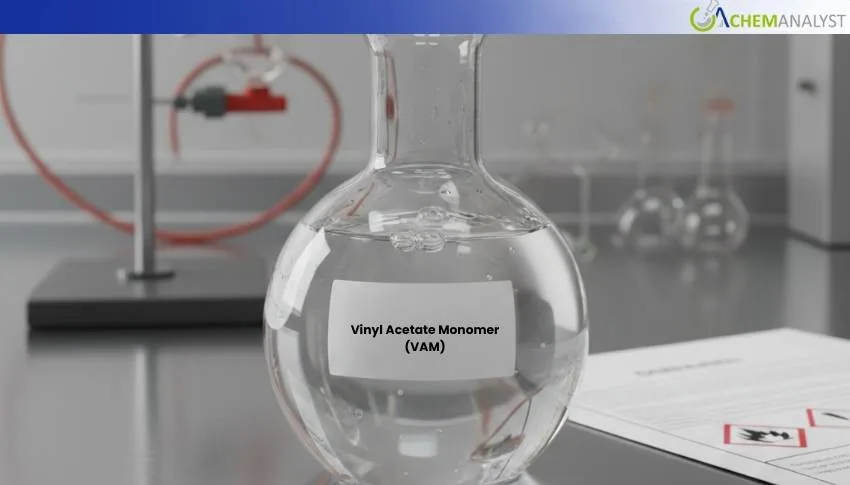
U.S. Vinyl Acetate Monomer (VAM) market prices saw a decline in November due to an oversupply of materials and stable production levels, although some downstream consumers/makers were still pushing for a higher price. With the high profit margins giving VAM producers a positive outlook for increasing production and, therefore, flexibility to offer lower prices, many consumers were remaining cautious about making large purchases.
The decline in VAM prices was happening at the same time as there was a lot of available supply. Most of the needs were satisfied by domestic suppliers. There were no disruptions in either the Gulf Coast ethylene supply or natural gas supply. The moderate prices of energy helped maintain healthy operating profit margins for VAM producers, who therefore continued to operate at high levels of production capacity.
The combination of changes in feedstock dynamics contributed to the softness within the industry. Acetic acid's price decrease was rather limited, while ethylene experienced significantly larger drops, translating into lower costs for production. As a result, with both items decreasing, there is now less cost support from Acetic Acid and Ethylene, plus VAM's only remaining support will be competitive pressure.
The VAM demand signals are mixed with steady consumption in PVA applications such as packages, construction, adhesives, and detergent pods, indicating a degree of resiliency. However, the overall market confidence is being brought down by weakness in the EVA segment, where, due to declining orders for photovoltaic and foam products, there has been a slowdown in the production and sales of these products. The competitive nature of the overseas offers further adds to this pressure and restricts the potential for any domestic pricing rebound.
In November, Celanese, an industry-leading producer of VAM, announced its 3rd quarter results for 2025. These results are indicative of the larger difficulties being faced by chemical markets. For the 3rd quarter, Celanese had net sales for the quarter of $2.4 billion, representing a 4% decrease from the previous quarter; both volumes and prices have declined. Celanese indicated that demand headwinds are impacting all its end-use sectors, and thus, has created a cautious purchasing environment, which has affected the way VAM is being traded in the month of November.
As we move forward, the recent bearish trend for VAM prices will likely continue short term because of the influx of bears and the reliability of plants. However, given that a significant portion (61%) of VAM production comes from the industrial-grade market, there is still strong demand within the coatings and adhesives markets to help offset pricing decreases.







Leave a Comment
Comments (0)