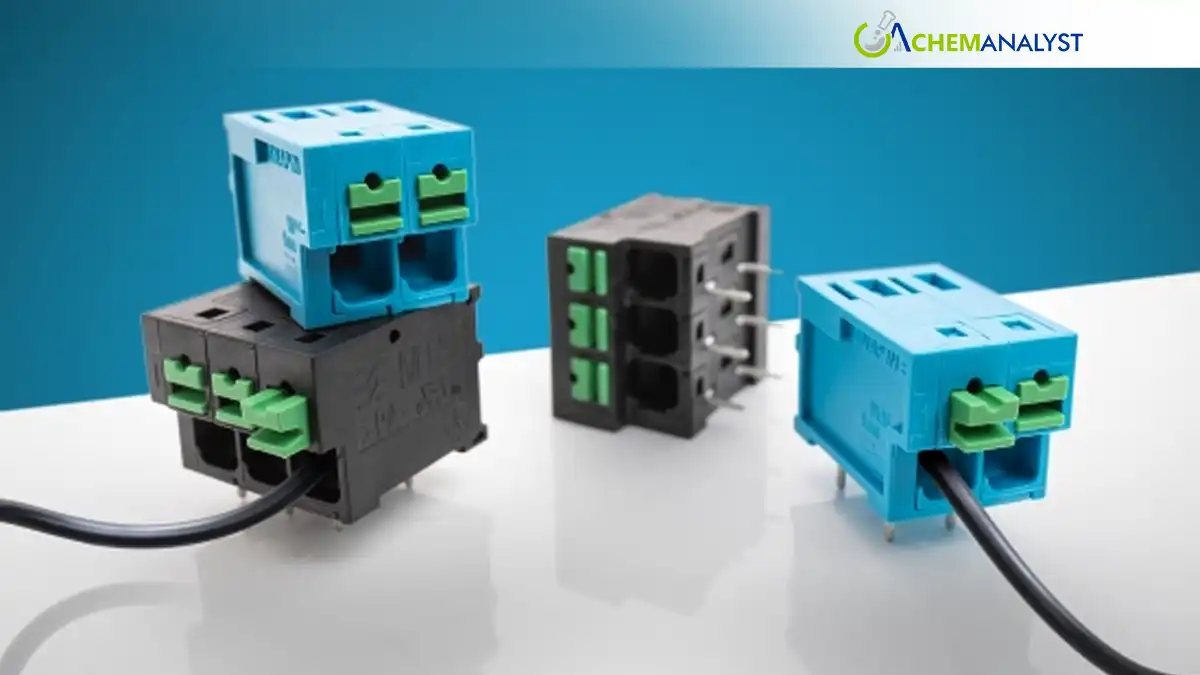
German electrical engineering leader Weidmüller is strengthening its next-generation electronics portfolio by adopting advanced engineering materials from BASF. The company has chosen BASF’s Ultramid Advanced N3U41 G6 for use in the PCB connectors and terminals of its newly launched OMNIMATE 4.0 product family, a move aimed at supporting faster, smarter, and more durable electronics manufacturing.
The partnership highlights the increasing demand for high-performance materials in industries such as drive technology, power supply systems, and energy distribution. As electronic devices become smaller and more powerful, manufacturers are under growing pressure to improve reliability, thermal resistance, and automation compatibility. BASF’s advanced polyphthalamide (PPA) material is designed specifically to meet these evolving industrial requirements.
At the core of the solution is Ultramid Advanced N3U41 G6, a high-performance PPA engineered to endure harsh thermal and environmental conditions while maintaining strong mechanical and electrical performance. One of its major advantages is its suitability for reflow soldering, an essential process used in modern printed circuit board assembly. The material also supports flexible color customization in standard industrial RAL shades, including orange, blue, and green, allowing manufacturers to implement precise color coding for safer assembly and easier maintenance.
A key benefit for electronics manufacturers is that the material maintains complete UL certification across all color variants. This enables companies to produce customized connectors and PCB terminals without sacrificing regulatory compliance or safety standards. BASF says its extensive portfolio of pre-colored granules gives customers greater design flexibility compared to competing materials on the market.
Andreas Stockheim, responsible for business management of PPAs at BASF, said the company was pleased to provide both high-performance material properties and a broad color selection for Weidmüller’s new product range. He noted that BASF is currently a leading supplier of pre-colored granules for PA9T and other PPA materials, while also offering UL-certified masterbatches for manufacturers that prefer self-coloring solutions.
Weidmüller explained that the material aligns closely with the automation-focused philosophy behind its OMNIMATE 4.0 platform. The company’s PCB components are designed for compact yet efficient power transmission while meeting strict high-voltage performance requirements. The inclusion of snap-in connection technology allows tool-free and rapid wiring, significantly reducing assembly time and improving production efficiency in automated manufacturing environments.
Johann Klippenstein, Head of Device Connectors at Weidmüller, stated that OMNIMATE 4.0 products are specifically developed for fully automated wiring processes. He added that BASF’s PPA material delivers excellent mechanical and electrical performance even in compact connector designs. Combined with the wide color palette, the solution offers customers flexibility while complying with DIN standard VDE 60335-1 for high-performance electronics applications.
The material also addresses growing industry demands for miniaturized components capable of operating reliably in harsh conditions. BASF’s laser-sensitive Ultramid Advanced N3U41 G6 LS combines non-halogenated flame retardancy with low moisture absorption, strong dimensional stability, and excellent electrical characteristics. It is engineered to perform consistently in environments exposed to dust, dirt, and humidity.
With a comparative tracking index (CTI) of 600 and a relative thermal index (RTI) of 150°C, the material supports the ongoing trend toward smaller and more heat-resistant electronic components while maintaining safety, durability, and long-term operational reliability.







 About ChemAnalyst
Leave a Comment
Comments (0)