Global Melatonin Market is projected to grow from USD 628 million in 2025 to USD 1342 million by 2036, registering a CAGR of 7.1% during the forecast period. Chemically known as N-acetyl-5-methoxytryptamine, melatonin is an indoleamine that is heavily commercialized as a dietary supplement and active pharmaceutical ingredient. Its industrial manufacturing process typically relies on multi-step chemical synthesis starting from raw materials such as 5-methoxyindole and oxalyl chloride, which undergo amidation, reduction, and subsequent acetylation using acetic anhydride, structurally mirroring the production of synthetic serotonin but replacing the 5-hydroxyl group with a methoxy group and introducing an N-acetyl chain. As an active pharmaceutical ingredient, crystalline melatonin exhibits notable processing benefits and exceptional thermal resistance, maintaining stability up to its melting point of approximately 117°C, which allows it to withstand the high-heat extrusion processes heavily utilized in the manufacturing of modern gummy formulations and controlled-release matrices. Furthermore, its distinct solid-state crystalline structure provides excellent barrier properties against oxidative degradation when compounded into dense solid dosage forms, offering superior shelf-life, mechanical handling advantages, and compounding uniformity over traditional botanical sleep aids or volatile herbal extracts. The surging demand for this compound is fundamentally driven by shifting global health paradigms and an increasing incidence of sleep disorders linked to modern, high-stress urban lifestyles, particularly across North America and Europe. Additionally, robust economic investments in the preventive nutraceutical sector, regulatory approvals expanding its application in over-the-counter care, and the rising consumer preference for non-habit-forming sleep therapies are establishing a favorable commercial landscape, while rapid urbanization, changing dietary habits, and expanding healthcare expenditures in the Asia-Pacific region further accelerate regional supply chain and manufacturing expansions.
Melatonin Applications in Packaging and Construction Industries
Melatonin is predominantly utilized within the nutraceutical and dietary supplement industries as a potent chronobiotic agent designed to synchronize circadian rhythms and alleviate sleep-onset insomnia. This compound is specifically selected for these applications due to its exceptional lipophilic nature and high bioavailability, which enable it to efficiently cross the blood-brain barrier and rapidly bind to specific neuronal receptors to induce physiological drowsiness. The market demand is heavily propelled by the rising global prevalence of sleep disturbances stemming from high-stress urbanized lifestyles and excessive artificial blue-light exposure in modern economies, shifting consumer focus toward holistic and preventive wellness solutions. From a technical perspective, the material's demand is further accelerated by innovations in advanced delivery systems, where the integration of liposomal encapsulation, controlled-release polymer matrices, and sublingual formulations has dramatically enhanced the chemical's stability and prolonged its physiological half-life, offering superior efficacy compared to conventional immediate-release formats. Additionally, the increasing consumer shift toward clean-label ingredients has catalyzed demand for phyto-melatonin and sustainably sourced biosynthetic variants, appealing to the broader eco-conscious demographic. Driven by these intersecting consumer and technical forces, the overall market trajectory is characterized by robust expansion and increasing market penetration as the compound is successfully integrated into multi-ingredient stress-management blends, functional beverages, and specialized wellness products across globally expanding consumer demographics.
Global Melatonin Market Segmentation by Resin Type and End-Use Application
The global melatonin market is primarily segmented by application into dietary supplements, pharmaceutical formulations, and functional food and beverages, as well as by dosage form encompassing tablets, capsules, gummies, liquid suspensions, and sublingual sprays. Within these structural classifications, the solid dosage forms—specifically tablets and capsules—currently hold the leading position in the market, a dominance fundamentally attributed to the chemical's high stability in a crystalline solid state, extended shelf-life, cost-effectiveness in large-scale manufacturing, and the technical feasibility of engineering biphasic or sustained-release polymer matrices that effectively mimic the body's endogenous nocturnal secretion patterns. Conversely, the gummies and liquid suspensions category has rapidly emerged as the fastest-growing segment with the highest economic growth potential, heavily propelled by surging global demand for pediatric sleep management solutions and dysphagia-friendly adult functional confections. The rapid expansion of this specific segment is technically driven by melatonin's distinct solubility parameters in specialized hydrocolloid matrices and recent advancements in lipid-based microencapsulation, which collectively mask the active compound's inherently bitter taste profile, preserve its structural integrity during thermal extrusion, and significantly enhance transmucosal bioavailability to ensure rapid onset of action.
North America's Dominant Role in the Global Melatonin Market
North America currently holds the undisputed leading position in the global melatonin market, commanding the geographic landscape through robust domestic consumption and widespread regional adoption. This dominant standing is primarily underpinned by a highly favorable regulatory environment, specifically the policy framework established by the Dietary Supplement Health and Education Act, which classifies the compound as a dietary supplement rather than a strictly regulated pharmaceutical, thereby facilitating frictionless over-the-counter commercialization and widespread retail accessibility. Amplifying this regulatory advantage is a strong prevailing consumer sentiment focused on holistic wellness and preventative health, where elevated disposable incomes and an increasing societal awareness of stress-induced sleep deficits continually stimulate regional demand. Furthermore, the region maintains an aggressive commitment to localized investment and research and development, channeling significant capital into advanced manufacturing efficiencies, precision synthesis, and the creation of highly bioavailable formulations. Driven by this localized culture of scientific innovation, North America is actively pioneering the versatility of the chemical, expanding its integration far beyond standard nocturnal sleep-aid applications into lucrative new sectors such as functional relaxation beverages, stress-relief fortified foods, and advanced neuro-cosmetics, thereby cementing the region's central role in the global evolution and diversification of the compound.
Recent Developments and Strategic Initiatives (2025)
The global melatonin market remains resilient, characterized by sustained capital expenditure (CapEx) and ongoing Brownfield Expansions. Key industry players are maintaining a confident outlook by directing investments toward increasing the capacity of existing portfolios to meet sustained demand across pharmaceutical, nutraceutical, and agricultural applications. Major manufacturers are concurrently prioritizing process innovation to optimize production efficiency and secure supply chain reliability without disrupting current operations. This strategic approach allows the industry to seamlessly scale output and adapt to evolving market needs while avoiding the risks of stagnation or oversupply, reflecting a robust commitment to long-term growth.
Key Players in the Global Melatonin Market
Major players in the Global Melatonin market are Natrol, Pfizer
Years considered for this report:
Historical Period: 2015-2024
Base Year: 2025
Estimated Year: 2026
Forecast Period: 2026-2036
This report will be delivered through an online digital platform with a one-year subscription, along with quarterly updates.
Objective of the Study:
• To assess the demand-supply scenario of the Melatonin, covering production, demand, and supply at the global level.
• To analyze and forecast the market size of Melatonin
• To classify and forecast the Global Melatonin market based on end-use industries and regional distribution.
• To examine competitive developments in the global Melatonin market, such as expansions, mergers & acquisitions, and other strategic initiatives.
Research Methodology: How Was the Melatonin Market Data Collected?
To extract data for the Global Melatonin market, primary research surveys were conducted with Melatonin manufacturers, suppliers, distributors, wholesalers, and traders. During the interviews, respondents were also asked about their competitors.Through this approach, ChemAnalyst was able to identify and include manufacturers that could not be captured through secondary research due to its limitations.Moreover, ChemAnalyst analyzed various market segments and projected a positive outlook for the Global Melatonin market over the coming years.
ChemAnalyst calculated the global demand for Melatonin by analyzing the volume consumed by end-user industries. The forecast was developed based on the growth rates of these end-use industries. These values were obtained from industry experts and company representatives and were externally validated by analyzing the historical sales data of respective manufacturers to determine the overall market size. Additionally, various secondary sources, such as company websites, association reports, and annual reports, were reviewed by ChemAnalyst.
Key Target Audience for This Report
• Melatonin manufacturers and other industry stakeholders
• Organizations, forums, and alliances related to Melatonin distribution
• Government bodies, including regulatory authorities and policymakers
• Market research organizations and consulting firms
The study provides insights into several critical ques tions relevant to industry stakeholders, including Melatonin manufacturers, customers, and policymakers. It also helps identify high-growth segments over the coming years, thereby supporting stakeholders in making informed investment decisions and facilitating strategic expansion.
Report Scope and Market Segmentation Framework
In this report, the Global Melatonin market has been segmented into the following categories. In addition, key industry trends have been detailed below:
Attribute
Details
Market size Value in 2025
USD 628 Million
Market size Value in 2036
USD 1342 Million
Growth Rate
CAGR of 7.1% from 2026 to 2036
Base year
2025
Estimated year
2026
Historical Data
2015 - 2024
Forecast period
2027 - 2036
Quantitative units
Demand in thousand tonnes and CAGR from 2026 to 2036
Report coverage
Demand by End- Use, Demand by Region, Demand by Sales Channel, Demand-Supply Gap.
Segments covered
By End-Use Application: (Dietary Supplements, Pharmaceutical Industry, and Others) By Sales Channel: (Direct Sale and Indirect Sale)
Regional scope
North America, Europe, Asia Pacific, Middle East and Africa, and South America.
Market Data & Insights
Table of Content
1. Demand by End- Use Application
Discover which end-user application (Dietary Supplements, Pharmaceutical Industry, and Others) are creating a market and the forecast for the growth of the Melatonin market.
2. Demand by Region
Analysing the change in demand of Melatonin in different regions, i.e., North America, Europe, Asia Pacific, Middle East and Africa, and South America, that can direct you in mapping the regional demand.
3. Demand by Sales Channel (Direct and Indirect)
Multiple channels are used to sell Melatonin. Our sales channel will help in analysing whether distributors and dealers or direct sales make up most of the industry's sales.
4. Demand-Supply Gap
Determine the supply-demand gap to gain information about the trade surplus or deficiency of Melatonin.
I am satisfied with overall performance of ChemAnalyst. Weekly updates before the final report were especially helpful and reassuring. Additional requests on the interim and/or final reports were handled in a swift and professional manner
Mr.Shin Dosho
Member - Board of Directors
Osaka Gas Co. Ltd
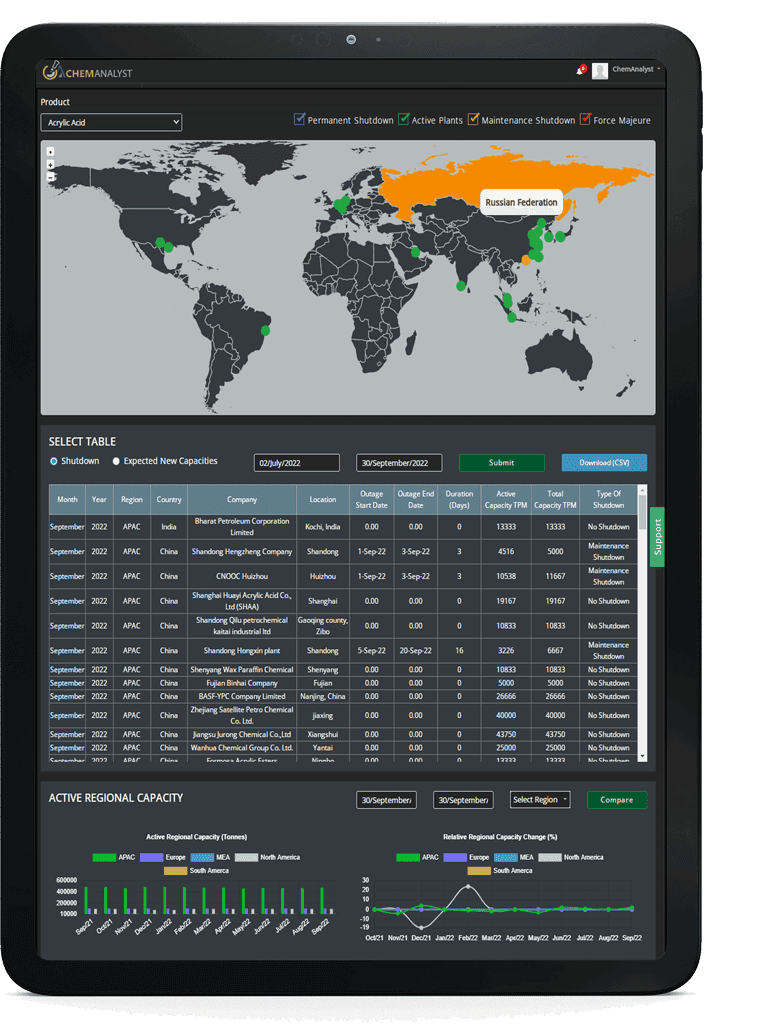
Disruption Tracker
Disruption Tracker reflect the major shutdown on monthly basis which will help you in
tracking the inventory management and smooth functioning of business. Unforeseen shutdowns and disruptions
resulting in a loss of production capacity to impact the bottom line. The capacity tracker provides industries
with a global view of production and consumption capacity loss that reflects the corresponding conversion factors.
It also highlights the immediate impact on supply due to planned and unplanned outages as well as upcoming start-up
of new capacities. Additionally, it emphasizes how each shutdown—whether due to a maintenance turnaround or a case
of force majeure, affects the plant's operating rate for the given duration. Disruption tracker gives a clear insight
into the worldwide outages affecting the commodity of interest. With every shutdown, it also reflects the impact on
supply of the product in the market at a Global level.
The Global Melatonin Market was valued at USD 628 million in 2025 and is projected to reach USD 1342 million by 2036, growing at a CAGR of 7.1% during the forecast period.
The report covers market sizing and forecasting (2015–2036), segmentation, regional analysis, competitive landscape, and recent strategic developments. It also offers solutions including Custom Research for tailored business strategies.
Our Solutions
Custom Research
We at ChemAnalyst provide tailor-made solutions to our clients based on their requirements which help them in building and expanding their business by developing customized strategy such as sales strategy, GTM Strategy, product portfolio and new product development. Our dedicated team helps clients in getting the best solution for their requirements. We at ChemAnalyst look forward to serving our clients for long term association.
Techno Economic Feasibility Report (TEFR)
ChemAnalyst provide TEFR reports which include market sizing, plant cost (ISBL and OSBL units), financial modelling, covering all the major financial calculations and ratios including production cost, IRR, major technology, licensing fee (if required), and others fixed and variable costs. TEFR reports will help the client to build greenfield project as well as brownfield expansion for a specific geography. Our Team of experts have delivered multiple TEFR reports which help clients in moving ahead of their business competition by grabbing the opportunity and expanding their business portfolio.
Price Benchmarking
Pricing benchmark report provides real-time data perpetuating current market scenarios, in a world that is changing at a rapid pace, having real-time prices is an imperative to make impactful insights and thereby informed decisions. The Price Benchmarking report provides pricing data for an individual market, or group of markets, which can be converted into localized insights and comparable listings. Benchmarking Reports help clients to make informed decisions by construing the data on several filters: region, country, category, grade and subsequently increasing their brand presence. Clients majorly require pricing benchmarks when they opt for a competitive pricing strategy.
We use cookies to deliver the best possible experience on our website. To learn more, visit our
Privacy Policy.
By continuing to use this site or by closing this box, you consent to our use of cookies.
More info.


 About ChemAnalyst