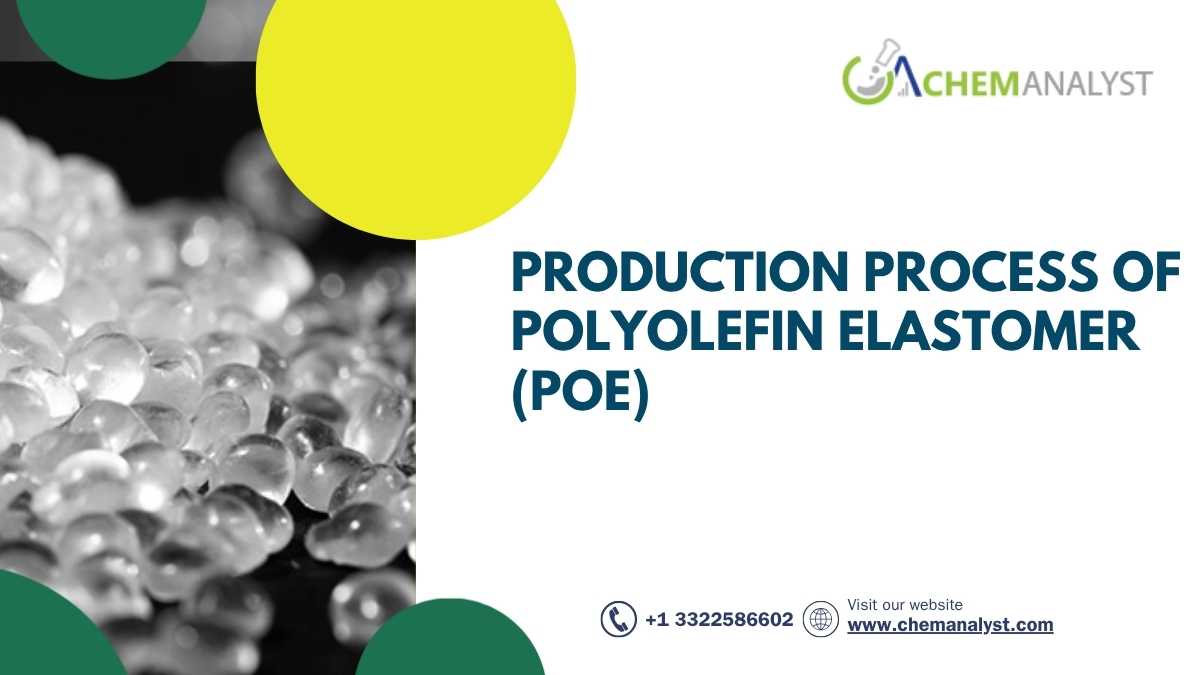
Polyolefin Elastomer (POE) combines plastic processability with rubber-like flexibility, making it essential in automotive, packaging, and electronics. Understanding its production supports performance, sustainability, and cost decisions critical as industries shift toward efficient, scalable, and environmentally friendly material solutions.
Introduction
Polyolefin Elastomer (POE) is a high-performance thermoplastic elastomer known for its flexibility, impact resistance, and ease of processing. It is widely used across industries such as automotive, photovoltaic, footwear, wire and cable insulation, and flexible packaging. Its ability to combine the processability of plastics with the elasticity of rubber makes POE an indispensable material in modern manufacturing.
Understanding the production process of POE is essential for stakeholders involved in material selection, production planning, and sustainability compliance. The manufacturing method affects not only product performance but also operational efficiency, emissions profile, and supply chain resilience. As global industries pursue greener technologies and performance-oriented materials, knowing how POE is produced enables better decision-making around cost, scalability, and innovation.
Overview of the Production Process
POE is produced via a catalytic copolymerization process where ethylene is polymerized with alpha-olefins such as 1-butene, 1-hexene, or 1-octene. The process is carried out under controlled low-pressure conditions using single-site catalysts. The goal is to create polymer chains with short-chain branching, yielding a material that combines elasticity with thermoplastic characteristics.
The production process typically includes the following stages: feedstock purification, catalyst preparation and injection, polymerization in a continuous reactor system (either gas-phase or solution-phase), separation of unreacted monomers, additive incorporation, and pelletization. These steps are optimized for product uniformity, efficiency, and minimal waste.
Yield efficiency can reach up to 95% depending on process type and catalyst system. By-products are minimal and mainly include unreacted monomers and inert gases, which are often recycled internally to reduce waste and improve raw material utilization.

Raw Materials and Input Requirements
The key raw materials used in POE production are:
• Ethylene: The primary monomer, usually derived from steam cracking of hydrocarbons.
• Alpha-Olefins (1-butene, 1-hexene, or 1-octene): Co-monomers that control branching and elasticity.
• Catalysts: Advanced metallocene or Ziegler-type single-site catalysts.
• Co-Catalysts: Compounds such as methylaluminoxane (MAO) that activate the catalyst system.
High purity of ethylene and alpha-olefins is critical—typically above 99.9%—to ensure stable catalyst performance and product consistency. The catalysts used are sensitive to moisture and oxygen, requiring strict handling protocols. Solvents may be used in solution-phase processes, while gas-phase systems rely on inert gas circulation and fluidized beds.
Additives such as antioxidants or processing stabilizers may be introduced during or after polymerization to enhance thermal and oxidative stability during storage and downstream processing.
Major Production Routes
The production of POE takes place through low-pressure catalytic polymerization using one of the following two methods:
1. Solution Polymerization:
o Utilizes hydrocarbon solvents like hexane.
o Polymerization occurs in a loop reactor under moderate pressure and temperature.
o Offers excellent control over polymer microstructure and comonomer distribution.
o Requires additional solvent recovery and recycling systems.
2. Gas-Phase Polymerization:
o Carried out in fluidized bed reactors without solvents.
o More energy-efficient and environmentally friendly.
o Lower CAPEX and simpler operation, making it popular in large-scale installations.
Regional Preferences:
• South Korea and Japan typically use metallocene-based solution processes for high-end grades.
• Middle East and China often adopt gas-phase technology, particularly in integrated petrochemical complexes.
• Europe and the U.S. implement both, depending on grade requirements and plant infrastructure.
Green Alternatives:
Bio-based POE production is under development using bio-ethylene and renewable alpha-olefins. These emerging methods aim to align with circular economy objectives and reduce reliance on fossil fuels.
Equipment and Technology Used
POE production involves specialized equipment to manage pressure, purity, and catalyst sensitivity while maintaining operational efficiency.
Key Equipment Includes:
• Monomer Purification Units: Remove moisture, oxygen, and other impurities.
• Polymerization Reactors:
o Loop Reactors for solution processes.
o Fluidized Bed Reactors for gas-phase processes.
• Catalyst Feed and Injection Systems: Enable precise catalyst delivery and activation.
• Solvent or Gas Recycle Systems: Improve raw material efficiency and reduce emissions.
• Pelletizing Systems: Convert polymer melt into uniform granules for downstream use.
• Process Control Systems: Distributed Control Systems (DCS) ensure consistent operation and rapid response to deviations.
Technological Innovations:
• Real-time monitoring using digital twin technology.
• AI-driven analytics for yield optimization.
• Energy recovery systems to repurpose exothermic heat for process needs.
• Advanced safety interlocks for high-reliability operations.
Environmental and Safety Considerations
Though POE production is generally cleaner than traditional rubber processing, environmental and safety considerations remain vital due to catalyst handling, flammable monomers, and energy consumption.
Emission Profile:
• GHG emissions from ethylene production and compressor energy.
• VOC emissions in solvent-based (solution-phase) processes.
• Catalyst waste containing trace heavy metals.
Control and Mitigation Measures:
• Closed-loop monomer and solvent recovery systems to reduce emissions and losses.
• Effluent treatment plants (ETPs) for aqueous discharge.
• Advanced flare systems for safe handling of unreacted gases.
• Catalyst residue neutralization and safe disposal.
Regulatory Compliance:
• USA: EPA regulations for emissions and OSHA for plant safety.
• EU: REACH compliance, Emissions Trading System (ETS), and IED.
• Asia-Pacific: Increasing adherence to global ESG frameworks.
Plants are expected to conduct regular safety drills, environmental impact assessments, and risk evaluations to meet regional and global sustainability mandates.
Conclusion and Future Innovations
POE production is a technologically sophisticated process defined by precise catalytic control, feedstock purity, and evolving environmental standards. As industries push toward lightweight and high-performance materials with a lower carbon footprint, POE's role in modern manufacturing continues to grow.
Innovation Pathways:
• Bio-POE: Leveraging renewable feedstocks for reduced GHG emissions.
• Next-generation catalysts: Offering higher activity and reduced toxicity.
• Modular production units: Supporting regional supply resilience and lower transportation emissions.
• Carbon capture integration: Applied to upstream ethylene cracking units for greener input streams.
As the polymer sector evolves, POE will be at the forefront of combining functional performance with sustainability, offering manufacturers a strategic material for the future.
FAQs
Q1. What is the main method used to produce POE?
POE is primarily produced via low-pressure catalytic copolymerization of ethylene and alpha olefins, using metallocene catalysts. The process is carried out in either solution-phase or gas-phase reactors.
Q2. What are the environmental concerns in POE production?
Key concerns include VOC emissions (in solvent-based systems), energy consumption, and catalyst disposal. Most modern plants use closed-loop systems and advanced effluent treatment technologies to minimize impact.
Q3. Is there a sustainable version of POE available?
Yes. Research and pilot-scale production of bio-based POE using renewable ethylene and alpha-olefins are ongoing. These alternatives support circular economy goals and help reduce reliance on fossil-derived feedstocks.