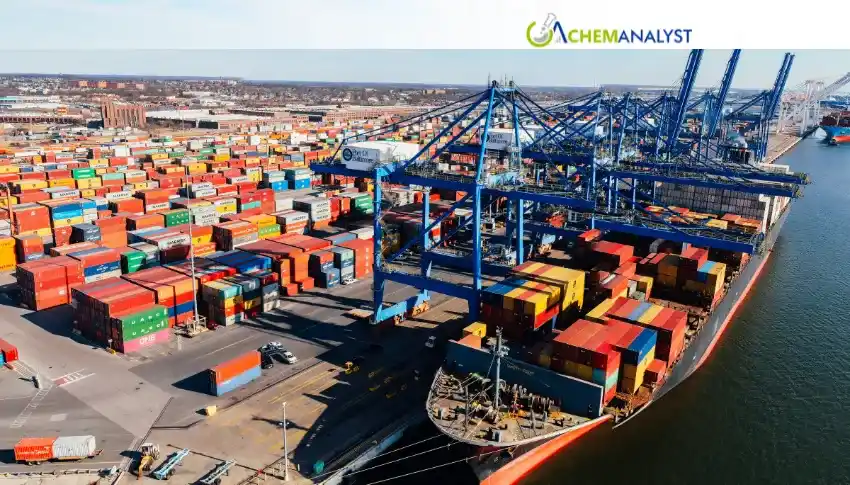
What Happened
Container freight rates from Asia to the US continued climbing this week, with the Panama Canal Authority confirmed it will cap daily transits starting in September. Rates are running between $6000-$7,400/FEU, and the East Coast rates between $8000-$10,500/FEU, the West Coast rates have risen more than four folds and the East Coast roughly threefold since the US-Iran war began. A 9% week-on-week rise on both Shanghai-Los Angeles and Shanghai-New York lanes was recorded, while a 9% rise to the West Coast and 3% to the East Coast was logged. The Shanghai Containerized Freight Index (SCFI) rose 1.6% for a fourth straight weekly gain. On the tanker side, US chemical tanker rates were largely flat to softer, with the transatlantic route edging down and Rhine River disruptions continuing to pressure several European-linked lanes.
Why it happened
Persistent peak-season demand, tightened vessel capacity, and rising costs are driving these container rate gains. As the carriers cut August capacity by 9% month-on-month on Asia-USEC and 0.4% on Asia-USWC through blank sailings, tightening available space. Several carriers have also announced Panama Canal surcharges on Asia-USEC and Asia-Gulf Coast routes effective September, adding further cost pressure compounding the effect of the Canal Authority's newly announced transit limits. On tankers, thin prompt space is keeping some lanes firm (USG-Asia), while others (USG-India) remain soft on weak enquiry, and Rhine River constraints continue to weigh on European-linked trade.
What it means
The widening East-West Coast rate spread is becoming a real routing decision for shippers. Xeneta's Peter Sand noted that importing into the East Coast is now $3,334/FEU more expensive than the West Coast, this gap is larger than the entire pre-crisis cost of shipping a container into either coast as the shippers with flexibility have strong incentive to shift East Coast-bound cargo to the West Coast despite added inland trucking/rail costs. The upcoming Panama Canal transit cap adds a further structural constraint on USEC and Gulf Coast routings just as carriers layer on canal surcharges, reinforcing the cost gap rather than narrowing it.
Short-term outlook
Rates on the transpacific are likely to stay firm through the coming week, expecting stability as capacity remains tight and peak-season demand holds. Into September, the newly confirmed Panama Canal transit cap is the key variable to watch it lands alongside the carrier surcharges already announced for Asia-USEC and Asia-Gulf Coast routes, so the two pressures are likely to compound rather than offset each other, keeping East Coast and Gulf-bound rates elevated and potentially widening the coast-to-coast spread further. On the tanker side, rates should stay broadly range-bound, with Rhine River conditions remaining the main swing factor for European-linked chemical tanker lanes; a prolonged low-water situation could tip more lanes toward softness, while any resolution would likely stabilize rates on the affected routes.








 About ChemAnalyst
Leave a Comment
Comments (0)