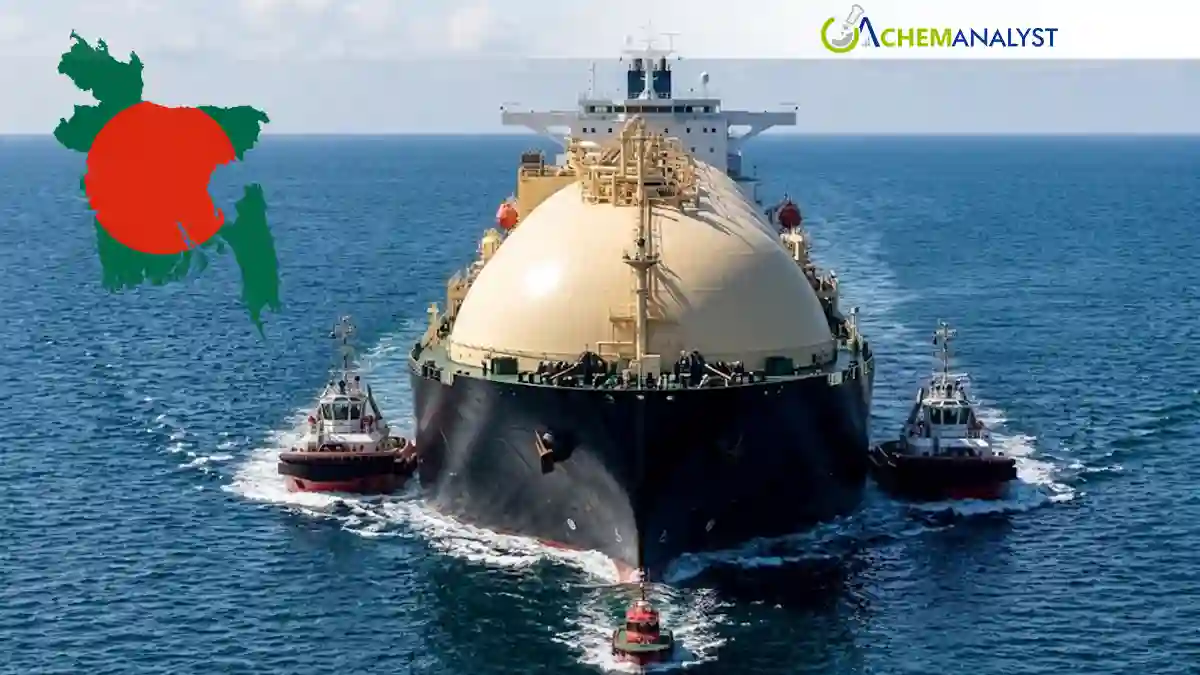
Bangladesh's gas market is absorbing a compound supply shock rather than a single disruption. A war-driven collapse in contracted LNG deliveries from Qatar has coincided with a fire that removed roughly half the country's regasification capacity, leaving the national grid short at a moment when it has almost no buffer.
Regasification capacity still impaired three weeks on
Gas supply from the two Moheshkhali LNG terminals fell to around 410 million cubic feet per day (mmcfd) as of the morning of 12 August, according to Petrobangla's production and marketing division. The terminals have a combined regasification capacity of 1,100 mmcfd — 600 mmcfd at the Excelerate Energy-operated facility and 500 mmcfd at Summit LNG's — putting current throughput at roughly 37% of nameplate, a shortfall of about 63%.
Two separate constraints are responsible. One of Excelerate's two boilers is functional while the second remains under maintenance, and adverse weather has prevented an LNG carrier from berthing at Summit's terminal.
The Excelerate unit has been operating below capacity since a fire broke out at the floating storage and regasification unit (FSRU) on 21 July. The blaze burned for more than 15 minutes and caused extensive damage to power, control and instrumentation cabling serving both boilers. Officials from the Energy and Mineral Resources Division and Petrobangla indicated the boilers themselves were not directly damaged, but replacement cables were unavailable locally and had to be imported, extending the outage. Technical teams from the United Kingdom, the United Arab Emirates and Singapore were brought in to complete repairs.
The terminal resumed partial operations on 6 August after a two-week shutdown, initially restoring the grid to around 800 mmcfd of regasified LNG. Full capacity has not yet returned.
At the peak of the outage in late July, total national gas supply dropped to approximately 2,150 mmcfd against official demand of around 3,854 mmcfd — well below the roughly 2,700 mmcfd average maintained over the preceding year.
Chattogram bearing the heaviest load
The industrial hub of Chattogram, which depends almost entirely on the two Moheshkhali terminals, has been hit hardest. Karnaphuli Gas Distribution Company Ltd reported city demand of around 350 mmcfd against supply of just 210 mmcfd — a gap of roughly 140 mmcfd, or 40%. Supply had stood at 230–234 mmcfd the previous morning before declining again after noon.
KGDCL has prioritised residential consumers and CNG stations to avoid complete disruption, but the strain is visible across the industrial base. On 5 August, garment exporter Pacific Jeans Group shut nine factories in the Chattogram Export Processing Zone because of inadequate gas supply. CNG stations across Dhaka and Chattogram have reported multi-hour queues and low line pressure.
In response to the outage, the government approved a fast-track third FSRU at Moheshkhali in late July, to be supplied by China National Energy Engineering & Construction Company.
Qatari force majeure remains the structural problem
The terminal outage is the acute shock; the loss of Qatari volumes is the structural one.
Qatar is Bangladesh's largest LNG supplier, accounting for roughly 60% of the country's LNG import requirement in 2025 according to industry estimates — equivalent to something in the region of 4 million tonnes against total imports of close to 7 million tonnes. Petrobangla holds two long-term sales and purchase agreements with QatarEnergy, one for 2.5 million tonnes per annum and a second for 1.8 mtpa, together totalling around 4.3 mtpa.
Following the outbreak of the US–Israeli war on Iran on 28 February and the subsequent closure of the Strait of Hormuz, QatarEnergy halted production and declared force majeure in early March — the first of Bangladesh's long-term suppliers to do so. Oman's OQ Trading and US-based Excelerate Energy followed within days, and QatarEnergy has rolled its force majeure forward on a monthly basis since.
The damage subsequently became physical as well as logistical. Iranian missile strikes on Ras Laffan Industrial City on 18 and 19 March damaged two LNG production trains and a gas-to-liquids facility, removing an estimated 17% of Qatar's export capacity — roughly 12.8 million tonnes per year. QatarEnergy officials have indicated repairs could take between three and five years.
The consequence for Bangladesh is a halving of contracted volumes. QatarEnergy notified Rupantarita Prakritik Gas Company Limited (RPGCL) that it may deliver only 50% of scheduled 2026 cargoes, cutting deliveries from 40 to around 20 — volumes that were expected to cover close to 35% of Bangladesh's planned 115-cargo import programme for the year. QatarEnergy has also signalled that reduced deliveries could persist for three to five years. The Energy Division has formed a committee to assess the fallout and says it will negotiate for at least 80% of committed volumes.
Estimates of pre-war deliveries vary by source. Kpler data cited by Reuters put Bangladesh's Qatari intake at 19 cargoes before the war, while Petrobangla data reported by The Business Standard indicate eight cargoes between January and the first week of March. Following the outbreak, no cargoes loaded at Ras Laffan reached Bangladesh for several months, though at least one vessel was reported to have secured safe passage through the Strait in the interim.
The spot pivot and its cost
Bangladesh has covered the gap almost entirely through the spot market. Kpler data show 35 spot cargoes imported since March. RPGCL had issued tenders for 38 spot cargoes by early July, against an original 2026 plan that envisaged far heavier reliance on term supply.
The financial consequence has been severe. Petrobangla's LNG subsidy requirement for fiscal year 2025–26 rose to around Tk 16,600 crore against an original allocation of Tk 6,000 crore, with officials attributing roughly Tk 10,600 crore of the overshoot directly to war-driven spot purchasing. Pricing has moved against buyers as well: Platts assessed the JKM benchmark for August delivery into Northeast Asia at $19.436/MMBtu on 14 July, up from $15.167/MMBtu on 26 June.
Petrobangla is also exploring government-to-government arrangements with alternative suppliers, with the stated intention of pursuing whichever option offers the best commercial terms, and has widened its search well beyond the Middle East.
External financial support has partially cushioned the blow. On 15 May, the World Bank approved $350 million in additional financing under Bangladesh's Energy Sector Security Enhancement Project, doubling the facility to $700 million. The IDA payment guarantee-backed instrument supports LNG import payments through standby letters of credit and short-term credit lines, and is intended to help Petrobangla shift toward longer-term procurement and away from expensive spot buying.
Implications for the hydrogen peroxide market
The chemical sector's exposure to this disruption runs through feedstock and utility gas rather than through demand. Hydrogen peroxide production depends on hydrogen typically sourced from natural gas reforming, alongside steam and power — all of which are directly affected when grid pressure falls.
Through the first half of 2026, subdued hydrogen peroxide demand from both domestic and export channels meant that gas constraints translated into limited visible impact on operating plants; producers were not running at rates that made feedstock availability binding.
That calculus is now shifting. With the combined Moheshkhali outflow at roughly 37% of capacity, the shortfall is deep enough that it cannot be absorbed through grid load management alone, as evidenced by outright industrial shutdowns in the Chattogram belt. ChemAnalyst assesses that a sustained supply gap at these levels will begin to constrain Bangladeshi hydrogen peroxide output if the weather-related berthing delays at the Summit terminal are not resolved promptly and Excelerate's second boiler does not return to service.
The near-term direction depends on two resolvable operational issues. Beyond that, the more durable risk is the Qatari one: with contracted volumes halved and Ras Laffan repairs measured in years rather than months, Bangladesh's chemical producers face a structurally tighter and more price-volatile gas position through 2026 and likely beyond.







Leave a Comment
Comments (0)